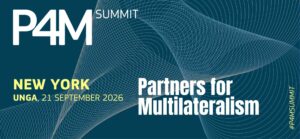
Launched at the United Nations in New York, a new international initiative seeks to strengthen cooperation between Western countries and the Global South through multilateralism, international law, and reform of global institutions.
On September 21, 2026, an important diplomatic initiative took shape in New York, receiving relatively little international attention amid the many crises dominating the 81st session of the United Nations General Assembly.
Representatives from Australia, Barbados, Brazil, Canada, India, Kenya, and the European Union launched the Partners for Multilateralism, International Law, Peace and Prosperity (P4M), a new international platform aimed at strengthening cooperation among countries committed to the principles of the United Nations Charter.
The initiative comes at a time of increasing geopolitical tensions, armed conflicts, economic fragmentation, and growing concerns about the effectiveness of international institutions.
Unlike traditional alliances organized around military or economic blocs, P4M presents itself as an open and flexible platform for dialogue, coordination, and practical cooperation among countries from different regions and political traditions.
Building Bridges Between the West and the Global South
The initiative was launched by European Council President António Costa alongside representatives of six countries from different continents.
Its geographical diversity is particularly significant. Brazil and Barbados bring Latin American and Caribbean perspectives, Kenya represents an important African voice, India brings the perspective of a major Asian power, while Australia, Canada, and the European Union contribute their own international relationships and institutional experience.
Perhaps one of the most significant aspects of this initiative is its potential to build bridges between Western countries and the Global South.
At a time when international relations are increasingly framed through competing geopolitical blocs, P4M brings together governments with different histories, economic realities, and political perspectives. The participation of countries such as India, Brazil, Kenya, and Barbados alongside the European Union, Canada, and Australia suggests a willingness to explore common ground beyond traditional divisions.
Whether this cooperation can contribute to a more balanced and inclusive international order will depend on the ability of its participants to address not only shared challenges but also the inequalities that have historically shaped relations between the West and the Global South.
The summit’s joint declaration was also signed by additional countries, including Türkiye, Norway, Spain, Ireland, Uruguay, Guatemala, and several other European nations.
The participating governments expressed concern about growing international polarization, violations of international law, protectionism, economic coercion, and the increasing use or threat of military force.
They reaffirmed their commitment to sovereign equality, territorial integrity, the peaceful settlement of disputes, international humanitarian law, and the protection of human rights.
Reforming the United Nations
A central objective of the initiative is to strengthen and reform the multilateral system, particularly the United Nations, making international institutions more representative, inclusive, and effective.
The declaration recognizes that the international system established after the Second World War must respond to a world that has become increasingly interconnected, complex, and multipolar.
Beyond questions of international security, the participating countries identified several areas requiring stronger global cooperation: climate change, biodiversity loss, artificial intelligence, global health, international finance, and the resilience of global supply chains.
The declaration also recognizes growing inequalities within and between countries as challenges to social cohesion, stability, and sustainable development.
These commitments connect international peace and security with economic development and the conditions of everyday life, recognizing that cooperation cannot be limited to diplomatic negotiations alone.
From Declarations to Cooperation
Speaking at the summit, European Council President António Costa emphasized that countries across continents and political traditions continue to share a commitment to international cooperation despite growing global divisions.
The participating governments agreed to maintain regular exchanges and develop practical forms of coordination, with the United Nations remaining at the center of the initiative.
Following the summit, Costa announced that senior officials had been tasked with establishing a coordination channel and identifying priority areas for cooperation. EU High Representative Kaja Kallas would coordinate these efforts on behalf of the European Union.
However, P4M is still at an early stage. Its significance will depend on whether participating governments can translate their common declaration into concrete initiatives, institutional reforms, and coordinated responses to international crises.
The diversity of its participants is both an opportunity and a challenge. Countries with different strategic interests and political traditions will need to demonstrate that cooperation can extend beyond statements of shared principles.
A Possible New Direction for International Relations
The emergence of P4M raises a broader question about the future of international relations.
At a time when global affairs are frequently presented through competition between major powers, the initiative introduces another possibility: countries from different regions working together without necessarily organizing themselves around a single geopolitical center.
Its importance may ultimately lie less in the creation of a new diplomatic grouping than in the recognition that the challenges confronting humanity cannot be resolved by any country acting alone.
Whether P4M becomes an effective instrument of international cooperation remains to be seen.
But its launch in New York deserves international attention. In a world increasingly shaped by confrontation, the willingness of governments from different continents to reaffirm international law, strengthen the United Nations, and pursue shared solutions represents a development worth following.
The central question is now whether this commitment to multilateralism can move beyond diplomatic declarations and become a practical force for peace, cooperation, and human development.