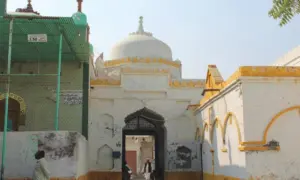
In the historic publication of Sindhi folklore entitled “Folk Tales of Sind and Guzarat”, written by Charles August Kincaid and published in Karachi in 1925, there is the tale of Udero Lal which can spread a message of peace and mutual understanding between Hindus and Muslims. The legend of Udero Lal contains an effective message of religious freedom and opposition to forced conversions according to the Quranic principle of verse 2:256 stating “la ikrah fiddin” (There is no compulsion in religion).
By Milena Rampoldi, ProMosaik.
For the Hindu believers, Udero Lal, also known as Jhulela, Zinda Pir or Sheikh Tahir, is the central water deity and folk saint of Sindh, revered as an incarnation of the Hindu river god Varuna. For the Muslims of the region, Udero Lal is a Sufi-style saint. So Udero Lal is an important example of Hindu-Muslim syncretism and can promote peaceful coexistence.
His legend talks about how forced conversions were stopped in Sindh history more than a millennium ago. In the 10th century, Sindh was ruled by a harsh king named Mirkhshah who demanded that local Hindus either convert to Islam or face death. On that occasion of danger, the local Hindu community gathered on the banks of the Indus River. There they prayed, chanted and fasted for 40 days. A booming voice from the river promised that a divine child would be born in Nasarpur to save them. And this boy was Udero Lal.
When Mirkhshah sent soldiers to capture the divine boy, his kingdom was suddenly struck by massive floods and the palace towers caught fire. Udero Lal appeared and delivered a message of interfaith unity, stating:
“He whom you call Allah, and my people call Krishna, are but one and the same.”
Terrified and humbled, Mirkhshah surrendered and abandoned his plan of forced conversions of Hindus to Islam.
Up to our epoch, Udero Lal has been an important spiritual figure in the region of Sindh being part of the folklore as a strong message against forced religious conversions.
Celebrated during festivals like Cheti Chand, Udero Lal remains an enduring cultural symbol against religious coercion and a patron saint of peace across communities in the Indus Valley, as point out by Dr. Muhbat Ali Shah and Dr. Muhammad Shahban Sahito in their article Promoting Tolerance and Harmony: Lessons from the Shared Sacred Space of Jhule Lal/Udero Lala in Sindh, Pakistan.
The story is not just a literary expression of a historical event but relates to a shrine which becomes a space which can serve as model for conflict resolution and peace building. History survives in a shrine-focused symbol of social and religious coexistence of two religious communities cultivating the ideal of peace and religious freedom. Shrines are important places to promote harmony and peace linked to a certain geographic location becoming a positive symbol. The shrine of Udo Lal was built by the Mughal emperor Shah Jahan and completed in 1666.
This white shrine, featuring both a mosque and a Hindu temple, is an architectural marvel that symbolizes the coexistence of different faiths in the Sindh region.
In my opinion, what counts here is the maintenance of the differences, of the dual identity of Udero Lal who means something different in the two communities. In contemporary Sindh, Udero Lal’s shrine continues to be a symbol of tolerance and unity without forcing one of the communities to change its own view. What counts is not to be identical but united in the shared belief in the oneness of God.
Udero Lal based his philosophy and teachings on principles of coexistence, peace, harmony, love, tolerance, and brotherhood which respect differences and religious differentiation. The story and the symbol connected with it show the importance of the promotion of interfaith dialogue resulting in peaceful coexistence between two religious communities which are very different.