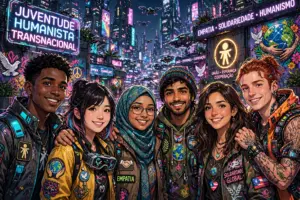
The Transnational Awakening of Youth
São Paulo, September 2026.
Editorial Line: Universalist Humanism, Social Analysis, Human Rights and Nonviolence
Youth mobilizations in Europe and Brazil reveal a transformative scenario in which new generations are taking the front line in the resistance against socioeconomic austerity, the rising cost of living, and the advance of the far right. In Western Europe, as seen in Germany (GenZ regelt!), France, and Italy, students have brought together denunciations of the increasingly precarious conditions of housing, employment, and education with direct protests against the proliferation of hate speech and extremist platforms.
In Brazil, university students and young people from the outskirts and marginalized communities have demonstrated their role as a democratic antibody and political mediator. The “domino effect” of mobilizations that spread across dozens of educational institutions in all regions brought together grassroots brigades and digital ecosystems in active campaigns of direct dialogue. Far from being isolated movements, these actions are part of a transnational wave characterized by decentralization and a refusal to accept the systematic loss of rights and future prospects.
Although economic suffocation and the deterioration of living conditions serve as immediate triggers, a deeper analysis allows us to identify a much broader phenomenon: the collapse of traditional institutional models. New generations have grown up without the ideological, religious, or political reference points that shaped the twentieth century. There is a widespread perception that politicians’ formal democracy, mass media, and faith in the “god of money” have proven empty and incapable of containing environmental collapse, wealth concentration, and systemic violence. Narratives of progress and meritocracy have crumbled, exposing the absurdity of a system that sacrifices human life and the planet in favor of financial accumulation.
Within this dynamic, contemporary psychological suffering, expressed in alarming rates of anxiety, panic, depression, and hopelessness, is no longer interpreted as an individual biological failure. Young people have realized that this pain was not an isolated mental illness, but rather an inevitable human response to the suffocation caused by individualistic, hypercompetitive, and discriminatory values. The cry heard in the streets — “It wasn’t depression, it was capitalism” — makes this existential shift explicit: by demedicalizing their distress, critical generations transform anguish into transformative indignation and individual loneliness into a communal experience of liberation.
For humanist thought, the way these mobilizations are organized is revealing. This is a movement that does without strongmen, pyramidal party structures, or closed dogmas. Its coordination takes place horizontally, distributed across digital and face-to-face networks, where instant communication and authentic aesthetic expression (such as handmade protest signs and symbolic interventions) reflect a profound search for dignity. Young people are not asking permission from the frameworks of modernity or postmodernity; they are inaugurating a method of direct, decentralized action grounded in the legitimacy of coexistence and mutual recognition.
These revolts reveal that human beings are not merely economic agents driven solely by material consumption needs. What is emerging on the horizon is a new planetary sensitivity, in which the meaning of life reemerges through affection, solidarity, and respect for diversity. This is the blossoming of a profound spiritual need that connects with the essential motivation of consciousness: the desire to overcome pain and violence, to embrace differences, and to build a common human project without walls or moral and physical borders.
We are witnessing the end of an era and the painful yet hopeful birth of the human being of the future. If the old system of anti-values is collapsing and losing its ability to discipline consciousness, it is up to us, individuals and communities with a humanist sensibility, to decide how we will contribute to building the planetary civilization that is taking shape.
The critical generation, standing at the turning point between a dying world and another being born, has already awakened and is on the move. The imperative of our time is not to fit this force into the old molds of the past, but to accompany, inspire, and protect the youthful flame that has rekindled dignity.
It is time to act, starting from our personal and community circumstances, so that this vital force may continue to grow and inspire society with the principles of active nonviolence, personal liberation, solidarity, and the common good. History has opened the way for the intentional creation of the humanity of the future.
Marco Suárez is a Digital Transformation specialist; holds a Master’s degree in Education; and specializes in Digital Products and Artificial Intelligence. He is a postgraduate student in Neuroscience and Behavior, researching “Cognitive Decline Caused by the Passive and Unconscious Use of Digital Technologies.”
Digital Technologies teacher at Escola Senac São Paulo and Escola Conquer.
He leads the “Decolar Digital” Program, which provides digital literacy to young people in situations of social vulnerability, focusing on the critical and proactive use of digital technologies.
Humanist researcher and educator, member of the Pindorama Center for Humanist Studies (CEH Pindorama).