It’s three in the morning. Yesterday—or today, depending on how you count the hours—I spent far too much time scrolling through clip after clip on my phone: the elections, the war, corruption, sexy guys, a recipe. One after another, they seemed to create something in me while simultaneously triggering something from my past, the person I wanted to be, or the things I still want to do. Anger, sadness, desire, curiosity, all passing through me in a matter of seconds.
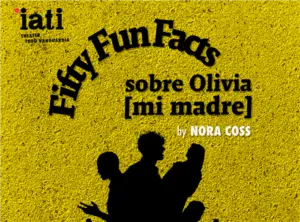
Then I realized I hadn’t written anything about Fifty Fun Facts sobre Olivia [mi madre], a play by Mexican playwright Nora Coss, directed by Manuel Ortiz Ossandon, which will be presented at IATI
Theater in New York City from November 6 to 22.
I needed to hurry up.
So I sat down to read the fifty-something pages of the script.
The play opens with Emilio, a fourteen-year-old boy, struggling to find the words to speak about his mother, Olivia. An older Emilio, now twenty-five, is also present, as if the younger boy needs the assistance of his future self to tell the story. But before he can begin, three other voices intervene: Hombre, Mujer, and Mujer Mayor. They take over the narrative, offering anecdotes, observations, judgments, and sometimes contradictory interpretations of Olivia’s life.
And here is where, from the point of view of form, the play becomes particularly beautiful. Coss constructs two pieces of the same puzzle—an unsolved puzzle that somehow fits together. On one side is Emilio, searching for a way to tell his own story. On the other is Olivia, whose life is reconstructed through the voices of others. The two narratives move alongside each other, sometimes intersecting, sometimes contradicting each other, until we begin to understand that Emilio’s search for his own voice cannot be separated from the story of his mother.
Of course, we laugh. Well, I did while reading.
And, of course, we encounter pain. Sometimes I stopped reading just to consider the deeper significance of a few lines of dialogue, or what was being said between them.
For example, when the voices introduce Emilio, one says:
“De padres mexicanos, pero nacido en los Estados Unidos.”
Another proudly announces:
“American-american.”
To which a third responds:
“Quién sabe qué quiera decir eso, pero okey.”
Whatever that means.
And isn’t that precisely the question we keep asking ourselves? What does it mean to be American-American? Or Mexican-American? Or to belong to a country whose language you speak but whose culture does not entirely embrace you? Or to belong to another country whose culture you inherited but whose language you can barely speak?
The story goes beyond language. In fact, it challenges language itself.
Emilio, who barely speaks Spanish, must suddenly confront his mother’s serious illness in Mexico. He has to navigate hospitals, doctors, medical procedures, paperwork, and the terrifying possibility of losing her. And he must do it all in a language he does not fully command.
As I write this, I realize that even at fifty-seven, I have not yet had to deal with something quite like that—not for a parent, a husband or wife, a child, or a dear friend.
Not yet.
What happens when pain and desperation reach a place where language cannot follow? When necessity forces us to communicate in words we barely understand? In Emilio’s case, learning Spanish is no longer a question of preserving his cultural roots. It becomes a matter of caring for his mother.
Coss also reverses an experience familiar to many immigrants in the United States: being forced to navigate an unfamiliar system in a language that is not their own. Emilio, born in the United States, must confront that experience in Mexico, the country his mother calls home.
The play is told predominantly in Spanish, although bilingualism remains essential to its structure. A Spanish-speaking audience can follow the voices reconstructing Olivia’s life with relative ease. But I wondered whether an English-speaking spectator with little or no knowledge of Spanish might experience some of the same disorientation and desperation that Emilio experiences.
Perhaps that is part of the theatrical challenge. The production will use bilingual supertitles, but I wonder whether understanding the words necessarily means understanding the experience.
And from detail to detail, from anecdote to anecdote, from one contradictory recollection of Olivia to another, the play begins to acquire a rhythm that made me wonder how the director would approach its staging.
As I continued reading, Bernadette Mayer’s Midwinter Day came to mind. In that poem, the ordinary events of a day become a rapid succession of perceptions, memories, images, and associations. I have always been fascinated by that almost meditative state in which the mind moves from one moment to another, sometimes with astonishing speed, sometimes with the strange clarity of a dream.
To my surprise, toward the end, Coss’s play seemed to arrive at precisely that place.
The narrative became, in my reading, a collage of images and fleeting moments, like short clips passing through the mind. Years of experience seemed to coexist in a single minute. Memories no longer needed to follow a chronological order. They appeared, disappeared, and returned, as they often do when we are alone with our thoughts.
Perhaps that is why the play reminded me of my own evening of scrolling through my phone. One image provokes anger, another desire, another sadness. Some awaken memories we thought we had forgotten. Others remind us of the person we once wanted to become. Yet there is a difference: the clips on my phone are selected by an algorithm, while the fragments of our memories seem to follow a mysterious logic of their own.
Or do they?
Fifty Fun Facts sobre Olivia [mi madre] is a story about identity and language, but it is also a story about silence, about that space that language cannot fill.
The three voices can tell us almost everything about Olivia. They can describe her habits, her marriage, her mistakes, her illness, and her love for her son. Emilio, meanwhile, can describe the hospital, remember conversations, and recite seemingly useless facts. But expressing what he feels is another matter.
There is something heartbreaking about the possibility that we may know so many facts about someone we love and still be unable to say what that person means to us.
I am looking forward to seeing what artistic choices Manuel Ortiz Ossandon makes in bringing these fragments to the stage. Will the memories unfold as Emilio’s deliberate reconstruction of the past? Or will they arrive unexpectedly, like involuntary visitors who interrupt the present?
Perhaps the director will find a way to make both possibilities coexist.
Don’t miss it.
Well, it’s five in the morning. Too late for me. Time to sleep.
And, as usual, I’m going to bed with a question that perhaps the director is also considering: Do we summon our memories to reconstruct a story, or do they come to us uninvited, visitors from a past that refuses to stay in the past?
Perhaps that is the beauty of memory.
And its horror, too.
Performance information:
Fifty Fun Facts sobre Olivia [mi madre], written by Nora Coss and directed by Manuel Ortiz Ossandon, runs November 6–22, 2026, at IATI Theater, 64 East 4th Street, New York City.
Performances are Thursdays and Fridays at 7 p.m., Saturdays and Sundays at 3 p.m. The approximately 75-minute production is performed in Spanish and English with bilingual supertitles.
Tickets: General admission $40; students and seniors $35.
More information: www.iatitheater.org