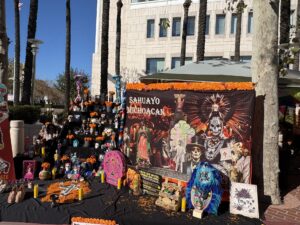
It is two o’clock in the afternoon on Saturday, November 7th, in Santa Ana, a town in Southern California. The sun is shining brightly in the sky and down onto the sidewalks of the main thoroughfare, where *Noche de Altares* [The Night of Altars]—an event sponsored by the city government and the Mexican Cultural Center—is about to begin. Families, joined by various local social and cultural organizations, are setting up altars in memory of their loved ones. Beside photographs of the deceased, they place personal belongings, favorite foods, and an abundance of marigolds—small, orange, carnation-like flowers that many recognize as a decorative bloom for Halloween, though in reality, they have a completely different history.

Cat—who descends from the Ñuu Savi (People of the Rain) on her mother’s side and the Zapotec (People of the Clouds) on her father’s side, both indigenous to the Mexican state of Oaxaca—helps me understand the tradition of honoring the dead. This practice was not a public affair, nor did it take place in November; that timing was imposed by the Spanish colonizers, who introduced their own holiday. Originally, the months dedicated to the dead were August and September. The rituals did not last just a few days; rather, they were divided into two twenty-day cycles. Families would set up an altar in their home, using it to support their loved one on their journey through the underworld. They provided the departed with energy—drawn from the sun via marigolds, from food, and, of course, from the act of remembering them and showing them affection.
I make my way along this enchanted path: what care I see in the perfect arrangement of images, flowers, drawings, and objects! And there is even a touch of irony—a quality that helps in navigating grief and makes life a little lighter for those who remain.


And so, I arrived at the site of my appointment: Hind Rajab’s car. Cat had prepared me, warning that the emotional impact would be intense—many people, upon encountering this installation—a vehicle riddled with the 335 bullets fired by the Israeli army—have been moved to tears. The little girl, with her lion-like mane of hair, wears a serene smile and seems to gaze upon us all with kindness. A child of similar age approaches her timidly—a little Catrina dressed in red—reaches out, and gently touches the car .


The altar that Cat and other activists have set up to commemorate those killed in the ongoing genocide in Gaza leaves no one out: there are children, their mothers and fathers, sisters, brothers, grandparents, journalists, cameramen, doctors and all medical staff, and political prisoners. As the stream of people reaches it, they slow down, read the names, and look at the faces smiling back from the photographs.


This is not a commercial celebration; you won’t see tourists strolling about, but rather local families—mostly of indigenous descent. These cheerful people, dressed in costumes and wearing makeup, are the descendants of the peoples who inhabited these lands before the arrival of Europeans. They are the survivors of massacres, violence, humiliation, and oppression. Today, they have embraced a people living thousands of miles away—a people they know to be enduring the very same tragedy—by inviting them to take part in one of their most sacred rituals. It is their way of offering support and strength to the Palestinians.
Cat explains to me that the opportunity to engage with a people living through an existential tragedy creates a special bond and helps new generations grow in awareness—prompting them to ask questions about their own origins and the values that shaped native civilizations, values distinct from the culture imposed upon them, which can be reclaimed through a process of creative exploration: “By supporting the struggle of the Palestinian people, we also awaken our own consciousness. I believe my ancestors would be proud of what we are doing; we have not forgotten them.”
This celebration, overflowing with life and color—a harbinger of love and life—stands as proof that those who believe they can erase a people’s memory are both foolish and deluded. The message placed at the center of the altar is clear: “The resistance of some is the resistance of all.”

The celebration grows livelier by the hour. We are waiting for sunset, for only then will the symbolic figure of La Catrina make her appearance, and the candles can be lit. Here she comes, approaching; men clear a path for her, and she is escorted by a group of mariachis. “La Catrina,” my mentor explains, “isn’t part of the original ritual—much like the candles, which were once used simply for illumination. She originated as a cultural project by the artist José Guadalupe Posada at the beginning of the last century, intended to mock the wealthy—who, in her presence, become the equal of everyone else. She became so popular, however, that she was absorbed into the folklore of the ritual; today, women and girls alike love to dress up as La Catrina.” “And what about the candles?” I ask. “Those are more for us—to help us stay focused on our goal, to keep us from giving up,” Cat replies with a sly smile.


Within a few minutes, the altars light up; the one dedicated to the Palestinians—featuring Hind, who looks like a little star perched on the roof of a car—shines brighter than the rest, thanks in part to a charming “Free Palestine” sign made of 1960s-style light bulbs, powered by batteries. It was brought by friends from the Long Beach “banner drop” group—for some time now, they have been staging a weekly nighttime protest by lowering this illuminated sign from a highway overpass. The air is filling with incense, and the drums have begun to beat; from this point on, it is no longer appropriate to describe what happens. Anything can unfold for those who choose to participate, but there is nothing to fear—this is not about seeking the kind of horror-movie thrill that leaves you breathless and drained of energy. On *Día de los Muertos* [Day of the Dead], love is both given and received.
For the sake of accuracy, it is worth noting that Halloween itself—which today we see trivialized into cheap supermarket trinkets and stripped of its profound essence—actually has noble origins: it was a Celtic festival rooted in even more ancient rituals.