By Md. Kafi Khan (Dhaka Bureau)
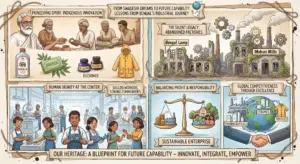
Every successful industrial venture begins with a dream, but not every dream withstands the rigorous tests of time. When we revisit Bengal’s rich industrial past- evoking enduring household names like Boroline, Margo, Sulekha, Duckback, Bengal Lamp, and Mohini Mills- we encounter an inspiring era when local entrepreneurship was fueled by scientific curiosity, collective self-confidence, and a vision for economic self-reliance. During the early twentieth century, pioneers inspired by figures like Acharya Prafulla Chandra Ray demonstrated how indigenous knowledge, research, capital, and human effort could merge to build productive institutions capable of serving everyday public needs.
Yet, the historical trajectory of these enterprises reveals a sobering contrast. While select historic brands successfully navigated changing markets and retained their commercial identity, numerous iconic factories faded into silence, leaving behind abandoned production halls, rusting machinery, and fading memories. This historical reality prompts a fundamental economic and social question: Why do some indigenous enterprises survive for generations, while others disappear despite enjoying extraordinary public recognition and affection?
Reviewing history, we discover deeper lessons for sustainable economic progress, moving beyond mere historical nostalgia or conventional profit calculations.
True Development Lies in Production, Not Mere Consumption
In the modern marketplace, consumers frequently view international brands as symbols of quality and social distinction. While global trade and open competition naturally enhance consumer choice and drive product standards, difficulties arise when foreign origin becomes a substitute for objective judgment, sidelining domestic alternatives despite their competitive qualities. A society’s true economic resilience is not measured solely by its ability to import and consume sophisticated global products, but by the capacity of its own workers, engineers, and researchers to innovate, manufacture, and create shared value.
Bangladesh’s contemporary industrial experience demonstrates that domestic enterprise possesses immense potential. Alongside the remarkable global success of the ready-made garment industry, sectors such as pharmaceuticals, ceramics, and food processing have established robust productive foundations. These achievements prove that local entrepreneurship can thrive internationally when vision, investment, skilled labor, and market opportunities converge. However, sustainable advancement requires moving beyond low production costs alone- demanding continuous investment in innovation, technological upgrading, and effective collaboration between educational institutions and industry.
Placing Human Dignity at the Center of Economic Transition
Mainstream economic discourse frequently reduces industrial performance to export volumes, capital investments, and balance-sheet figures. However, the silent walls and deteriorating structures of abandoned factories tell deeper human stories that financial statements cannot capture. Every production floor represents skilled workers who acquired specialized technical expertise, families depending on regular incomes, and local communities woven together by shared economic activity.
Consequently, industrial restructuring or commercial distress must never be treated purely as cold financial adjustments. Ethical stewardship demands balancing operational discipline with genuine human solidarity. Compassion without economic discipline cannot sustain an enterprise, but efficiency without human consideration creates unnecessary hardship. Responsible management must ensure that when businesses transition or restructure, worker retraining, community resilience, and social welfare remain central priorities.
Institutional Integrity Over Individual Charisma
History consistently shows that a revered brand name or an extraordinary founder cannot indefinitely shield an enterprise from weak governance, delayed modernization, or a lack of strategic foresight. An enterprise that operates efficiently in one generation can become vulnerable in another if it fails to modernize its machinery, adapt to technological shifts, or maintain strict financial discipline.
Sustainable institutions rely on transparent accountability, effective boards, rigorous risk management, continuous research, and structured succession planning. As enterprises expand, informal management arrangements invariably become inadequate for complex operations. Professional leadership and objective performance evaluation become essential for long-term survival. While visionary founders spark initial dreams, subsequent generations must sustain them through competence, integrity, and ethical stewardship. A factory’s future should never depend entirely upon the presence of one extraordinary individual; its lasting strength lies in the institutional framework that individual builds.
Turning Heritage into Living Capability
Bengal’s indigenous industrial history contains both profound inspiration and essential warnings. It should not serve as a museum of past glories, but rather as an active blueprint for future capability. The finest tribute to early pioneers is not passive sentimentality, but the determination to build modern enterprises that succeed globally not simply because they are local, but because they embody excellence, ecological responsibility, and a deep commitment to human well-being.
The ultimate measure of progress is not how proudly we remember yesterday’s enterprises, but how successfully we build those capable of serving tomorrow. By uniting institutional integrity, structural innovation, and a people-first approach in every stage of development, future generations will inherit far more than familiar brand names- they will inherit dynamic, thriving industries that empower communities, protect livelihoods, and sustain peace through shared economic prosperity.

Md. Kafi Khan:
Md. Kafi Khan is a writer, columnist, and researcher. He is a contributor to the Dhaka bureau of the International Press Agency- Pressenza.