By Genevieve B. Kupang, Makati, Philippines, November 22, 2026.
Reimagining Future-Ready Higher Education Beyond the AI Finish Line
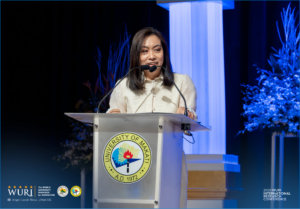
When higher education leaders declare a graduating cohort future-ready, they rarely confront a practical follow-up question: ready for how long? At the 2026 World University Rankings for Innovation (WURI) Global Conference (WIRC 2026), hosted by the University of Makati and the WURI Foundation, Commission on Higher Education (CHED) Commissioner Hon. Michelle A. Ong, DPA, challenged educators, researchers, policymakers, and scholars to move beyond static models of workforce preparation. Addressing the assembly under the theme “Enabling AI and lifelong learning to prepare learners and educators for an AI-driven, technology-intensive workforce,” Ong argued that genuine readiness is a sustained habit of continuous learning, ethical judgment, and institutional adaptability, long after our learners have graduated from college.
 CHED Commissioner Hon. Michelle A. Ong, WURI Foundation Founder Prof. Dong-Sung Cho, and University of Makati President Dr. Elyxzur C. Ramos join resource speakers, academic leaders, research presenters, local and international delegates at the 2026 WURI International Research Conference (WIRC 2026) hosted by the University of Makati. (Photo: Angel Locsin Riosa / UMak CIC)
Grounded in multidisciplinary systems and ethical autonomy, Ong’s keynote serves as a structured policy synthesis. Rather than treating artificial intelligence (AI) as a technical disruption, she examined the labor landscape through three intersecting forces: technological change, persistent exclusion, and sustainability.
Empirical data underscores the urgency of this convergence for the Philippines. While roughly one-third of Philippine enterprises have adopted AI, up from a fifth the previous year, fewer than one in five feel prepared, constrained by deficits in AI and digital skills. Meanwhile, an International Monetary Fund (IMF) assessment indicates that more than one in three Filipino workers hold jobs exposed to AI, affecting young, college-educated urban professionals in the services sector. Although six in ten of these roles stand to be augmented rather than replaced, spanning educators, managers, engineers, and lawyers, roughly 14 percent face displacement risks, particularly in customer service, accounting, clerical administration, and business process outsourcing. International Labor Organization (ILO) data similarly places 28 percent of the Philippine workforce in generative AI-exposed occupations, second to Singapore across ASEAN countries. Reflecting these shifts, the domestic IT and business process management sector has adjusted its 2028 employment target downward from 2.5 million to between 1.85 and 2.14 million, requiring professionals who combine AI fluency with human judgment, empathy, and leadership.
 Dressed in Barong Tagalog and Filipiniana ensembles, the Tunog Kawayan Angklung Group, led by composer Rolando Aponio of the UMak Center for Culture and the Arts, welcomes CHED Commissioner Hon. Michelle A. Ong, DPA, and 2026 WIRC participants at the Administration Building lobby. (Photo: Genevieve B. Kupang)
For Ong, this industrial transition is already taking shape locally. Plans for a 1,620-hectare Philippine and United States economic security zone in New Clark City project 130,000 to 190,000 direct jobs once operational. Students entering college in 2026 will graduate directly into that semiconductor and high-technology labor market by 2030. Drawing on her leadership experience as former President of Mabalacat City College and referencing international cases, from Taiwan’s 45-year development of the Hsinchu Science Park to TSMC’s 2023 workforce bottlenecks in Arizona, Ong noted that physical infrastructure cannot outpace human capital development.
 A presentation slide from CHED Commissioner Hon. Michelle A. Ong’s keynote highlights the projected 130,000 to 190,000 direct jobs at the proposed 1,620-hectare New Clark City hub by 2030.
Hon. Ong emphasized that technological adoption must be guided by pedagogical design rather than market momentum alone. Citing research from Turkey, where high school math students given unrestricted chatbots saw practice scores rise by 48 percent, but exam scores drop 17 percent below peers without AI. Contrasting it with a World Bank teacher-guided AI program in Nigeria that produced up to two years of learning gains in six weeks, she demonstrated that instructional design and human mentorship determine educational outcomes. Referencing UNESCO’s observation that classroom dynamics have shifted into a teacher, AI, and student relationship, she called for investment in faculty immersion, noting that as of 2022, only seven countries had formal AI training frameworks for educators.
Confronting the second force, structural exclusion, remains equally central to institutional reform. With UNESCO estimating 251 million children and youth out of school globally, digital innovation risks widening inequality if limited to institutions with reliable internet, time, and financial security. To broaden access, Ong highlighted the Philippines’ Lifelong Learning Development Framework Act, which enables recognized higher education institutions to offer for-credit micro-credentials in fields such as AI and cybersecurity. Co-designed with industry, local governments, and TESDA, these modular pathways turn lifelong learning into an accessible bridge for working adults and underserved communities.
 CHED Commissioner Hon. Michelle A. Ong, DPA (center), joins University of Makati executive leaders, WURI Foundation Founder and Chair Prof. Dong-Sung Cho, and afternoon resource speaker Dr. Euiho Suh, Vice President of aSSIST University and Director of the aSSIST K-Index. (Photo: Genevieve B. Kupang)
Concluding with three institutional commitments, teaching AI literacy alongside ethics and critical thinking, designing learning with excluded communities rather than simply for them, and integrating sustainability into curricula and campus decisions, Commissioner Ong outlined a practical roadmap for academic leadership. Supported by CHED’s flexible higher education AI policy, institutions can now adapt general education courses, minors, and specialized degrees to regional workforce needs, a shift also reflected in WURI’s expanded AI evaluation categories that recognize state universities, local colleges, and private institutions alike.
 Advancing Higher Education Innovation Together: WIRC-26 Conference Chair and University of Makati President Dr. Elyxzur C. Ramos, CHED Commissioner Hon. Michelle A. Ong, DPA, and WURI Historian and Baguio Central University International Relations Officer Dr. Genevieve B. Kupang pose together during the 2026 WURI International Research Conference on November 19, 2026.
Ultimately, Commissioner Ong reminded the conference that the future is a set of choices institutions can prepare for and shape. In an era where technical tools expire quickly, true readiness lies in cultivating graduates who retain their agency, evaluate algorithmic outputs critically, and continue learning long after leaving the classroom. By anchoring innovation in wisdom, inclusion, and the public good, higher education ensures that progress is measured by the human lives it improves.
 Opening Day Powerhouse (L–R): WURI Foundation Chair Dr. Dong-sung Cho, JIE Guest Editor Dr. Henry Magat, CHED-OPSD Director IV Jimmy G. Catanes, Ph.D., CESE, Genesis BBQ Asia Pacific Managing Director and Resource Speaker Mr. Jack Lee, WURI Foundation Executive Officer Dr. Jin-suk Kim, and Dr. Kyung-Sung Kim gather on the first day of the 2026 WURI International Research Conference (WIRC-26) on November 18, 2026.
 Members of the University of Makati (UMak) Welcoming Committee, dressed in traditional Filipiniana and Barong Tagalog attire and holding ceremonial garlands, greet delegates of the 2026 WURI International Research Conference. (Photo: Jane Beatrice Tagacay, UMak CIC)
##########
#CHEDAchieve #Future-readyEducation #AIDrivenTechnologyIntensiveWorkforce
#WIRC2026 #WURI2026 #TunogKawayan #UMakCCA #UniversityOfMakati #FilipinoHospitality
#CulturalShowcase #BCUIROSoarsHigher
About the Author:
Dr. Genevieve B. Kupang has served as the WURI Historian since 2024. She is also the Dean of the Graduate School and International Relations Officer at Baguio Central University.