On November 19, the leaders of the three largest nuclear powers on the planet—namely, China, the U.S., and Russia—agreed, following an 80-minute meeting, on a joint Declaration for Peace. It consists of four articles, but in this text, we will focus on the fourth point, which states verbatim:
“The three heads of state reiterated that a nuclear war cannot be won and must never be allowed to break out. The three countries will engage in dialogue to reduce nuclear risks and prevent the proliferation of nuclear weapons.”
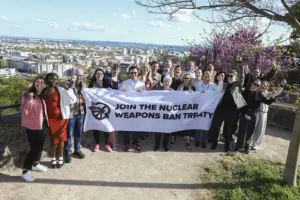
This is what all domestic and international media outlets reported (apparently correctly). What they did not cover—and continue to fail to cover (apparently incorrectly)—is the UN Treaty on the Prohibition of Nuclear Weapons (TPNW), which has 101 member states and will hold its first review conference in a few days at UN headquarters in New York: November 29–December 6.
This is a prime opportunity for countries that are not yet parties to this treaty, such as Greece, to observe the proceedings of the conference as observer states, alongside the U.S., Russia, China, and the remaining six—namely France, the U.K., India, Pakistan, Israel, and North Korea. Here is Rhodes; here is the leap, so to speak.
But let’s return to the joint statement by China, the U.S., and Russia. It certainly didn’t come about by chance, not at such a high diplomatic level. Beyond the announcement itself, we need to recognize that all three of these countries have, in recent years, been pursuing massive programs to modernize and expand their nuclear arsenals—China in particular. However, the TNP has been in force since 2021. On a diplomatic level, this was a huge victory for the international anti-nuclear movement, as it resulted not from statements by heads of state, but from pressure by civil society through ICAN. One of the Nobel Peace Prizes that certainly “was worth the money” in 2017 was the award given after the final text of the TPNW, as proposed by ICAN, was adopted.
China, Russia, and the United States have not (yet) acceded to this treaty, but they maintain relations with the 101 countries that have signed, ratified, or acceded to this historic agreement. And that is significant. By sending a consistent and unequivocal message about the need for nuclear abolition, TPNW member states are exerting constant pressure that pushes leaders to do what President Xi has just done, namely to declare that nuclear weapons “must be completely banned and completely destroyed.”
Furthermore, this outcry against nuclear weapons in recent years—with the TNP having played a decisive diplomatic and mobilizing role—has been reinforced by scientific studies that provide new evidence, updated with the latest technological data. One such study is that of The Lancet Commission on Global Health Threats of the 21st Century. This is a scientific study published by one of the most important and widely recognized international medical journals, which as stated in its introduction maintains
“a proactive, health-focused approach aimed at identifying and prioritizing the most significant threats to global health for the remainder of the century.”
This study has created a pyramid of threats with four categories: threats that could lead to the extinction of the human species by 2100; major catastrophic threats; major risks and causes; and the broader threat landscape. Extermination threats, which constitute the first category of the pyramid, include a nuclear conflict followed by a nuclear winter, and the malicious use of artificial intelligence, including the development of biological weapons. The study was published on October 15, and one month later, on November 15 (four days before the joint statement by China, the U.S., and Russia), more than 100 medical and health journals, including The Lancet, The BMJ, and the International Nursing Review, issued a joint call for the immediate abolition of nuclear weapons. This move follows joint appeals regarding the nuclear threat published in 2023 and 2025, ensuring that this issue remains constantly on the medical community’s agenda.
The appeal, published a few weeks before the Review Conference of the Treaty on the Prohibition of Nuclear Weapons (TPNW), states:
“Healthcare professionals have a vital role to play in keeping the focus on health during public discussions about the nuclear threat. We need a verifiable agreement with specific deadlines for the elimination of all nuclear weapons. That is why it is essential for the health sector to continue demanding that every country—including nuclear-armed states—accede to the Treaty on the Prohibition of Nuclear Weapons. At stake is not only the flourishing but also the very survival of the human race.”
In recent years, due both to Russia’s invasion of Ukraine and to Israel’s genocide of Palestinians in Gaza and the U.S. war against Iran, threats to use nuclear weapons have been made by heads of state (the U.S., Russia, Israel, France, and the UK) have issued threats to use nuclear weapons. The idea of a “Euro-bomb” has been floated, as well as that of the French nuclear umbrella (which won’t save anyone, but that’s a topic for another article), and finally, the expiration of the START Treaty on the control and reduction of U.S. and Russian nuclear weapons. All media outlets, with very few exceptions, as well as EU governments (since we are members as a country)—with the exception of those of Ireland, Malta, and Austria—which are already members of the SAPO—focus on the power, terror, and dystopia of nuclear weapons. However, they do not mention the struggle waged by the majority of nations on the planet against the existence of nuclear weapons and the violent, colonialist, and nihilistic diplomacy that accompanies them. They refer to the Treaty on the Non-Proliferation of Nuclear Weapons (NPT) and not to the Treaty on the Prohibition of Nuclear Weapons (TPNW), which is the most up-to-date, inclusive, and binding instrument for the elimination of nuclear weapons.
And yet, for the first time since 2021, when the Treaty on the Prohibition of Nuclear Weapons entered into full force, these three countries—which could, within 45 minutes, nearly the entire human race and alter the very nature of all life on the planet forever, are speaking out about the need to reduce nuclear risks. And this is a small victory in the face of the dystopia of nuclear weapons. The struggle continues for all of us, as long as nuclear weapons exist and people, communities, and environments continue to be affected by them—even if there is no officially declared nuclear war. To achieve ultimate victory over the nuclear dystopia, beyond diplomatic means, there is a need for something deeper: placing humanity at the center as the core value and concern that underpins all action and diplomacy.