Perugia, the capital of Italy’s so-called “green heart,” has, thanks to the initiative of the association Umbria della Pace, welcomed a living symbol of Palestinian resistance, hosting it in one of its most beautiful and emblematic locations: the Garden of the Righteous of the World, within the ancient San Matteo degli Armeni complex. This is also the home of Aldo Capitini’s personal library, from which, back in 1961, he launched the Perugia–Assisi Peace March.
More than sixty years have passed, and the Perugia–Assisi march has become more ritual than substance. Many today would be surprised to read the words of this philosopher of nonviolence and discover that his goal was to nurture “ideas and initiatives opposed to capitalism, colonialism, imperialism,” or that “the struggle for peace must be severe against the disguises of various imperialisms, against crusades against one people or another,” as he wrote in one of his editorials in the periodical IL POTERE È DI TUTTI, which he founded in 1964 and which is still accessible in his library.
There could have been no better place to plant the olive of Palestinian resistance—a small tree that survived the destructive fury of Israel. The plaque explains why this tree is not dedicated to a single individual, as the others are, but to the defense of a right that becomes action: the right of a people to self-determination and freedom, for which every era of history has produced martyrs—fighters resisting oppression in all its forms.

Today, more than ever, the initiative of Umbria della Pace, welcomed and supported by the city administration, is both important and courageous. It is important because it allows anyone visiting the San Matteo degli Armeni complex to see that Perugia recognizes the right of an oppressed people to resist. It is courageous because the long arm of the Zionist entity could have “tarnished” the initiative with the instrumental accusation of antisemitism, as has occurred on many other occasions.
Thus, seeing the Palestinian flag honored by the many attendees, including Councilor Croce representing the city, added even greater meaning to the initiative. As was recalled during the ceremony, the planting of this small green child of war-torn Palestine, miraculously smuggled out of the Gaza Strip, is not only a symbolic gesture of solidarity but also a call to action: for each of us, in our own way, to help halt the ongoing genocide and to stop the criminal Zionist project that has advanced for nearly 80 years, crushing even international law with impunity.
What would Capitini have said in response to the latest atrocity at the United Nations, from which, just ten days ago, the shameful Security Council Resolution 2803 emerged, flagrantly violating the principles of the UN Charter? We are certain he would have denounced the servile corruption that bows to the law of the strongest, and that his decades-old call “to create a permanent mobilization to monitor foreign policy, military policy, educational policy, and to denounce mistakes, faults, distortions, alliances of conservatives, imperialists, capitalists…” would have grown even louder, demanding action—because active nonviolence can rightly be called resistance, and it is far from mere salon chatter.
It is true that Aldo Capitini believed he could change the world by confronting the powerful—that is, the criminals of history—with the force of nonviolence, modeled on Gandhian resistance. Yet Capitini was also the nonviolent Catholic who did not fear fascist reprisals when, in 1929, he called the Lateran Pacts a “bargaining chip” between Pius XI and Fascism, and who refused Giovanni Gentile’s blackmail to join the Fascist Party in order to avoid being fired.
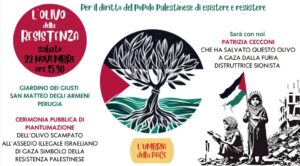
All of this leads us, along with Gabriele De Veris, the librarian who showed us his works, the event organizers, and all the attendees, to believe that the founder of the Perugia–Assisi march would have supported Palestinian resistance. The small olive tree, which survived the criminals marked with the Star of David, would have been welcomed by him as a symbol of resistance and as a call not to yield to the blackmail of a false promise of peace—whose true face, stripped of media masks, reveals itself not as peace but as pacification enforced through coercion by Zionist colonialism, backed by Western supremacism, servile to the powerful and oppressive toward those who demand freedom.
And so, alongside trees planted in memory of, or in tribute to, figures such as Maria Montessori, Carlo Urbani, Danilo Dolci, Anne Frank, Gino Strada, Pietro Terracina, and many others—including artists who have consistently demonstrated their commitment to human rights—the little olive tree from Gaza, with its explicit plaque, will be in excellent company.
Its coincidental planting near World Tree Day and UNESCO’s day dedicated to protecting the olive tree—as a symbol of resilience, cultural identity, and a millennia-old source of nourishment for humanity—draws attention to the ongoing violence endured by the Palestinian rural environment. Here, the destruction of orchards and olive groves, the uprooting and theft of centuries-old olive trees, and the cutting down of younger trees throughout illegally occupied Palestine are near-daily crimes, left unchallenged by the world of the powerful, complicit with the Zionist entity, and without shame or accountability.
However, as one speaker recalled, the olive tree is capable of regenerating—even from its ashes—and not even frost can kill the root that is its “mother,” the heart of the olive’s resistance, which produces sprouts and true rebirth, passing its DNA from the mother root to its new sprouts. The small olive smuggled out of Gaza, perhaps descended from the millennial olives of Gethsemane, is thus a symbol of regeneration, standing as proof that “resistance will not be crushed, even by tanks.”
One of the speakers recalled a phrase written on a wall in Nusseirat, now destroyed by Israeli forces, quoting a Greek poet: “They tried to bury us. They did not know we were seeds.” This is evident in the sprouts emerging from burned or felled Palestinian olive trees. Nothing more is needed to show that the olive represents the capacity to resist evil and, ultimately, the path to peace—not the peace imposed by the oppressor, but a peace guided by the compass of resistance.
As we close this article, we share a statement from another Umbrian organization, Fondazione PerugiAssisi, which calls for participation in the November 29 demonstration, the international day of solidarity with the Palestinian people. The foundation condemns the disgraceful UN Security Council Resolution 2803 as “a new attack on peace and human rights…” and “a plan for war, not peace,” providing extensive and indisputable documentation.
From Italy’s “green heart,” that is all for now.