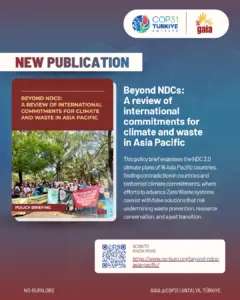
Antalya, Türkiye – 12 November 2026 – As COP31, the UN Climate Change Conference, brings Zero Waste into the global spotlight as a climate priority, a new policy brief by the Global Alliance for Incinerator Alternatives (GAIA) Asia Pacific finds that climate finance is influencing which waste and climate pathways countries pursue, often favoring capital-intensive technologies and downstream waste management over upstream prevention and community-led zero waste systems. The policy brief, Beyond NDCs: A Review of International Commitments for Climate and Waste in Asia Pacific, examines the third generation of Nationally Determined Contributions (NDC 3.0) of 16 countries in Asia Pacific. The findings raise urgent questions about whether climate commitments are actually driving meaningful change or reinforcing approaches that leave the root causes of the climate crisis unaddressed.
The brief shows that in the region, the adoption of false solutions is a system-wide climate governance issue and is not confined to countries with limited economic or institutional capacity. Furthermore, countries receiving conditional finance – external financial support via loans, contracts, or economic assistance – have a higher likelihood of including false solutions in their NDCs. This raises important questions about how available financing pushed by rich countries influences choices on climate solutions and national climate priorities.
Key findings include:
-
References to carbon markets, credits (whether carbon or plastic), offsets, internationally transferred mitigation outcomes (ITMOs), emissions trading systems (ETS), and similar approaches appear in all 16 NDCs studied
-
Eight countries receive conditional finance, and they propose 27 false solutions altogether. This averages to 3.38 per country vs 2.75 for countries receiving unconditional finance
-
Six countries – The United Arab Emirates (UAE), Mainland China, Indonesia, Nepal, Singapore, and Bangladesh – include waste incineration in their plans
-
Only three countries Bangladesh, Indonesia, and Palau mention Reuse in their commitments
-
Carbon capture, utilization and storage (CCUS) is the most widespread false solution among the sample, featuring in twelve countries
-
Bangladesh combines waste-to-energy (WTE), refuse-derived fuel (RDF), landfill gas capture and CCUS with recycling, composting and resource recovery.
Climate finance risks reinforcing false solutions
This brief complements the findings of GAIA AP’s Citizens Atlas on False Climate and Circularity Solutions, which tracks waste infrastructure investments associated with major international financial institutions. It showed that IFI-funded waste projects often reinforce false solutions rather than address the crisis at its source.
Zero Waste must be at the center of climate action
Six countries Bangladesh, Mainland China, Indonesia, Nepal, Thailand, and the UAE include Zero Waste measures alongside at least one false solution. This exposes a fundamental contradiction where governments recognize waste prevention and resource conservation in their climate plans while simultaneously promoting approaches that sustain waste-intensive systems.
“Governments and international finance institutions (IFIs) cannot claim climate action while financing infrastructure that depends on waste to keep operating, ” states Mayang Azurin, GAIA Asia Pacific’s Deputy Director for Programs. “Incineration locks communities and economies into decades of waste generation, destroys valuable materials that could be reused and recycled, and diverts investment from genuine Zero Waste solutions.”
COP31 must deliver real climate solutions, not false promises
As zero waste takes the spotlight for the first time in COP, the briefing’s findings challenge governments and financial institutions to confront the existing gap between their climate commitments and the approaches they continue to support.
Highlighting the disconnect in commitments and actual national priorities, Sumana Narayanan, GAIA Asia Pacific’s Deputy Director for Programs, states, “When national climate plans only give superficial nods to zero waste while doubling down on incinerators and offsets, they fail to provide support to what communities actually need. True climate action today and beyond COP31 means false techno-fixes with legally binding frameworks for reuse, reduction, and zero waste.”
Read the full report here: https://www.no-burn.org/
Explore and contribute to the Citizens Atlas on False Climate and Circularity Solutions here: https://citizensatlas.vercel.
About the report:
Beyond NDCs: A Review of International Commitments for Climate and Waste in Asia Pacific is a policy brief prepared and published by the Global Alliance for Incinerator Alternatives (GAIA) Asia Pacific in November 2026. It examines the NDC 3.0 submissions of 16 countries across Asia Pacific, assessing their commitments on waste, false solutions, Zero Waste measures, and climate finance conditionalities. The study is a document-based analysis of NDC texts. It does not constitute a comprehensive assessment of countries’ actual policies, funded projects, or implementation practices.
##########
About GAIA:
GAIA is a network of grassroots groups as well as national and regional alliances representing more than 1000 organizations from 92 countries. With our work, we aim to catalyze a global shift towards environmental justice by strengthening grassroots social movements that advance solutions to waste and pollution. We envision a just, Zero Waste world built on respect for ecological limits and community rights, where people are free from the burden of toxic pollution, and resources are sustainably conserved, not burned or dumped. www.no-burn.org
Media contact:
Marvee Sambajon, Communications Officer for Campaigns, GAIA Asia Pacific
marvee@no-burn.org | +639083493069
Dan August Abril, Communications Officer for Programs, GAIA Asia Pacific