For much of my adult life, human rights have not been a subject I merely studied. It has been a matter that hit my heart and occupied my mind. I could never treat a violation as an abstraction, because behind every human rights violation lies a human being — the pain, the agony, the fear of millions upon millions of people on every continent. Democracies, authoritarian regimes, and every governing authority in between commit or tolerate some form of abuse: crimes against humanity, war crimes, genocide, ethnic cleansing, the persecution of minorities, online violence, sex trafficking and child abuse in conflict zones, and the mounting suffering inflicted by climate change on people who did nothing to cause it.
By Alon Ben-Meir
I speak with a heavy heart about these violations that are taking place nearly everywhere, and with impunity. I know such horrors have occurred throughout history. What is different now is that we are witnessing them in real time; atrocities unfold day in and day out. I ask how it is possible that we, as human beings, have lost our moral compass and descended into a new darkness where we stand by as atrocities unfold and the perpetrators walk free.
That is why I established the Institute for Humanitarian Conflict Resolution. The Institute’s purpose is to disseminate information through every available form of communication, to convey the intensity and scale of human rights violations in their many places and forms, and above all to call for action. We can no longer afford complacency. We can no longer afford to turn our backs. Hundreds of millions of people are affected, and many endure suffering that is simply unimaginable to those of us who are safe.
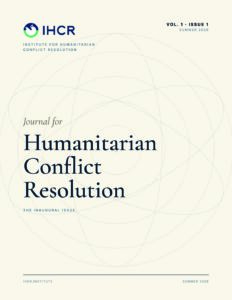
Having established the Institute, I invited leading academics and professional scholars to write essays on human rights violations in their many forms. I feel extraordinarily honored that so many individuals responded with enthusiasm. For this first summer edition (https://ihcr.institute/book/journal-for-humanitarian-conflict-resolution-volume-1-issue-1-summer-2026/), eleven distinguished contributors have given us their work in addition to my own. What follows is a brief account of each essay and what it offers to those whose lives depend on ending these violations, or, at a minimum, mitigating them.
Evaggelos Vallianatos argues that fossil-fuel burning is a slow war on humanity, and that a binding Fossil Fuel Non-Proliferation Treaty and a just transition to renewables could spare billions from lethal heat, fires, floods, hunger, and displacement, saving the lives of millions who have done nothing to cause it and sparing them from suffering, displacement, and death.
Drawing on his own back-channel diplomacy, Ambassador Frederic C. Hof shows how quiet groundwork, now reflected in the new Israel-Lebanon framework, can potentially end 78 years of hostility that left thousands killed, reconciling Israeli security with Lebanese sovereignty so that uprooted Lebanese and Israelis can return home and rebuild.
Cemre Ulker maintains that technology-facilitated violence is a fast-escalating digital war on women that spills into physical abuse, and that strong laws, platform accountability, and digital literacy could free millions—especially women journalists and rights defenders—to participate safely in civic and political life.
Sam Ben-Meir contends that stripping the Rohingya of citizenship denies them the recognition that makes personhood possible, and that restoring their legal status—an obligation of reason, not charity—would end their confinement in camps and give them protection, voice, and a place to belong.
Wioletta Rebecka and Alain Bayongwa argue that sexual violence in eastern Congo destroys belonging as much as bodies, and that “Practical Justice”—recognition, storytelling, vocational skill, reciprocal contribution—can restore displaced women’s dignity, income, and standing even where courts fail, enabling them to support their children.
Writing from exile, Nguyễn Ngọc Như Quỳnh asserts that Vietnam’s repression has shifted from prison cells to algorithms, and that sustained international pressure for free expression would release prisoners of conscience, spare their families years of hardship, and let ordinary Vietnamese speak and organize without fear.
Hafza Girdap demonstrates how Türkiye’s post-2016 purge weaponized patriarchy, jailing mothers, dismissing hundreds of thousands of women, and gutting protections after withdrawing from the Istanbul Convention—and that ending this gendered repression would restore livelihoods, reunite imprisoned mothers with their children, and let exiled women reclaim citizenship.
Caroline Ewing and Anne Speckhard hold that nihilistic online extremism is driven less by ideology than by Dark Tetrad behaviors — grooming, sextortion, cruelty, notoriety-seeking—and that detecting these patterns early could spare thousands of vulnerable young people, some as young as eight, from exploitation, self-harm, and violent death.
Daniel Bar-Tal submits that Zionist ideology, Holocaust-rooted victimhood, and 125 years of conflict have turned Israeli Jews from victims into perpetrators of occupation and mass killing—and that ending it would spare Palestinians further displacement and death while freeing Israelis from endless war, militarism, and eroding democracy.
Katrina Fotovat claims that dismantled US gender programs and AI-driven abuse have left women unprotected, and that funding women-led organizations and seating women at AI’s design table would protect women from political vulnerability and technology-facilitated violence, preventing tens of thousands of deaths and child marriages.
Mike Bedenbaugh reasons that America’s humanitarian failures—abandoning the mentally ill, leaving migrants dying in deserts, closing rural hospitals—stem from a severed link between power and responsibility, and that accountable, locally rooted federalism with firm rights guardrails would restore steady care and dignity to the most vulnerable.
Alon Ben-Meir argues that Israel committed genocide in Gaza and continues ethnic cleansing in the West Bank. Israel—a sanctuary born of unspeakable suffering—has become an engine of it. A nation founded to end persecution cannot survive as its author. Israel has betrayed the very reason it was created; its redemption rests on justice for the Palestinians—without it, there is no redemption at all.
Together these essays span continents, disciplines, and forms of abuse, yet they converge on a single conviction: none of this suffering is inevitable or irreversible. Each author identifies not only a wound but a remedy. That is the purpose of this journal—to name what is being done to human beings, to insist on accountability, and to show that action is not only possible but an imperative. The voices in these pages have no advocate but our attention.
Dr. Alon Ben-Meir is President of the Institute for Humanitarian Conflict Resolution.