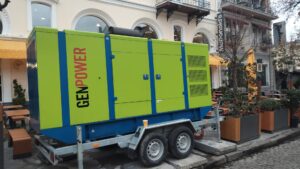
In the photo there is a GENPOWER, on a trailer, parked in front of McDonald’s on Deribasovskaya. The most important street in the historic center of Odesa.
In the Odesa Oblast (region) there was an attack on the night of November 2nd with 193 drones that did not hit residential areas but hit the 110kV DTEK substation and the port area, putting the entire region into scheduled blackouts from 2 to 12 hours a day, to optimize the distribution of the remaining energy.
McDonald’s works. The generator burns diesel and the fryer is on.
A business that can afford a generator does not close. It only pays extra for fuel.
The war on infrastructure is never symmetrical.
It does not hit those who have a generator. It hits those who don’t.
_Those who don’t have it_
In Ukraine there are over 10 million pensioners. The declared average pension is 5,800 UAH (about 114 EUR), the minimum is 2,361 UAH (about 46 EUR). A pension of 3,200 UAH (about 63 EUR) a month is no longer enough to live on, let alone to keep warm.
A small balcony portable power station, a small EcoFlow or Bluetti, costs today in Odesa 12,000 – 15,000 UAH (about 236 – 295 EUR).
A small 3 kW diesel generator, the one that can run a fridge and a heater, costs 25,000 – 30,000 UAH (about 492 – 590 EUR).
That is 5-10 months of minimum pension.
To this we must add diesel: 60 UAH per liter (about 1.18 EUR), with a consumption of 3-5 liters per hour. Running a generator for 6 hours costs as much as 2 days of groceries for a pensioner.
The worker, male or female, who in the last three years has seen real wages collapse does not have 500 euros set aside for a generator.
They may have a 20,000 mAh power bank that lasts one evening.
When the power goes out, on the 5th floor of a Soviet building without an elevator, the water goes out too, because the building’s pumps are electric, and the centralized heating goes out.
What remains is the cold. What remains is hunger because neighborhood bakeries, like the one destroyed on November 2nd, do not all have a GENPOWER.
What remains are neglected diseases because heart or diabetes medicines need to be kept cool or need electricity.
_The invisible victims_
It would be wrong to think that an attack on a power plant or a waterworks has no victims because there is no dead body under the rubble.
There are victims, but they die a week later, of pneumonia in an apartment at 12 degrees, of a heart attack because the ambulance does not arrive due to the blackout, of hunger because the pension does not arrive at the ATM.
And let it be clear, the same happens, in the same way if not worse, beyond the front line.
In Donetsk, in Belgorod, in Kursk, because infrastructure is blown up on the other side of the front too, those who pay are never those who decide the war.
Those who pay are always the working classes.
Only those who have relatives working in Italy or Poland who can send 100 euros (about 5,078 UAH) to buy a small heater and bread are saved.
The generator in front of McDonald’s is the perfect photograph of war inequality: those who can afford it stay warm.
Those who cannot, remain in the dark and in the cold.
Today, November 3rd 2026: it is 9°C, cloudy, and there is 91% humidity.
The low tonight was 9°C, because in Odesa there is not a big temperature range, but from tomorrow a drop in temperatures is expected:
On November 4-5-6, lows of 3°C are forecast, with icy wind from the north at 26 km/h and a wind chill between 0°C and -1°C.
On November 7th a low of 1°C is forecast, with a wind chill of -2°C in the morning due to icy wind.
In practice we are already in an early winter regime.
_Winter estimate:_
Historical data for Odesa:
– _January_: average low -3.7°C, average high +1.7°C.
The average temperature in February is -1° with a low of -2.7°C
Temperature lows are -15°C or below, every winter.
The “record” in Odesa was -28°C in February 1929.
The average of recent years is milder but deceptive: December low +2°C, January -1°C, February 0°C, but icy north wind and 80% humidity make the perceived temperature much lower.
_What it means for an apartment without power/heating:_
– Today inside an unheated working-class apartment it is already too cold.
– With -3°C outside in January, inside an unheated house it is 8°C if the neighborhood heating plant, which is electric, does not work.
Below 10°C inside the house risks begin for the elderly: hypothermia, bronchitis etc…
– With -15°C outside = inside the house it gets to between 0°C and -2°C. Without a generator, without a heater, survival is at risk.
This is the point: it is not simply that “it is cold”.
It is that in Odesa in January it is like in Trieste when the bora blows hardest, but if they cut your power you have no way to heat yourself at all, unless you have 500 euros for the cheapest generator, which lasts a few hours and you can afford the diesel to run it.
I have seen several times elderly people picking up cardboard from dumpsters, they do not directly burn the cardboard in the stove to warm themselves, because it would burn immediately without practically heating anything.
As was done in Italy during the First World War, you wet the cardboard, you roll it into balls and you let it dry (but this operation also requires time and sufficient heat) and then you burn it together with the lumber you find.
In short, at the front goes, forced to do so, the poor people, who have no exemptions for study or because they do essential work, including recruiters, criminals who send to the front those they round up in the streets, or, as always happens, those who can bribe.
And it is always the poor people who remain in the cold, hungry and without enough drinking water, which must be bought because from the taps comes water that is not potable.
Ceasefire!
Now!
Note: I used today’s exchange rate:
1 EUR = 50.78 UAH.


