Rita Bhowmick (Dhaka Bureau),
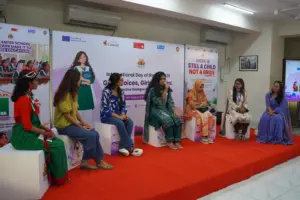
A new chapter in the movement for women’s and girls’ rights in South Asia unfolded in Bangladesh. Adolescent girls have actively voiced their demands for an end to child marriage, access to quality education, safe environments, and equal opportunities in every sphere of life. On the occasion of International Day of the Girl Child 2026, girls took center stage at a special dialogue held in Mirpur, Dhaka, sharing their lived experiences of discrimination and presenting concrete demands to protect their rights and future.
Organized by the non-governmental development organization Manusher Jonno Foundation (MJF) under the theme ‘End Child Marriage and Invest in Girls’ Rights,’ the event bypassed traditional representation. Instead of adults speaking on their behalf, adolescent girls led the conversation themselves.
Urgent Need for Structural and Social Change
Speaking at the event, Shaheen Anam, Executive Director of MJF, emphasized that verbal encouragement alone is insufficient; society must create realistic environments and opportunities for girls to exercise their rights.
‘Simply saying that girls will conquer the world is not enough. We must ask how they will achieve that and what opportunities we are creating for them. Child marriage violates girls’ fundamental right to make decisions about their own lives,’ said Shaheen Anam.
She called for stronger law enforcement, greater accountability, and rigorous oversight from government institutions at both national and local levels.
Alarming Findings from Key Studies
Presenting findings compiled from studies by UNICEF, UNFPA, and the Bangladesh Bureau of Statistics (BBS), Lysa Mahmud Hema, Assistant Project Manager at MJF, highlighted critical statistics:
47.2% of women aged 20–24 in Bangladesh were married before turning 18.
13.4% were married before reaching the age of 15.
Secondary school completion rates show a sharp decline- dropping from 91.3% at the primary level to 75.9% at lower secondary, and down to just 41.1% at upper secondary level.
Intergenerational Dialogue: Intersectional Barriers and Discrimination
During the intergenerational dialogue, adolescent participants highlighted the multifaceted challenges they encounter in daily life:
Right to Education and Decision-Making: Sumaiya Akter from SERAC Bangladesh noted that without access to education, girls cannot exercise meaningful choices regarding their careers or personal relationships.
Gender Disparity in Sports:
Sadia Akter Eva, a student living in a shelter home (Maer Achol), and Tasneem Ferdousi from BISC pointed out that boys are prioritized with more time and resources in school sports. Tasneem questioned social norms, asking, ‘How can a 16- or 17-year-old girl, who has not yet reached emotional maturity, be expected to manage a household and raise a child of her own?’
Menstrual Stigma and Indigenous Rights: Ukhenu Marma addressed menstruation-related taboos, ethnic discrimination, and the right to study and express oneself in one’s mother tongue.
Equal Rights for Girls with Disabilities: Ayesa Akter, a visually impaired adolescent, stated, ‘Girls with disabilities need opportunities and equal rights through accessible learning materials like Braille and audio formats, not sympathy. In other countries, students with disabilities can study a wide range of subjects, but in Bangladesh, this remains a dream.’
Equal Educational Investment:
Wadifa Rahman Apshara, a student at SFX Greenherald International School, urged the government and institutions to invest equally in boys’ and girls’ education to curb dropouts and child marriage.
Root Causes: Poverty and Climate Vulnerability
Distinguished speakers noted that beyond social stigma, extreme poverty, climate vulnerability, and a lack of safety drive families to marry off their daughters prematurely.
In the closing remarks, Wasiur Rahman Tonmoy, Lead of Youth and Social Cohesion at MJF, expressed gratitude to development partners- including the European Union, Global Affairs Canada, the Embassy of Switzerland, Plan International Bangladesh, and Nagorikata CEF. He urged the international community to move beyond awareness campaigns and invest concretely in policy enforcement and educational infrastructure.
Blending cultural performances by children with serious policy dialogue, the event made it clear that adolescent girls are not passive subjects of sympathy, but active drivers of their own future.

Rita Bhowmick:
Rita Bhowmick is a prominent Bangladeshi journalist, researcher, and writer with nearly three decades of experience, widely recognized for environmental journalism. Holding honors and master’s degrees in Geography from the University of Dhaka, her analytical perspective spans environmental and social issues. Since 1997, she has worked for leading national dailies such as Jugantor, Samakal, and Ittefaq. Currently, she serves as a correspondent for Pressenza- Dhaka Bureau and a senior reporter for Banglaaffairs.com, where her work centers on the intersection of environment, climate, and their correlation with women, children, and social welfare.
Her reports focus deeply on environmental themes- particularly women and children, food security, rural livelihoods, and climate change vulnerabilities. She has earned various fellowships for research, including with SNV (2018), Earth Journalism Network (2026), OKUP (2026), and a 2024 study on rural indigenous women’s agricultural contributions and wage disparities. She completed the Thomson Foundation’s ‘Women in Journalism’ program and has received the UNFPA Media Award, Meena Media Award, WFP Media Award, and multiple Bazlur Rahman Memorial Medals. Author of over thirty books, Rita Bhowmik is an active member of the National Press Club and Bangla Academy, contributing significantly to impactful and solution-oriented environmental journalism.