Part of “A Violence Too Large to See” — Exploring how economic structures and the beliefs behind them can limit or expand human possibilities.
Bangladesh at a Crossroads
On October 29, 2026, the United Nations General Assembly gave Bangladesh three additional years before graduating from the category of Least Developed Countries. Although the country has made significant economic progress, concerns remain about its vulnerability to international competition and the possible loss of trade preferences.
The decision raises a fundamental question: What does economic development really mean if the people producing a country’s wealth remain economically vulnerable?
The news brought me back to a visit I made to Bangladesh more than twenty years ago, when I encountered two very different economic realities: women garment workers struggling to earn enough to meet their basic needs, and a banking initiative founded by Muhammad Yunus that was bringing financial resources to people traditionally excluded from the economy.
Discovering Bangladesh
In the early 2000s, I traveled to Bangladesh as part of a delegation working to develop the Humanist Movement in the country.
Bangladesh was unlike anything I had encountered in Europe or the United States. The density of human life was astonishing. People were everywhere: in the streets, markets, on rickshaws, and in neighborhoods where daily life seemed to unfold collectively rather than privately. I remember people sleeping on their rickshaws and families living in buildings still under construction.
It was also an extraordinarily young country. Around the year 2000, more than half of its population was under the age of 25. Poverty was visible, but so was the intensity of human relationships and people’s determination to improve their circumstances.
Among those who approached our delegation were volunteers interested in the Humanist Movement. Some were also involved with an institution challenging conventional assumptions about poverty and banking: Grameen Bank.
A Bank That Went to the People
Grameen Bank was founded by economist Muhammad Yunus, who began experimenting with small loans to impoverished villagers in 1976. The institution formally became a bank in 1983. What interested me most was not the microcredit model itself, but the belief behind it.
Conventional banks evaluate borrowers based on income, assets, collateral, and credit history. Those with few resources are often considered too risky to finance. The result is a system in which people who already have resources can access more, while those with little remain excluded.
Grameen challenged this logic. Rather than focusing on what poor women lacked, it recognized what they might accomplish if given access to financial resources. The bank provided small loans to women excluded from conventional banking, with employees working directly in communities, building relationships, and understanding local conditions. Instead of expecting people to come to the bank, the bank went to them.
At the end of our visit, our hosts took us to a Grameen store, where we purchased locally made souvenirs—a small glimpse of the economic opportunities being created.
Grameen’s experiment helped inspire a broad microfinance sector throughout Bangladesh. Microcredit has its limitations: repayment pressures can burden borrowers, and loans alone cannot overcome poverty. But Grameen’s deeper contribution was to challenge a fundamental assumption: that people without financial resources also lacked economic potential.
The Women Who Made the Clothes
During that same visit, I encountered another side of Bangladesh’s economic development. The country had become a major garment producer, supplying clothing to retailers in Europe and the United States. By 2000, the industry accounted for more than 75% of Bangladesh’s merchandise export earnings and had become a driving force in the country’s economic transformation.
But behind this success was another reality.
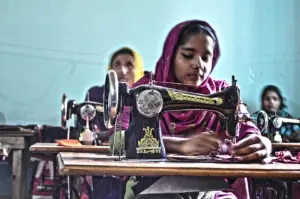
I learned about women working in garment factories for approximately three dollars a day, producing clothing that might sell for more than twenty dollars in American stores. Of course, retail prices reflected many additional costs, but the contrast was striking. Women made up much of the workforce, while management remained largely in men’s hands.
At the time, women garment workers were demanding an additional dollar a day—a modest increase that could make a meaningful difference in their ability to feed their families and meet basic needs.
Their demand raised a simple question: If their labor was helping drive Bangladesh’s economic success, why couldn’t they earn enough to live decently?
This to me was an example of economic violence—a form of violence that does not necessarily involve physical force or deliberate harm, but can be embedded in economic arrangements that leave people unable to meet their basic needs, even as their labor contributes to the prosperity of others.
But when I returned to New York, I encountered an unexpected obstacle.
When a Belief Becomes Economic Reality
When I returned to New York, I tried to organize support for the garment workers through friends in the Bangladeshi journalistic community. At the time, at least eight Bangladeshi daily newspapers served the community, and I approached journalists I knew, hoping to draw attention to the women’s demands.
Their response surprised me.
They explained that raising wages could lead manufacturers to relocate production to Thailand or other Asian countries with lower labor costs. Bangladesh could lose factories, jobs, and export earnings.
Their concern was understandable. International manufacturers could move production in search of lower costs. But what struck me was how quickly the conversation shifted. I had come to discuss women struggling to meet their basic needs. Instead, I found myself hearing why improving their conditions might endanger the country’s economic future.
The journalists weren’t necessarily indifferent to the workers’ suffering. They were operating within an economic framework in which low wages were seen as essential to Bangladesh’s competitiveness. Within that framework, an additional dollar a day appeared less as a modest improvement in people’s lives than as a threat to economic stability.
What struck me was how an assumption about economic necessity had come to define what was possible. No one needed to argue that women should live in poverty. Once low wages were accepted as a condition of economic survival, their poverty became something that had to be tolerated.
This is how beliefs can shape reality without our recognizing them as beliefs. They establish the limits of what we consider practical, reasonable, or even imaginable. And when those assumptions go unquestioned, arrangements created by human decisions begin to appear as unavoidable facts of life.
The experience left me with a question: What kind of economic development depends on keeping the people who make it possible from earning enough to meet their basic needs?
Two Ways of Seeing Economic Possibility
Looking back, what strikes me is that these two experiences occurred in the same country, among women facing economic insecurity, yet reflected very different assumptions. In the garment industry, women’s wages were viewed primarily as a cost to be contained. At Grameen, poor women were seen as people with untapped capacities who could create economic opportunities if given access to resources.
Neither experience was without limitations. But the contrast was revealing.
One approach began with the requirements of an existing economic system. The other began with the possibilities of human beings.
In 2006, Muhammad Yunus and Grameen Bank received the Nobel Peace Prize. Nearly two decades later, when student protesters helped bring down Bangladesh’s government in 2024, student leaders turned to Yunus to head an interim administration, seeing in him the possibility of a different future.
His achievement at Grameen was not that he had solved poverty, but that he had challenged a deeply rooted assumption through practical experience. What had once seemed unrealistic became possible because someone began with a different belief—and acted on it.
Recognizing What We Believe
More than two decades later, I still remember the women garment workers asking for one additional dollar a day. Their demand was modest, but the response it provoked revealed something much larger.
We tend to think of economic arrangements as realities to which people must adapt. Yet these arrangements are also the product of human decisions, priorities, and beliefs. What appears inevitable today may become possible to change when we begin to question the assumptions behind it.
Recognizing those assumptions does not eliminate economic constraints or provide easy solutions. But it opens the possibility of asking different questions—and acting in different ways.
Perhaps this is where overcoming economic violence begins: not simply by seeking better outcomes within existing arrangements, but by questioning whether those arrangements place human well-being at their center.
The women in Bangladesh were not asking for an economic theory. They were asking for the possibility of improving their lives.
Ultimately, the measure of economic development should not be only how much wealth a society produces, but how many people gain the opportunity to improve their lives and shape their own futures.