by Asif Showkat Kallol
Long queues have returned to petrol stations across Bangladesh as the conflict in the Middle East disrupts global energy supplies, sparking panic buying and allegations of hoarding.
Government officials insist there is no real shortage.
On Tuesday, joint secretary Monir Hossain Chowdhury, spokesman for the energy and mineral resources division, told reporters that stocks stand at 193,000 tonnes- enough for April. Fresh cargoes are due, including 54,600 metric tonnes arriving this week, with more shipments planned from Malaysia, Indonesia, and India’s Numaligarh refinery.
Yet motorists continue to queue for hours, driven by rumours of price rises that ministers have repeatedly denied. ‘Government will not increase fuel prices,’ said junior public administration minister Md Abdul Bari. Cabinet secretary Nasimul Gani added that radical measures such as extended weekends or widespread work-from-home arrangements are not under consideration, citing inadequate infrastructure.
Instead, the government has issued repeated austerity circulars. Offices must use natural daylight, halve the use of lighting, keep air conditioners at 25°C or above, switch off equipment when rooms are empty, and limit vehicle use. Civil servants have been ordered to remain at their desks from 9 am to 9:40 am daily. Vigilance teams will monitor compliance, though officials admit many directives are routinely ignored.
Authorities have seized 87,000 litres of hoarded fuel across 64 districts and imposed fines of Tk950,000. The petroleum dealers’ association has urged citizens not to buy beyond normal needs.
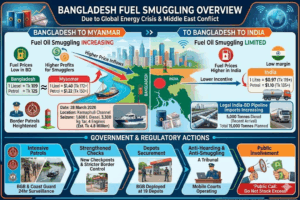
A growing concern is cross-border smuggling. Fuel is flowing out of Bangladesh towards Myanmar, where civil war has driven prices roughly 25% higher (petrol around $1.22 per litre, or about Tk150 at current exchange rates near Tk123 per dollar). On 28 March, the coast guard arrested seven men in Chattogram and seized 1,600 litres of diesel, 3,300 kg of tar, and four engines from a trawler bound for Myanmar. Patrols have been stepped up along the coast and land borders, with rewards offered for information.
While smuggling to India remains minimal, Indian pump prices are comparable or slightly higher; legal imports from India via pipeline are being expanded to bolster supplies.
Energy experts have warned that keeping prices steady will require tougher action. Prof Dr. M Shamsul Alam, energy adviser to the Consumers Association of Bangladesh (CAB), told the media that if the government does not want to raise fuel prices, it must take strong administrative measures to prevent large-scale smuggling.
Ministers say the current strategy of conservation directives, anti-hoarding drives, and diversified imports can manage the situation in the short term. Longer-term security, however, will depend on stricter border controls and sustained public restraint. Education authorities are also preparing hybrid online-offline classes to cut energy use in schools.
Meanwhile, the Bangladesh government has approved the emergency direct purchase of 260,000 tonnes of fuel to ensure energy security amid global market volatility caused by Middle East conflicts. The decision was finalised during a meeting of the Cabinet Committee on Government Purchase, chaired by Finance Minister Amir Khasru Mahmud Chowdhury.
The total volume is split between crude oil and diesel: 100,000 tonnes of crude oil from Abir Trade & Global Markets; 160,000 tonnes of diesel (60,000 tonnes from PT Bumi Siak Pusako Zapin of Indonesia and 100,000 tonnes from ExxonMobil Kazakhstan Inc). Three other proposals were withdrawn at the request of the energy division.
For now, the message from Dhaka is calm: stocks are adequate, prices will hold, but discipline is required on both sides of the pump.
The Author:
 Asif Showkat Kallol: Works for a German-based online outlet, The Mirror Asia, as Head of News and Contributor, Pressenza- Dhaka Bureau.