By Asif Showkat Kallol (Dhaka Bureau)
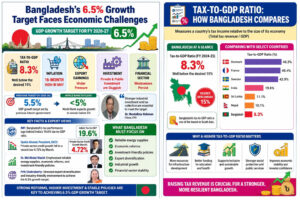
Against the backdrop of multifaceted domestic economic crises and escalating global geopolitical uncertainties, the Government of Bangladesh has set a highly ambitious GDP growth target for the upcoming fiscal year 2026-27. Standing firm in the face of adverse conditions, the government has projected this growth rate at 6.5 percent in its latest budget. However, the country’s economists and business leaders believe that merely setting a target is not enough; achieving it under current circumstances will require major structural reforms and a rapid revival of private sector investment.
For the readers of Pressenza- a global medium and voice for international peace, nonviolence, and human rights- the key dimensions, challenges, and expert analyses of this budget projection are highlighted below:
The Multidimensional Crisis: Major Obstacles to Growth
Bangladesh has outlined this growth target at a time when its macroeconomic indicators are under severe strain. The primary economic bottlenecks include:
* Stagnation in Tax Collection: According to data from the International Monetary Fund (IMF), a sharp decline was observed in tax revenue performance during FY2024-25. Currently, Bangladesh’s tax-to-GDP ratio remains stagnant at just 8.3 percent, whereas a minimum benchmark of 15 percent is considered necessary for a sustainable and self-reliant economy. In comparison, neighboring India boasts a ratio of nearly 19.6 percent, highlighting the stark institutional weakness in Bangladesh’s revenue sector.
* Persistent Inflation and Constrained Domestic Demand: Although inflation has eased slightly from its previous double-digit peaks, it remains elevated enough to severely constrain the purchasing power of ordinary citizens and domestic demand. In May, inflation hit its highest level in 16 months, further discouraging the private sector from committing to new investments.
* Rising Investment and Production Costs:** Industrial producers are struggling as the costs of electricity, gas, transportation, and raw material imports continue to spiral upward. Business leaders warn that these escalating production expenses are eroding the country’s competitiveness in international markets. This is compounded by high borrowing costs and acute liquidity pressures within the banking sector.
Global Uncertainty and Forecasts by International Agencies
Beyond domestic hurdles, the volatile global geopolitical landscape is putting Bangladesh’s high aspirations to a rigorous test. Ongoing tensions in the Middle East- particularly the Iran-Israel conflict- have intensified volatility in international energy markets, dealing a heavy blow to import-dependent economies like Bangladesh.
Due to this fragile global environment, the World Bank expects international markets to remain subdued next year and forecasts that Bangladesh’s economy is likely to expand by less than 5 percent. Notably, the country’s previous interim administration had targeted a GDP growth of 5.5 percent for the fiscal year 2025-26. However, actual GDP growth in FY2024-25 plummeted to just 3.49 percent. Jumping from that baseline to a 6.5 percent target presents a massive psychological and practical hurdle.
Observations from Experts and Business Leaders
This budgetary projection has drawn mixed reactions from the nation’s leading policy researchers and business representatives:
Dr. Mostafizur Rahman (Distinguished Fellow, CPD): ‘The economy is facing renewed pressures from geopolitical uncertainty in the Middle East. Even in this environment, the government has set an ambitious growth target. Achieving it will require stronger industrial investment and improved tax collection. Whether such improvements can materialise under current conditions remains highly uncertain.’
Dr. Md. Abdul Mazid (Former Chairman, NBR): ‘Budget projections should be viewed as indicative roadmaps rather than guaranteed outcomes. If 70 to 80 percent of the revenue and expenditure targets are achieved, reaching the projected growth rate may still be possible. However, questions remain about the realism of those assumptions. Achieving it requires more than announcements; ensuring a reliable gas and electricity supply, keeping lending rates reasonable, and simplifying the tax system will be critical.”
Taskin Ahmed (President, DCCI): ‘By March, private credit growth had fallen to a record low of 4.72 percent. A major reason for this is that government borrowing from the banking system has crowded out private sector lending. Amid high inflation, energy shortages, and liquidity pressures, achieving a 6.5% growth rate will be exceptionally challenging.’
Pressenza Editorial Analysis
While economic growth is indispensable for building a welfare-oriented and inclusive society, such growth must be sustainable and conducive to generating meaningful employment for citizens. Although Bangladesh’s 6.5 percent growth projection signals confidence in its economic future, the lived realities of ordinary citizens and industrial entrepreneurs tell a different stories.
Without fundamental reforms- such as addressing vulnerabilities in the banking sector, curbing corruption, easing credit access for small and medium enterprises (SMEs), and ensuring robust energy security- this paper’s target will fail to bring tangible changes to human lives. Ultimately, it is not the grandeur of the target’s ambition but the honest and effective ‘implementation’ of policies that will determine whether Bangladesh can successfully navigate this economic storm.
##########
The Writer:
 Asif Showkat Kallol: Works for a German-based online outlet, The Mirror Asia, as Head of News and is a Contributor at Pressenza- Dhaka Bureau.