by Maruf Ul Alam (Dhaka Bureau)
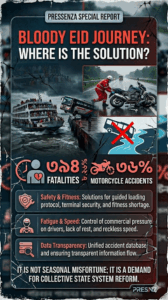
In Bangladesh, a densely populated South Asian nation, the joy of the Eid-ul-Fitr festival has once again turned into profound grief. A harrowing statistic covering a 15-day period from March 17 to March 28 reveals that approximately 394 people lost their lives in accidents across roads, rails, and waterways. According to independent monitoring organizations, this massive loss of life is not merely a series of ‘accidents,’ but rather a reflection of structural failures and long-standing mismanagement within the transport sector.
According to the latest report by the Bangladesh Jatri Kalyan Samity (BJKS), 394 people were killed and 1,288 injured in 377 accidents over 15 days during this Eid journey. However, a significant gap exists between government and private data.
Government Data: Typically prioritizes police-recorded incidents or immediate major casualties.
Private Monitoring: Includes data from hospitals, regional media, and deaths occurring during subsequent treatment, resulting in a wider scope.
Experts believe this division of data serves as a major obstacle to formulating effective national policies.
A Symbol of Systemic Failure: The Daulatdia Tragedy
On March 26, a passenger bus lost control while boarding a ferry at the Daulatdia ferry terminal in Rajbari and plunged into the Padma River. According to international news agencies Reuters and AP, at least 26 people perished in this incident.
This tragedy was not solely due to driver error. It points directly to:
1. Lack of adequate safety barriers at ferry terminals.
2. Absence of guided loading protocols.
3. Deficiencies in vehicle fitness.
The question of how a bus loaded with passengers could plunge directly into the river at a high-risk point has now become a central concern for national safety.
Key Drivers of the Crisis
Analysis shows several critical factors contributed to this year’s carnage:
The Motorcycle Menace: Motorcycles accounted for 36.12% of total accidents. High speeds and riding without helmets have turned these vehicles into ‘death traps.’
Mixed Traffic on Highways: Frequent collisions occur on national highways due to the simultaneous movement of high-speed buses alongside slow-moving battery-run rickshaws and easy-bikes.
Driver Fatigue: Driven by the hope of extra profit during the Eid season, drivers are taking back-to-back trips without adequate rest, exponentially increasing the risk of accidents.
Institutional Weakness and Lack of Accountability
In a press conference held in Dhaka on Monday, Mozammel Hoque Chowdhury, Secretary General of BJKS, alleged that government monitoring has weakened due to the monopolistic influence of transport owner associations and labor federations. He noted that the formation of Eid management committees without passenger representatives has led to increased fare anarchy and chaos compared to previous years.
The Path Forward: A ‘Safe System Approach’
Security analysts argue that to prevent this mass death during Eid journeys, Bangladesh must adopt a ‘Safe System Approach.’ This philosophy acknowledges that humans may make mistakes, but road infrastructure, vehicle fitness, and emergency medical services must be designed so that those mistakes do not result in fatalities.
The transport system, known as Bangladesh’s lifeline, is now a name of terror for the common people. When millions return home for their roots during festivals, returning as corpses due to state mismanagement is unacceptable. Unless accountability is ensured, this ‘Bloody Eid Journey’ will remain nothing more than an annual statistic.