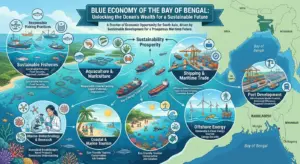
The Bay of Bengal is emerging as a frontier of economic opportunity for South Asia. Rich in marine resources, fisheries, biodiversity and maritime trade routes, it offers enormous potential for sustainable development. For Bangladesh, whose southern boundary opens onto this vast body of water, the blue economy represents a promising pathway to economic growth, employment generation and a prosperous maritime future.
The blue economy refers to the sustainable use of ocean and marine resources for economic growth, improved livelihoods and employment while preserving the health of marine ecosystems. It encompasses fisheries, aquaculture, shipping, port development, coastal tourism, offshore energy and marine biotechnology.
A Sea of Opportunities
Bangladesh’s maritime prospects gained greater significance following the peaceful settlement of its maritime boundary disputes with Myanmar in 2012 and India in 2014. These settlements clarified the country’s maritime boundaries and strengthened its rights to explore and manage marine resources. The challenge now is to transform these opportunities into tangible economic benefits.
Fisheries remain a major pillar of the blue economy. The Bay of Bengal provides fish, shrimp, crabs and other marine products that support food security, employment and export earnings. Modern fishing technology, sustainable aquaculture, improved fish processing and efficient cold-storage facilities could increase productivity and reduce post-harvest losses. Developing seaweed cultivation and other forms of marine farming could also diversify coastal livelihoods.
However, overfishing, illegal fishing and the capture of juvenile fish threaten marine resources. Scientific fisheries management, effective monitoring and protection of breeding grounds are essential to ensure that the ocean remains productive for future generations.
Maritime Trade and Port Development
The Bay of Bengal connects South Asia with Southeast Asia and major international markets. Its strategic shipping routes make it vital for global trade and regional connectivity. For Bangladesh, modernising ports and improving maritime transport could reduce trade costs, attract investment and strengthen export competitiveness.
Chattogram and Mongla ports play important roles in the country’s economy, while developments involving Payra and Matarbari offer further opportunities to expand maritime infrastructure. Efficient port management, improved transport links and modern navigation systems could help Bangladesh become a regional trade hub.
Regional cooperation among Bay of Bengal countries could further promote shipping, commerce, maritime safety and shared economic growth.
Offshore Energy and Marine Tourism
The Bay of Bengal also offers opportunities for offshore natural gas exploration and renewable energy development. Offshore wind, tidal and wave energy could contribute to energy diversification where geographical and technical conditions are favourable. Realising this potential will require advanced technology, investment, skilled professionals and careful environmental assessment.
Meanwhile, coastal tourism offers another avenue for economic growth. Cox’s Bazar, Saint Martin’s Island and the Sundarbans attract visitors through their natural beauty and ecological significance. Responsible tourism can generate employment, support local businesses and encourage investment in coastal communities.
Marine biodiversity may also provide opportunities for biotechnology, including research into pharmaceuticals, cosmetics and other valuable products. Investment in oceanographic research and collaboration between universities and industries could help Bangladesh explore these emerging sectors.
Challenges Beneath the Blue Horizon
Despite its promise, the blue economy faces significant challenges. Marine pollution, plastic waste, inadequate infrastructure, limited technological capacity and weak enforcement of environmental regulations threaten its development. Climate change further intensifies coastal erosion, sea-level rise, ocean warming and the risks associated with cyclones.
Millions of coastal residents depend directly or indirectly on marine resources. Therefore, development must protect small-scale fishers, improve working conditions and provide alternative livelihoods when fishing restrictions are necessary.
Without effective planning, economic activities could damage the ecosystems on which they depend. Sustainable development must balance commercial interests with environmental protection and social justice.
The Way Forward
Bangladesh needs a comprehensive, science-based strategy to unlock the Bay of Bengal’s potential. Investment in marine research, modern fishing fleets, fish processing, port infrastructure and skilled human resources should be prioritised. Stronger pollution controls, sustainable fishing practices and the protection of mangroves and marine habitats are equally important.
The government should encourage private investment and technological innovation while ensuring transparency and environmental accountability. Cooperation through regional platforms such as the Bay of Bengal Initiative for Multi-Sectoral Technical and Economic Cooperation (BIMSTEC) can strengthen joint efforts in marine research, disaster preparedness, pollution control and maritime security.
Universities and technical institutions must also expand training in marine science, ocean engineering, fisheries management and renewable energy to prepare a skilled workforce for the future.