By Asif Showkat Kallol (Dhaka Bureau)
As the delicate balance between human civilization and nature rapidly unravels, the mighty Brahmaputra River– one of South Asia’s primary lifelines- is facing a catastrophic existential crisis due to climate change. Multiple recent scientific studies and international reports warn that the river’s water flow could decline drastically by the end of this century, triggering unprecedented droughts, acute food insecurity, and economic instability across the entire region.
The Drying Flow of the Brahmaputra: An Ecological Catastrophe
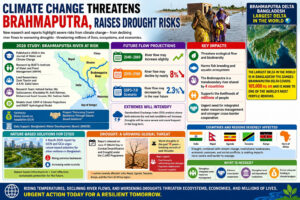
A new study conducted by a team of researchers from the Institute of Water and Flood Management (IWFM) at the Bangladesh University of Engineering and Technology (BUET) was recently published in the prestigious Journal of Water and Climate Change. Funded by the Global Center on Adaptation (GCA) and led by researcher Zarin Tasnim and Professor A.K.M. Saiful Islam, the study paints a grim picture of the Brahmaputra’s future.
Utilizing advanced ‘CMIP-6’ climate projections, the researchers demonstrated that while the river’s flow may see a temporary increase between 2040 and 2069, the average water discharge is projected to drop by approximately 8 percent between 2070 and 2100.
According to the Standardized Discharge Index (SDI), this decline will cause the severity and frequency of extreme dry spells and droughts to multiply. Furthermore, a reduction in the river’s ‘ecological flow’ will severely disrupt fish breeding, threatening aquatic ecosystems and the livelihoods of millions who depend on the river. Given that the Brahmaputra is a highly sensitive transboundary river flowing through China, India, Bhutan, and Bangladesh, the researchers emphasized the urgent need for enhanced international cooperation and integrated water resources management to avert this disaster.
Concrete vs. Nature: The Battle for Urban Survival
Meanwhile, another joint report released by the International Union for Conservation of Nature (IUCN) and the GCA raises serious alarms over the future of South Asia’s rapidly expanding cities. The report, titled ‘Compendium on Nature-Based Solutions for Urban Resilience in Bangladesh,’ highlights that urban centers are increasingly suffering from extreme heatwaves and severe water scarcity due to climate change.
The core message of the report is unmistakable: relying solely on concrete “grey infrastructure” is no longer enough to save our cities. Building true climate resilience demands integrating natural systems- such as vegetation, wetlands, and urban forestry- into urban planning. Adopting these ‘Nature-Based Solutions’ is not only cost-effective but also vital for long-term environmental sustainability.
Drought: The New Enemy of the Global Economy and Human Security
This climate-induced crisis extends far beyond environmental degradation; it poses a direct threat to global economic stability and human rights. A recent report under the Climate Adaptation and Resilience (CLARE) Programme notes that the world is currently experiencing some of the most severe droughts in recorded history.
From India and Nepal to Uganda, Tanzania, Kenya, and nations across the Horn of Africa, regions are suffering record-breaking losses under persistent dry spells. The report clearly defines the evolving nature of this crisis:
• Drought is no longer just an environmental issue; it is actively driving global food insecurity, critical shortages of safe drinking water, mass population displacement, and severe economic downturns.
• Institutional weaknesses, social conflicts, and economic pressures are compounding the effects of climate change, making the crisis significantly harder to manage.
Pressenza’s Perspective: A Unified Approach is the Only Way Forward
These collective studies and reports present world leaders with a harsh reality. This climate battle cannot be won with technological fixes or concrete dams alone. It demands equitable international water-sharing treaties, adequate resource allocation for drought-prone zones in national climate budgets, and above all, a shift back to nature-based solutions.
The lives, economies, and futures of millions of people in South Asia now hang in the balance on the future flow of the Brahmaputra river and the swift, decisive action of global policymakers. Time is running out, and nature’s warning signs can no longer be ignored.
##########
The Writer:
 Asif Showkat Kallol: Works for a German-based online outlet, The Mirror Asia, as Head of News and is a Contributor at Pressenza- Dhaka Bureau.