The first article in a series exploring how the present political moment could become an opportunity to build a world free of nuclear weapons.
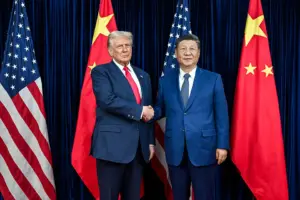
Much has been said about the meeting between Donald Trump, Vladimir Putin, and Xi Jinping in Shenzhen, China, on November 19. Political commentators have been busy trying to determine who won, who lost, and whether anything significant was accomplished. The meeting has often been discussed almost like a television show, with the public reduced to the role of spectators.
What if the most important outcome of this meeting is not what the three presidents accomplished, but what it has made possible?
Could President Trump use this opportunity to begin a historic process toward making the entire planet a Nuclear-Free Zone? And could American society help him make it happen?
The United States Has to Make the First Move
China has repeatedly expressed support for the complete prohibition and eventual elimination of nuclear weapons. But Beijing has also made its position clear: the United States and Russia, which possess by far the largest nuclear arsenals, must take the lead in making substantial reductions before China can be expected to participate in comparable negotiations.
This places a particular responsibility on Washington.
If President Trump wants to open the door to a broader international agreement, the United States must be prepared to initiate a concrete process of nuclear disarmament, beginning with Russia. This does not mean unilateral disarmament or abandoning national security. It means negotiating verifiable reductions while developing more reliable international security arrangements.
Trump has questioned the continued production of nuclear weapons. In February 2025, he declared, “There’s no reason for us to be building brand new nuclear weapons.”
Following the meeting in China on November 19, Trump acknowledged the difficulty of reaching an agreement. Speaking to Reuters, he said he would continue raising the issue “because it should be done, but it’s hard to do psychologically.”
Trump has expressed an interest in nuclear disarmament, but he also recognizes the obstacles. Could American society help create the political conditions that would allow him to move forward?
His relationship with Putin, however controversial, could provide an opening for negotiations that have remained stalled for years.
Could nuclear disarmament become the defining achievement of his presidency?
Breaking With the Past
Nuclear weapons belong to a technological and political vision developed in the middle of the twentieth century. Humanity has changed enormously since then, yet we continue to organize international security around the capacity to destroy entire cities and potentially civilization itself.
There is a historical precedent for changing direction. In 1985, Ronald Reagan and Mikhail Gorbachev affirmed that a nuclear war cannot be won and must never be fought. Two years later, they signed the Intermediate-Range Nuclear Forces Treaty, eliminating an entire category of nuclear missiles.
Today, the challenge is to go further: not simply reducing nuclear arsenals, but developing security arrangements that could eventually make nuclear deterrence unnecessary.
A Call for Support, Not Another Political Spectacle
Perhaps the most important way to understand the meeting in China is not as a political spectacle, but as a call for support.
The three presidents may have opened a door, but they cannot walk through it alone. Political leaders have the authority to negotiate agreements, but the public has an equally important responsibility to help create the conditions for their success.
If we believe in democracy, we must practice it—not simply by choosing our leaders, but by actively contributing to the future we want to build.
American society has enormous resources to contribute: scientists, military professionals, veterans, diplomats, universities, religious communities, journalists, educators, and organizations with decades of experience working for nuclear disarmament.
There are also younger generations whose future is being shaped by decisions they have had little opportunity to influence.
We are not asking young people to join an old struggle against nuclear weapons. We are inviting them to participate in opening a future in which nuclear weapons no longer have a place.
People with sharply different views of Trump and his administration can still work together toward nuclear disarmament. To let this opportunity pass because people who dislike Trump or oppose his agenda cannot bear to see him claim a win would be to let spite dictate the future of humanity. A president does not have to be universally admired to accomplish something of universal importance.
From Opportunity to Action
President Trump has an opportunity to initiate something that could change the direction of international relations for generations.
But the responsibility does not rest on his shoulders alone.
The United States must be willing to take the first step, and American society can help make that possible.
Can we encourage President Trump to take that first historic step? And what are we prepared to do to help him succeed?