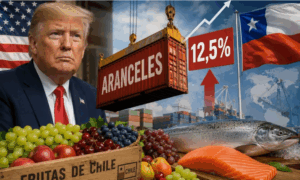
Chile cannot silently bow down to Trump because our dignity is non-negotiable. It must respond with wisdom, prudence, and unity.
In international law, treaties are upheld. Free trade agreements provide legal certainty, clear rules, and stability for investments. Chile, a small and serious country at the end of the world, has built its foreign policy on respect for international law. It is a state policy that transcends individual administrations. That is why Chile signed a Free Trade Agreement with the United States that took effect in 2004, convinced that both nations would respect the agreed-upon rules.
Today we see that, for the U.S. government, treaties are binding only as long as they serve its interests.
The Trump administration’s decision to impose 12.5% tariffs on most Chilean exports constitutes a new blow to that principle. Last year, it had already imposed 10% tariffs, but when the U.S. Supreme Court ruled that it lacked the authority to do so, it simply sought a new “legal” basis to impose an even higher tariff.
What is most revealing is not the tariff itself, but its selectivity.
Washington imposes tariffs on products where the cost to its economy is minimal, but excludes precisely those it considers strategic for its industrial and military development, such as copper and lithium. The conclusion is clear: this is not a policy motivated by a genuine concern over human rights violations through forced labor. It is a policy based exclusively on U.S. national interests.
And that is exactly what Chile should do: unapologetically defend its own national interests while respecting international law.
Canada, whose exports depended 75% on the U.S. market, quickly grasped this reality. Under the leadership of Mark Carney, the federal government and various provinces launched campaigns to prioritize the consumption of Canadian products, discourage tourism to the United States, remove U.S. products from their markets, and even debate restrictions on strategic exports such as electricity. It was not an irrational reaction. It was a demonstration of national dignity.
And Chile?
Today, our ruling class seems convinced that prudence lies in humbling ourselves in silence and waiting for the storm to pass. They confuse diplomacy with resignation and submission.
It is time to respond and open a discussion so that all of Chile stands behind the decision we make, just as happened in Canada. Even more difficult times may lie ahead, but national dignity takes precedence.
If the United States effectively disregards the Free Trade Agreement, Chile also has the right to review its economic relationship with that country.
I propose that, starting now, we prioritize the consumption of Chilean products or those from countries that respect their international commitments. Let’s stop buying hamburgers at McDonald’s, chicken at KFC, or pizzas at Pizza Hut or Papa John’s. Let’s avoid traveling to Miami or New York and refrain from using their commercial airlines. Will we be able to do this?
And let’s begin to explore tax mechanisms or export tariffs on strategic minerals destined for the U.S. market as long as measures that harm our exports remain in place.
Every major power defends its national interests. What is incomprehensible is that some would have Chile be a country that refuses to defend its own.
This is not about being against the United States. Chile and the United States have a long history of cooperation that must continue. But friendship between nations cannot be built on the humiliation of one of them.
Great powers respect those who respect themselves. President Ricardo Lagos demonstrated this by opposing the war in Iraq at the United Nations Security Council. Chile was respected precisely because it defended its convictions.
Today I ask whether Chile’s leadership will have the courage to defend national sovereignty with the same conviction with which other countries defend their own.
A country that accepts being humiliated in silence in the face of a treaty violation ends up sending the worst possible message: that its sovereignty is also up for renegotiation.
Sovereignty is not an empty word uttered in speeches on September 18 or in the State of the Nation Address on June 1. It is a matter of everyday conduct. It is exercised when a country dares to defend its interests and when its citizens are willing to prioritize the consumption of Chilean products or those from countries that respect their international commitments.
Chile cannot silently submit to Trump. Our dignity is non-negotiable. It must respond with wisdom, prudence, and unity.