By Asif Showkat Kallol (Dhaka Bureau)
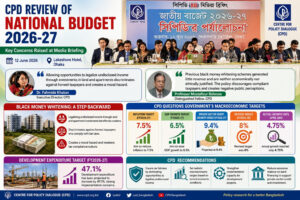
The Government of Bangladesh has decided to retain controversial provisions allowing the legalization of tax-evaded and illegally earned wealth- commonly known as ‘black money’- in its proposed national budget for the 2026-27 fiscal year. Leading civil society organizations and independent economic think tanks have fiercely criticized the move, labeling it ‘unethical’ and a ‘violation of tax justice.’
At a press conference held in Dhaka, the Centre for Policy Dialogue (CPD), one of South Asia’s most prestigious economic research organizations, expressed deep concern over the budget proposals. The think tank stated that this policy is equivalent to punishing honest, law-abiding taxpayers and is creating a profound ‘moral hazard’ within the country.
Discrimination Against Honest Citizens and Institutional Immorality
From the perspective of international human rights and social justice, this decision is being viewed as deeply discriminatory. According to the proposed law, individuals can bring undisclosed income into the formal economy by making large-scale investments in the housing sector, such as purchasing land or apartments.
Dr. Fahmida Khatun, Executive Director of CPD, voiced a strong protest against the decision- ‘If these opportunities remain in place, they create clear discrimination against honest taxpayers. There is no moral justification for such measures, and they will encourage citizens to evade taxes regularly.’
Critics argue that repeated amnesties and incentives are breaking the backbone of the country’s overall tax culture and eroding public confidence in the state’s economic framework.
Economic Ineffectiveness and Political Expediency
An analysis by Pressenza regarding the economic efficacy of this policy reveals that although the Bangladesh government has offered several opportunities to whiten black money in the past, these measures have failed to add significant revenue to the state exchequer.
Professor Mustafizur Rahman, Distinguished Fellow at CPD, told reporters that the decision is flawed from three perspectives: economic, ethical, and political.
‘Economically, there is no justification for this step because the government has received very little revenue from such initiatives in the past. Politically, it is impossible to defend, as it effectively rewards corrupt individuals and tax evaders, sparking intense resentment among the general public.’
Macroeconomic Targets vs. A Harsh Reality
Beyond the black money controversy, experts describe the primary macroeconomic targets for the 2026-27 fiscal year as ‘ambitious and unrealistic. Amid a global economic slowdown and local crises, the government aims for the following in the coming fiscal year:
* Reducing inflation to 7.5%.
* Achieving a GDP growth rate of 6.5%.
However, analysts warn that unrestrained government spending could further drive up commodity prices, potentially sabotaging the inflation control target. Furthermore, if the government becomes overly reliant on commercial banks to fund the massive budget deficit, it will severely “crowd out” credit flow to the private sector. While actual private sector credit growth was only 4.75% as of April this year, the 9.4% target for next year is being viewed as purely imaginary.
Similarly, while the development budget projects a massive 47.1% growth, significant questions remain regarding the implementation capacity of the country’s current bureaucratic and institutional structures.
Pressenza’s Take
Transparency in the tax system is a fundamental prerequisite for building a sustainable and equitable society. The proposed 2026-27 budget for Bangladesh could have been a major opportunity to restore economic stability. However, the tendency to protect special interest groups and patronize black money over meaningful economic reform may push the country further away from balanced economic development and social justice.
For the general public of Bangladesh, who are already suffering from widening economic disparity, this budget has brought more anxiety than relief.
##########
The Writer:
 Asif Showkat Kallol: Works for a German-based online outlet, The Mirror Asia, as Head of News and is a Contributor, Pressenza- Dhaka Bureau.