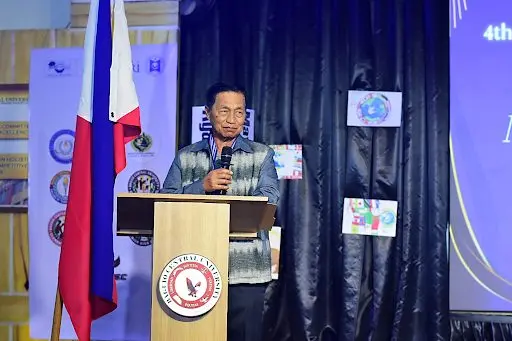

Keynote Address on Peace and Integral Regeneration: Congressman Atty. Mauricio Domogan addresses university officials, World March for Peace delegates, faculty, peace advocates, and students at Baguio Central University during the 4th World March for Peace and Integral Regeneration with ASEAN Festival. In his speech, he highlighted the vital role of education and core institutional values in cultivating a lasting culture of peace across communities and nations. Photo Credit: Erwin Escalada.
Keynote Message of Congressman Atty. Mauricio “Morris” G. Domogan
Hon. Officials of Baguio Central University; members of the board of trustees and university administration; our distinguished faculty and academic leaders; our peace advocates, community leaders, and partners in this gathering; our friends and guests from ASEAN and from different parts of the world; and most especially, to the students of Baguio Central University, good day to everyone.
It is a privilege to stand before you today as we gather for the 4th World March for Peace and Integral Regeneration with ASEAN Festival.
I am deeply grateful and honored by the invitation you extended to me to serve as your guest of honor and keynote speaker.
Let me begin with a few questions.
Why was Nelson Mandela willing to spend more than 27 years in prison for the cause of freedom?
Why did Dr. Jose Rizal walk toward his execution knowing that his life would be taken, yet still choose to face it with courage?
Why have men and women throughout history been willing to suffer, and even die, for justice, equality, dignity, and peace?
And why did Jesus Christ say: “You shall know the truth, and the truth shall set you free.”
What is it about these ideals—justice, liberty, equality, and truth—that has moved human beings to sacrifice comfort, security, and even life itself?
I believe the answer is simple, but profound: because there are values that become greater than the individual who carries them.
People may be imprisoned. People may be silenced. People may even die. But the longing for justice, liberty, dignity, and truth does not die so easily.
That is why gatherings such as this matter.
Today, people from different cultures, nations, and backgrounds have gathered
Around one aspiration, one longing, one desire, and that is peace.
And when people from different cultures and different histories gather beneath one word—peace—the distances between us begin to reveal what we have in common.
A march for peace is therefore a movement of hearts and convictions, a collective affirmation that the world we hope for is a world worth working for.
Every step expresses that hope. Every voice gives it greater strength. And when the march reaches its destination, the journey toward peace continues in the lives we touch and the communities we help shape.
This is where I find particular meaning in Baguio Central University’s four core values: justitia. Libertad. Equitas. Veritas (justice. Liberty. Equity. Truth).
These are not simply admirable words. They are four pillars upon which a culture of peace may stand.
 Participants gather for the 4th World March for Peace and Integral Regeneration with ASEAN Festival at Baguio Central University, led by emcees Mr. Charles Pineda and Ms. Josefa Dampalig. Photo credit: Dr. Altea Ramos.
Let us begin with justitia.
Peace requires us to confront injustice without becoming unjust ourselves.
That is not always easy.
When people are hurt, anger can feel like justice. When people are wronged, revenge can appear to offer satisfaction.
But history teaches us that one injustice answered by another does not create peace. It only extends the wound.
A wound can produce wisdom, or it can produce another wound.
Justice, therefore, requires something deeper: the courage to uphold what is right even when doing so is difficult.
After many years in public service, i have come to appreciate that institutions do not become strong simply because they possess authority. They become strong when people can trust them. And when justice is absent, resentment grows. Where resentment takes root, peace becomes difficult to sustain.
 Congressman Atty. Mauricio Domogan exchanges warm greetings and ideas with visiting peace advocates and humanists from Manila—Mina Tecson, Willa Tecson, Carmen Cabling, and Karina L. Santillan—highlighting the spirit of unity and cross-regional collaboration at the 4th World March for Peace and ASEAN Festival. Photo: Jojo Hubo.
Then comes Libertad (liberty).
Justice safeguards human dignity and protects the rights of every person. Liberty
Gives those rights room to breathe and gives people the freedom to shape their own lives.
 Building bridges for peace: Baguio Central University spearheaded the 4th World March for Peace and Integral Regeneration last October 3, 2026, in Baguio City, Philippines.
Freedom, however, also carries responsibility.
The freedom to speak must be accompanied by the willingness to listen. The freedom to disagree must leave room for respect. And the right to defend one’s convictions must never diminish the dignity or conscience of another.
That principle acquires particular meaning in a university.
A university is one of the few places in society where differences of thought are not something to be eliminated, but something to be examined.
Here, ideas meet ideas. Convictions encounter questions. Assumptions are tested against evidence. Perspectives are widened by the presence of others.
That is one of the quiet strengths of higher education: it creates a space where disagreement can deepen understanding rather than diminish respect.
Unity does not require uniformity. It requires the maturity to remain connected even when our convictions lead us along different paths.
 Supporting peace and integral regeneration: Congressman Mauricio Domogan joins BCU administrators Dr. Elma D. Donaal, VP Amalia Ancheta, and Dr. Genevieve B. Kupang alongside student-participants during the 4th World March for Peace and Integral Regeneration.
Then we come to equitas (equity).
If peace is to endure, the opportunity to live with dignity cannot belong only to those who already possess privilege, influence, or resources.
Education has a profound role to play here.
A young person who receives a good education gains possibilities—a wider horizon, a greater capacity to participate, and a stronger voice in shaping the future.
This is why the mission of Baguio Central University extends well beyond the conferral of degrees.
Education can become a bridge between potential and opportunity. And when education unites knowledge with character, freedom with responsibility, and ambition with service, it becomes a force for peace.
Our country recognized the importance of this when Executive Order No. 570 institutionalized peace education in basic education and teacher education.
The peace we hope to inherit tomorrow must be cultivated in the minds and hearts of the young today.
And that is precisely why this gathering matters. In bringing generations, cultures, and nations together under a common aspiration, this event becomes part of the foundation upon which a more peaceful society can rise.
 Standing and sitting together for a cause: Baguio Central University (BCU) Master of Public Administration (MPA) students clad in their 4th World March for Peace and Nonviolence t-shirts.
And then there is veritas (truth).
I believe truth may be one of the most important foundations of peace in our time.
A falsehood can travel across continents in seconds, while truth often requires evidence, patience, and scrutiny before it can be established. A distorted image can reach millions. A fabricated story can be repeated so many times that familiarity begins to masquerade as truth.
And when people no longer know what to believe, trust begins to weaken.
That is why the words of Jesus remain remarkably relevant: “You shall know the truth, and the truth shall set you free.”
Truth is a condition of peace. It allows dialogue to begin from reality rather than deception. It allows disagreement to remain honest. And it allows people to correct themselves when facts require them to do so.
Perhaps the greatest intellectual courage lies in being willing to change one’s mind when truth gives sufficient reason to do so.
For the young people gathered here, that responsibility will become even more important in the years ahead.
Your generation will live in a world where information is abundant, but wisdom will still require discernment.
And so, veritas is not simply about knowing facts. It is about respecting truth enough to seek it, examine it, and live by it.
 Good knowledge leads to justice. Good knowledge leads to dialogue and reconciliation… Baguio Central University supports the Ethical Commitment, empowering students, faculty, and leaders to use their knowledge for a just, peaceful, and sustainable world. #BCU #EthicalCommitment #SustainableFuture.
When we place these four values together, something important emerges.
Justice restrains power. Liberty gives people a voice. Equity widens the circle of opportunity. And truth gives us common ground on which dialogue remains possible.
 4th WMPIR participants in prayer for peace. We are stronger together, and our shared values will guide us as we navigate the challenges and opportunities ahead. Today, we reinforce the foundation of trust upon which our work is built. #Reflection #SharedValues #TrustAndIntegrity #StrongerTogether.
Together, they form a culture in which peace can take root.
And this is where integral regeneration finds its human meaning.
Regeneration is the work of restoring what has been broken and breathing new life into what has become tired, divided, or diminished.
A community is regenerated when trust is restored. A relationship is regenerated when people choose reconciliation over resentment. A society is regenerated when institutions recover integrity and citizens recover hope.
That kind of regeneration cannot be achieved by governments alone.
It requires people. It requires communities. It requires schools. It requires families.
It requires each generation to decide what kind of society it wishes to inherit and
What kind of society it is willing to leave behind.
And this is where our beloved City of Baguio has something important to contribute.
This city has long been a meeting ground—not because differences disappear here, but because people carrying different histories and identities have learned to share the same civic space.
There is wisdom in that experience.
Identity does not have to become isolation. Heritage does not have to become exclusion.
Difference, when met with respect, can become a source of enrichment rather than division.
That, too, is a form of peace—not the silence of sameness, but the harmony of difference.
 Members of the organizing team of the 4th World March for Peace and Integral Regeneration: Marga Taganas, MBA (Canva presentation designer), Genevieve B. Kupang (Lead Organizer), and Dr. Shamany Lokines (Awarding of Certificates to guests).
The same lesson is visible in our ASEAN community.
Our region is a tapestry woven from many histories—different languages, traditions,
Faiths, political experiences, and ways of understanding society and community.
Yet we continue to search for ways to live in the same neighborhood of nations.
That requires patience. It requires diplomacy. It requires restraint. And it requires the recognition that cooperation does not demand that we erase our differences.
I am convinced that we do not have to become the same in order to walk in the same direction.
That is one of the quiet lessons of this ASEAN festival.
The world does not become richer when every voice sounds alike. It becomes richer when different voices learn how to create harmony without surrendering their identity.
And today, as we hear solidarity messages from Europe, North America, Latin America, Africa, Australia, and Asia, we are reminded that the longing for peace crosses borders.
The accents may differ. The histories may differ. The circumstances may differ. But the aspiration is familiar:
A world where human dignity is not negotiable. A world where justice is not selective. A world where freedom is not reserved for the powerful. A world where truth is not sacrificed for convenience.
The messages may come from distant continents. Yet the responsibility they affirm ultimately rests upon the choices we make in our own homes and communities.
And this brings me to a thought I would like to leave with you:
Governments must protect it. Institutions must embody it. Schools must nurture it. Families must practice it. And individuals must choose it.
The real measure of this gathering will not be the number of people who marched today. It will be what happens after we return to our ordinary lives.
 Baguio Central University administrators and faculty present a Certificate of Appreciation and a token to Hon. Atty. Mauricio Domogan during the 4th World March for Peace and Integral Regeneration. Present with him are (L-R) VP for Finance Amalia Ancheta, VPAA Dr. Elma D. Donaal, Dean & IRO Dr. Genevieve B. Kupang, CTELA Dean Dr. Lourdes Trajano, and Graduate School faculty members Dr. Lourdes Eguia and Dr. Avilardo Leon.