Watchdog group urges duty-bearers to ensure children’s right to non-hazardous toys is upheld
27 November 2025, Quezon City. As the National Children’s Month is observed and as Christmas gets closer, the EcoWaste Coalition appealed to all sectors to take steps to ensure children’s safety from dangerous toys during the gift-giving season.
Dangerous toys, the group pointed out, pose risks of choking, laceration, strangulation, burns, injuries to the eyes, ears and other body parts, and exposure to hazardous chemicals such as heavy metals like lead and cadmium.
All children are highly vulnerable to dangerous toys as their brains and bodies are still developing, and are not able to assert their rights as young consumers, the group said. Children living in poverty may face higher risks due to their families’ lack of access to toys of good quality and to redress mechanisms, the group observed.
Duty-bearers, toy manufacturers, toy importers, toy retailers and toy regulators in particular, are duty-bound to implement quality and safety standards that will honor and uphold children’s right to safe and non-toxic toys, the group emphasized.
Periodic test buys conducted by the EcoWaste Coalition since 2011 indicate that many toys have not undergone quality and safety assessment and may present potential hazards to children, particularly if used without close adult supervision.
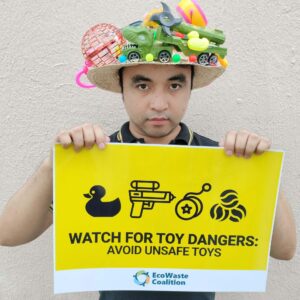
The EcoWaste Coalition urges consumers to watch out for toy hazards during the Christmas gift-giving season.
To keep children safe from dangerous toys, the group has again shared some tips on choosing child-friendly toys that can contribute to their full development instead of jeopardizing their health and future.
Gift givers are requested to consider the following tips when purchasing toys for children:
- Check the product label for the age suggestion, warnings and usage instructions; manufacturer’s markings; and the FDA-issued license to operate (LTO) number.
- Buy from legitimate sources and keep the proof of purchase to facilitate replacement, refund or warranty claim if needed.
- Look for toys that are suitable for the child’s age, aptitude, skill, and temperament, follow the age recommendation, and check for potential hazards.
- Avoid small toys and those with detachable parts that can pose choking risks.
- Avoid toys that can easily break into small parts or with small unsecured components like button cell batteries that may be ingested or placed in the nose or the ears.
- Avoid painted toys unless the paint used is certified lead-safe.
- Avoid toys made of polyvinyl chloride (PVC) plastic as they may contain toxic plasticizers called phthalates and other hazardous chemicals such as cadmium and lead.
- Avoid art toys and toy cosmetics that are not verified as non-toxic.
- Avoid play sands unless certified safe from asbestos.
- Avoid toys that shoot small or pointed objects into the air that may cause eye or body injuries.
- Avoid toys with sharp edges or points that may bruise or cut a child’s sensitive skin.
- Avoid toys with cords or strings longer than 12 inches that may get tangled around the neck and suffocate the child.
- Avoid toys that create excessive noise, which can damage a child’s sensitive hearing.
- Avoid stuffed toys with buttons or eyes that may be pulled loose and get swallowed by a child, as well as those with pellet-like stuffing that may get into a child’s hand and mouth when the toy breaks open.
- Avoid toys that tend to induce aggression and violence such as toy guns, toy knives and other toy weapons.
The EcoWaste Coalition will issue further consumer guidance during the holiday season on how adults can protect the children from dangers lurking in some toys.