Last year we covered the protest movement by Serbian students against a corrupt political class and President Vučić, which involved not only young people but also enjoyed broad support amongst the population. It all begun two years ago in Novi Sad, when the canopy of the newly built railway station collapsed, killing sixteen passers-by.
Since then, the protests have continued, with a new development that could radically change the situation: the Student List is challenging Vučić’s Serbian Progressive Party in the snap elections on Sunday 25 October and, according to the latest polls, could win. We discuss the situation with Miloje Savić, a Serb living in Brussels who is currently in Belgrade to vote and act as an observer.
What is the connection between the protest movement and the Student List?
The Student list sprout out of the protest movement. Almost two years ago the movement was really about asking for accountability for collapse of the canopy at the railway station in Novi Sad that on the 1st November 2024 killed 16 people. As of today, not a single person have been brought to justice. What is even more disturbing is that now former president of the Republic, Aleksandar Vučić, pardoned 49 people on his last day in the office (he resigned on 27 September after calling for early elections on 9 September). Until today we do not know who are these people, but we suspect that some of them are those high ranking officials in the government who were implicated in the case and against whom Higher Public Prosecutor’s Office was conducting investigations.
After institutional silence, it was obvious that government has no intention to address students’ demands on accountability, rule of law and independent work of institutions, so the movement moved to the next stage of fight for justice. It was sometime in late sping / early summer last year that students moved into a direct political force by formally demanding snap elections, which eventually paved the way for the creation of what we call today Student list.


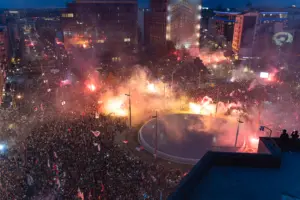
Rally on October 22nd in Belgrade
What are the main points of its election program?
The Student list has outlined a plan, which has 11 major points grouped around 4 major themes: 1) anti-corruption and institutional accountability, 2) social and economic reform, 3) media freedom and constitutional rule, 4) statehood and non-alignment policy.
In simple terms, The Student List is fighting for basic democratic values that former president Aleksandar Vučić and his loyal clique has dismantled and ridiculed for the past 14 years they were in power. We have been a State on the accession path to EU membership, but with SNS the government was doing everything in their power actually not to move along it by eroding every single value the EU stands for.
The student movement in Serbia preceded the youth protests that are now sweeping across France, Spain, Albania and Italy. In your opinion, are there any similarities between their demands?
Yes, I think we can identify some uniting points that all these movements accross the continent have in common. First, and very obvious, is the generation: these are all young people born in the 21st century. Second, they are very tech-savy, sometimes I think they really live the on-line reality. Third, we underestimated them; we underestimated how much they do care about their environment, their country and their society. Because their reality is in virtual space it was easy to think that this generation is not interested in the ordinary issues, but they proved us wrong: they are very much sensitive to injustice, inequality and unequal opportunities.
Even though the igniting spark may be different – a canopy collapse in Novi Sad in Serbia, shady deals around protected national parks land in Albania, educational and economic disparities in France and Italy – this generation is ultimately fighting for the same values. In my view those narrow down around accountability of individuals and institutions, generational equity, digitalized democracy (they shifted the discussion arena from TV studios and newspress to Instagram and TikTok), justice for environment and climate. We have to confront the reality of the devastated planet we are leaving to them as our generations’ defining legacy.


Welcome party for the students who have travelled more than 200 kilometres to reach Belgrade.
What possibilities do you see after the elections?
Swipping election victory is something we all wish for; to finish with the SNS regime and restart the institutions and the State again. I say again because we had similar situation in 2000 and we lived in a democratic country for a while (or as democratic as it could be after a decade of civil wars of former Yugoslavia); after that was only downhill. However, I’m worried that the succession of power won’t go smoothly.
Voting engineering is already in full progress. Diaspora was put under unfair election terms: either the poll stations were not open, leaving hundreds of citizens without possibility to vote like in Vancouver, Canada, or they will have to travel hundreds or thousands kilometres to the nearest station, like from Miami to Washington (distances in Canada are even larger), or simply the voting stations were not even open, like in Abu Dhabi, Doha, Slovakia or Romania, and all those posts had voting station during the last elections in 2023. Not to mention the latest obstacle that all across the world citizens will have to vote according to Belgrade time, so imagine someone in Bejing, New York, or LA who must go to poll stations after midnight according to local time. But diaspora is very inventive – some will organize a pijama party and go to vote.
This attemp to deny us constitutional rights had the result to unite diaspora even further. In addition, it was reported that more than 200,000 new IDs were issued, but no one knows who are these new citizens. Apparently unified voter register in Serbia has more registered voters than official number of citizens with the right to vote. Another common engineering technique was “phantom voters” (deceased are regularly misused for voting). Reports are already emerging from smaller towns across Serbia indicating that ballot papers and boxes are being swapped, with criminal tampering of election materials currently underway ahead of election day.
On a more realistic scenario, it is possible that both lists, Student and SNS, will claim victory on 25 October, after which we are facing a long stand off, possibly recounting every single vote. By prolonging and overturning the election, the regime will probably resort to tactics of attrition because they have enormous resources and have captured all institutions.
I am afraid that when we gather on the night of the 25th at the building of the Republic Election Commission (RIK in serbian), in Belgrade, which is announcing the election results, there will be riots and provocations on their part, because the RIK is located in the building of the National Assembly of the Republic of Serbia (the old Parliament) at the Kralja Milana street, right across from Pionirski Park, where an unhygienic paramilitary-mafia camp called “Ćaciland“ has been located for over a year. In claiming that outside and inside forces will stir unrest, the former president is simply laying the groundwork to disavow the very deeds he continues to inspire.
Photos by Miloje Savić