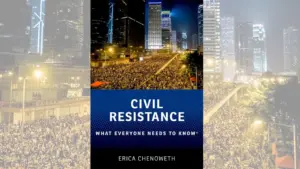
Life has likely not been easy for American scholar Erica Chenoweth since Trump’s rise to power: she is Harvard University’s first openly non-binary professor. Moreover, she conducts research on a topic that does not sit well with the political Right: civil resistance.
Her work was a major source of inspiration for the environmental movement Extinction Rebellion.(1) Early in her career, Chenoweth’s academic research focused on terrorism; at the time, she held the view that while violence rarely achieved the desired outcome, it was nonetheless unavoidable.
Challenged by proponents of nonviolence, she discovered that there was no valid data whatsoever on civil resistance. Through painstaking research, she and her colleagues subsequently examined all campaigns worldwide between 1900 and 2006 that involved at least 1,000 participants and aimed at systemic change—more than 200 of which used violence, while over 100 did not.
The surprising result: While only 26% of violent uprisings succeeded (and subsequently tended to lead to tyranny), 53% of nonviolent campaigns were successful—and these also tended to foster democratic structures. Furthermore, it emerged that every nonviolent campaign involving at least 3.5% of the affected population succeeded. She and her co-author, Maria J. Stephan, summarize their research findings in the book *Why Civil Resistance Works* (2), published in 2011. She subsequently expanded on this topic in 2021.
In *Civil Resistance: What Everyone Needs to Know* (3), she describes in detail the factors that determine the success or failure of nonviolent action. I was particularly struck by the case of West Papua (occupied by Indonesia), where decades of guerrilla warfare yielded no progress—resulting only in thousands upon thousands of deaths rather than independence. Yet civil resistance subsequently emerged, managing to wrest more concessions from the Indonesian regime in a short time than armed struggle had ever achieved. (4)
At the same time, however, Chenoweth notes that while nonviolent campaigns have become significantly more frequent since the 2010s, they are less likely to succeed than in the past. So, what is missing? She identifies four key factors: a lack of planning, organization, and participant training, as well as an insufficient effort to build the broadest possible base of supporters prior to attempting mass mobilization; a lack of momentum regarding growth and diversity, combined with the infrequent use of (general) strikes and civil disobedience; an over-reliance on the internet for organization; and, finally, a lack of adequate strategies to maintain unity and discipline. (5)
These are, for now, merely preliminary assumptions. According to Harvard University, Chenoweth is currently working on the book *The End of People Power*, in which she further analyzes the declining success of civil resistance over the past decade. We can certainly look forward to it. Unfortunately, while reading, I was repeatedly struck by the thought that it is not only the resistance activists who read her books, but also the dictators—who thus have all the time in the world to implement appropriate countermeasures. Perhaps, then, another factor she mentions is at least as crucial to the success of an uprising: remaining unpredictable! (6)
Footnotes:
[1] https://en.wikipedia.org/wiki/Erica_Chenoweth
[2] Erica Chenoweth, Maria J. Stephan: Why Civil Resistance Works: The Strategic Logic of Nonviolent Conflict. Columbia University Press, New York City 2011, ISBN 978-0231156837. In deutscher Übersetzung: Warum ziviler Widerstand funktioniert: Die strategische Logik gewaltfreier Konfliktbearbeitung, Nomos Verlag, Baden-Baden 2024, ISBN 978-3756018178, 57,24 Euro
[3] Erica Chenoweth: Civil Resistance: What Everyone Needs to Know. Oxford University Press, Oxford 2021, ISBN 978-0190244392, 56,74 Euro (Leider nur auf Englisch erhältlich, aber keine Angst, es liest sich sehr flüssig! Tipp: Via Fernleihe kostenlos in deine örtliche Bücherei bestellen.)
[ [[3] Erica Chenoweth: *Civil Resistance: What Everyone Needs to Know*. Oxford University Press, Oxford 2021, ISBN 978-0190244392, 56.74 euros (Unfortunately only available in English, but don’t worry—it reads very smoothly! Tip: Order it for free from your local library via interlibrary loan.)] ]
[4] Chenoweth 2021, S. 149. Siehe auch: https://wagingnonviolence.org/2016/02/uncovering-the-secret-history-of-struggle-in-west-papua/
[ [4] [4] Chenoweth 2021, p. 149. See also: https://wagingnonviolence.org/2016/02/uncovering-the-secret-history-of-struggle-in-west-papua/ ]
[5] Siehe auch: Agenda für Klimagerechtigkeit. Mit der Verschiebung der UN-Klimagespräche ergreift das Glasgow-Abkommen die Initiative zum Klimaschutz, Artikel von Andrea(s) Speck, in: GWR 453, November 2020
[ [5] See also: “Agenda für Klimagerechtigkeit. Mit der Verschiebung der UN-Klimagespräche ergreift das Glasgow-Abkommen die Initiative zum Klimaschutz” [Agenda for Climate Justice: With the postponement of UN climate talks, the Glasgow Agreement takes the initiative on climate protection], article by Andrea(s) Speck, in: *GWR* 453, November 2020.]
[6] Übrigens: Wer lieber Englisch hört statt liest, dem sei ein Vortrag Chenoweths aus dem Jahre 2012 empfohlen: https://alchetron.com/Erica-Chenoweth
[ [6] By the way: For those who prefer listening to English rather than reading it, a 2012 lecture by Chenoweth is highly recommended: https://alchetron.com/Erica-Chenoweth ]
Erica Chenoweth: Civil Resistance: What Everyone Needs to Know. Oxford University Press, 2021. 362 pages. Approx. 23.00 CHF. ISBN: 978-0190244422.