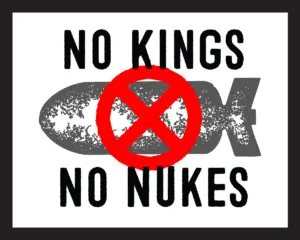
This article invites reflection on how the No Kings movement might move beyond a position of opposition to also become a space for developing constructive proposals—particularly around the role the United States could play in advancing global nuclear disarmament.
On November 19, in Shenzhen, China, the presidents of the United States, Russia, and China—three countries that together possess approximately 91% of the world’s nuclear weapons—met and discussed, among other issues, nuclear arms reductions. Although no concrete disarmament agreement emerged, the meeting offers an opportunity to reopen a discussion of fundamental importance to the future of humanity.
As discussed in the first article of this series, Can President Trump Save the World—If We Push Him to Do It?, President Trump has publicly expressed interest in nuclear disarmament while acknowledging the difficulties of negotiating such agreements. The question is whether American society can help create the conditions for concrete progress.
From Opposition to Proposition
The No Kings movement has demonstrated a capacity to bring people together around questions of democracy and political power. Could that same capacity also contribute to a discussion about the future of international security?
President Trump is in a position to initiate a process that could eventually free humanity from the threat of nuclear annihilation. Exploring this possibility would not require the movement to abandon its criticism of the administration. It would simply recognize that opposition to a president’s policies does not exclude the possibility of cooperation on an issue of common interest.
Reconnecting Generations
Among the Americans participating in today’s demonstrations are people old enough to remember, and in some cases to have participated in, the No Nukes movement that developed during the 1960s and 1970s and gained enormous visibility in the early 1980s.
That experience represents a valuable historical resource. But the objective today should not simply be to recreate the movement of forty or fifty years ago. We already know the dangers of nuclear weapons. What deserves greater attention now is the development of a credible strategy for eliminating them.
Such a strategy would need to address complex questions: how to initiate and sustain negotiations among nuclear powers, what security arrangements could eventually replace nuclear deterrence, and how scientists, military professionals, veterans, diplomats, and ordinary citizens could contribute to such a process.
This offers an opportunity to bring generations together, drawing on the experience of earlier movements while incorporating new perspectives and approaches to international security.
From Street Mobilization to a National Conversation
As winter approaches in the United States, mobilizing large numbers of people in the streets may become more difficult in some parts of the country. But the coming months could provide an opportunity to complement street mobilizations with another form of social participation: a broad national conversation through the media, online forums, interviews, and public exchanges.
Could the No Kings movement become a space for Americans from different backgrounds and generations to explore a strategy that would allow the United States to take the first concrete steps toward nuclear disarmament? The objective would be not simply to generate greater public awareness of the nuclear threat, but to explore a viable path toward overcoming it—a path capable of changing the face of humanity and opening new possibilities for generations to come.
We are not asking young people to join an old struggle. We are inviting them to participate in opening a new future.