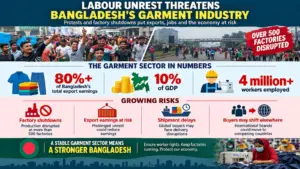
Weeks of worker protests demanding fair minimum wages and dignified working conditions have disrupted production and led to mounting factory closures across Bangladesh’s major industrial zones. The ongoing crisis has raised serious concerns over the country’s export earnings, the livelihoods of more than four million workers, and broader economic stability.
According to industry reports, more than 500 garment factories have faced production disruptions or closures in phases since late October. Workers have taken to the streets demanding wage increases aligned with rising living costs alongside safer workplaces, while labour leaders have warned that demonstrations will continue until authorities and factory owners reach a clear settlement.
The garment sector accounts for over 80% of Bangladesh’s total export earnings and roughly 10% of its gross domestic product (GDP). With more than four million workers relying directly on the industry to support their families, prolonged stagnation threatens not only foreign currency inflows and investment, but also the basic economic security of millions of households.
Dr Fahmida Khatun, executive director of the Centre for Policy Dialogue (CPD), noted that 15 days of protests, clashes, and shutdowns have placed the country’s primary export earner under severe strain. According to her, over 100 factories halted operations in a single day, preventing nearly 1.7 million workers from entering their workplaces. Even if normalcy returns immediately, she warned, the damage already incurred means export revenues will fall short of their potential targets.
Mustafa K, a former chief economist of Bangladesh Bank, observed that while the unrest began over wage hikes, it has since expanded to encompass overdue salaries and benefits, job security, and safer working environments. Pointing out that more than 100 factories remained shut on Thursday, he emphasized that uncertainty over resuming production is eroding buyer confidence. Economists caution that failure to meet existing shipment deadlines could jeopardize future orders and prompt international buyers to shift sourcing to competing markets such as India.
On the employers’ side, Mahmud Hasan Khan, president of the Bangladesh Garment Manufacturers and Exporters Association (BGMEA), stated that manufacturers are already grappling with rising production costs driven by Middle East instability and domestic energy shortages. While acknowledging the necessity of a revised wage structure, he maintained that implementation should be resolved through dialogue rather than street protests.
Garment workers currently receive a minimum monthly wage of Tk12,500. Although initial demands called for an increase to Tk30,000, workers’ representatives proposed Tk32,000 during the second meeting of the Minimum Wage Board. Taslima Akhter, president of the Garment Workers’ Solidarity organisation, noted that the board’s failure to convene its scheduled third meeting on 16 November has further deepened worker frustration.
While several factories have declared indefinite closures under Section 13(1) of the Bangladesh Labour Act, the number of units temporarily suspending operations differs from formal shutdowns. A recent CPD report also highlighted a less visible challenge: in several factories, workers report for duty but stage sit-in work stoppages, while other plants remain closed due to security concerns- leaving owners to bear wage and overhead costs without any output.
Export data, however, reflects a mixed picture. According to the Export Promotion Bureau (EPB), Bangladesh exported $13.75 billion worth of garments between July and October of the 2026–27 financial year, marking a 5.82% rise from $12.99 billion during the same period a year earlier. Shipments to the UK grew by 6.92% to $1.64 billion, while exports to the European Union rose by 2.79% to $6.43 billion. Conversely, BGMEA figures indicate that garment exports to the EU dropped by nearly 12% between January and September 2026 compared to the previous year- a decline largely preceding the current unrest.
After weathering a downturn in the previous financial year triggered by US tariff measures, Bangladesh’s $40 billion apparel sector had begun showing signs of recovery in the early months of the current fiscal year. Now, the industry faces a defining human and economic test: addressing workers’ legitimate grievances and safeguarding their livelihoods through fair, constructive dialogue, while preserving the production and delivery continuity vital to the national economy.