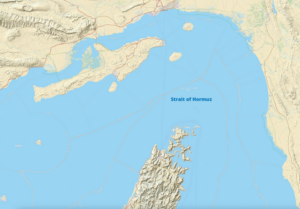
The United States says it controls the strait; Iran demonstrates that it can still prevent the world from using it normally
“A power can control the sea with aircraft carriers. Real power begins when ships are still afraid to sail through it.”
Washington claims that it controls Hormuz. Tehran responds that it will remain closed until the United States accepts its conditions. Between those two statements lies a far less solemn reality: ships continue to pass through only in a trickle.
The numbers matter more than the speeches. Before the war, around 130 to 140 vessels crossed the strait every day. This week, some measurements recorded barely eight in a single day. The ocean may be filled with U.S. destroyers, radars, aircraft, and surveillance systems. But when oil tankers do not sail, insurance companies raise risk premiums, and shipowners wait for instructions, naval power encounters an uncomfortable boundary: it can protect a route, but it cannot force commerce to trust it.
“Freedom of navigation ceases to be completely free when every captain must first ask whether he will return.”
Hormuz remains one of the planet’s energy throats. Hydrocarbons essential to Asia and to the functioning of the global economy pass through it. China, India, Japan, South Korea, and numerous economies depend directly or indirectly on that artery. That is why Iran does not need to defeat the United States militarily in order to retain influence. It only needs to maintain enough uncertainty for every ship, every insurer, and every market to recalculate the price of risk.
China watches Hormuz with a mixture of concern and calculation. It is one of the world’s largest buyers of crude oil, and a significant share of its energy imports depends on the Gulf. Every prolonged disruption makes routes, insurance, and supplies more expensive, but it also reinforces Beijing’s strategy of diversifying suppliers, increasing reserves, and deepening its ties with Russia and Central Asia. China does not need to intervene militarily to feel the impact; it only has to watch how every tension in Hormuz raises the cost of the energy that powers its industry.
“China does not need to control Hormuz to understand its power: it only needs to calculate how much each day costs when the throat of the world struggles to breathe.”
Washington possesses military superiority. Iran possesses geographic proximity, missiles, drones, small vessels, and the ability to turn every incident into a signal for the markets. That asymmetry explains the current paradox.
“The United States may dominate the military chessboard; Iran can still decide how much it costs to play on it.”
Hard Number
Since the beginning of the conflict, Hormuz has ceased to be merely a strategic threat and has begun to turn into a global bill. The disruption initially removed close to 10 million barrels per day from the market, while Brent rose by around 65% by the end of March, adding roughly US$46 per barrel compared with its previous levels. The World Bank later projected an average price of about US$86 per barrel for 2026, compared with approximately US$69 in 2025. If a normal flow of roughly 20.9 million barrels per day through Hormuz is used as a reference (equivalent to about one-fifth of global petroleum liquids consumption) every increase of just US$10 per barrel represents approximately US$209 million per day, or more than US$6 billion per month, applied to the value of the oil that normally passes through that throat.
On August 12, with Brent still around US$89 per barrel and traffic reduced to only a fraction of normal levels, the crisis continued to demonstrate that the true cost of Hormuz lies not only in the ships that remain idle, but in every refinery, insurer, industry, and consumer that ultimately pays the geopolitical premium of the strait.
“Since the beginning of the conflict, the energy premium caused by the war and the disruption of Hormuz may have added approximately US$400 billion to US$500 billion to the world’s oil bill. And that bill is still growing.”
“Hormuz does not need to sink a single oil tanker to make the planet pay: it only needs to add a few dollars to one hundred million barrels every day.”
The greater danger is that both powers may begin to confuse capability with control. Washington may believe that its naval presence guarantees the strait’s opening. Tehran may believe that prolonging the pressure will force the United States to negotiate. Meanwhile, every week of uncertainty affects prices, routes, insurance, inventories, and energy decisions thousands of miles from the Gulf.
Hormuz once again demonstrates that modern geopolitics does not always require conquering territory. Sometimes controlling fear is enough.
And there Iran still retains a disturbing advantage.
“Perhaps Hormuz no longer has an owner. But as long as Tehran can partially close its throat and Washington cannot restore commerce’s confidence, the strait will continue to breathe to Iran’s rhythm.”
“Hormuz does not need to close completely to remind the world who holds leverage; sometimes it is enough to make every ship, every insurer, and every market calculate the price of fear.”
Author: Mauricio Herrerac Kahn
Bibliography
- Reuters. “Trump Says U.S. Has ‘Total Control’ Over Strait of Hormuz,” August 12, 2026. On U.S. military control, the Iranian response, and the security of navigation through the strait.
- U.S. Energy Information Administration (EIA). Strait of Hormuz: The World’s Most Important Oil Transit Chokepoint. Reference on the strategic importance of Hormuz for global flows of oil.
- U.S. Energy Information Administration (EIA) – World Oil Transit Chokepoints / Strait of Hormuz:
https://www.eia.gov/international/content/analysis/special_topics/World_Oil_Transit_Chokepoints/
Provides data on the volume of oil that normally passes through Hormuz, around 20.9 million barrels per day in the first half of 2025, and explains its importance to global energy trade.
- Reuters – Iran, U.S. Make Competing Claims Over Control of Strait of Hormuz, August 13, 2026:
Examines the competing claims by Washington and Tehran over effective control of the strait and the consequences for navigation and global energy security.