Oil, Missiles, Aircraft Carriers, and the Lions Playing with a War No One Can Control
Israel, Iran, Hezbollah, and the Great Powers Facing the Strait Where Oil, Missiles, and Armed Diplomacy Can Set the Century on Fire
“When a peace needs aircraft carriers, sanctions, missiles, drones, and oil to stay alive, perhaps it is not peace, but a truce in full-dress uniform.”
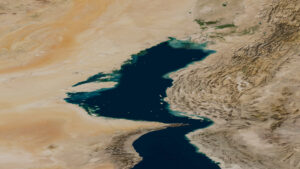
The Strait of Hormuz once again reminds the world that geography is not a schoolroom drawing, but a key placed at the throat of the planet. Nearly one fifth of the oil and liquefied natural gas moved by sea has passed through it, which turns that passage between Iran and Oman into an economic, military, and psychological valve. When Iran threatens to close it, it is not threatening only Washington, Tel Aviv, or Riyadh. It is threatening stock markets, maritime insurance, the price of fuel, European inflation, Asian refineries, and the ordinary citizen who does not know where Hormuz is, but ends up paying more for gasoline.
“The map always seems far away until it appears on the electricity bill.”
The current problem does not arise from a single shot, but from a chain of fire. Israel continues to attack positions linked to Hezbollah in Lebanon, Hezbollah responds or threatens, Iran accuses violations of regional understandings, the United States tries to appear as a firefighter while still holding the gasoline can, and the world once again watches the Middle East become a chessboard for powers that never place their own cities under the rubble. In southern Lebanon there have already been new deaths despite the truce, and every death on that border is not merely a local victim, but a spark placed beside the most expensive barrel on the planet.
“In the Middle East, even silence often comes with shrapnel.”
The so-called peace between the United States and Iran must be viewed carefully. It does not look like a deep peace, but rather a memorandum of survival. Washington needs Hormuz not to burn because a real closure would drive up the price of oil, hit its allies, and damage its own economy. Tehran needs to show that it does not kneel and that it can make every military pressure costly. Israel needs to prevent Hezbollah and Iran from consolidating power on its northern border. And Hezbollah needs to show that it is not a decorative piece on the Iranian board. Everyone says they are defending security, sovereignty, or stability. But when all the actors have missiles on the table, the word stability begins to sound like a vase placed on top of an earthquake.
“Diplomacy exists, but sometimes it enters the room after the generals have already chosen the chairs.”
Regarding Trump and the alleged payment of several trillion dollars to Iran, it is important to be rigorous. There is no serious basis for claiming that the United States directly paid “several trillion” to open the strait. What does appear in the available information is sanctions relief, the release or unfreezing of assets, economic concessions, and a negotiation for Iran to reduce restrictions on Hormuz during a window of time. That is not a simple check or a formal surrender. It is something more typical of modern imperial politics: ransom is not paid with a bag of money; it is paid with permits, oil, banks, sanctions, maritime corridors, and diplomatic silences.
“Big money rarely travels in briefcases; it prefers to move disguised as a technical agreement.”
The United States can indeed attack Iran with missiles from a material standpoint. It has bases, aircraft carriers, bombers, submarines, drones, satellite intelligence, and the capability to strike Iranian targets. The real question is not whether it can. The question is whether it can do so without setting the entire board on fire. Attacking Iran is not bombing a tent in the desert. It is touching a State with Armed Forces, missiles, regional networks, indirect allies, territorial depth, and the capacity to damage energy routes. There may be an attack, but there may also be a response against U.S. bases, ships, Israel, Gulf oil facilities, or maritime traffic. In geopolitics, being able to fire does not mean being able to control the rebound.
“The missile leaves in seconds; the consequence can last for decades.”
Russia observes this conflict with a mixture of warning, calculation, and opportunity. Moscow knows that a major war in the Gulf could make energy more expensive, distract the United States, strain Europe, and open diplomatic spaces for presenting itself as an indispensable actor. But it also knows that an out-of-control fire could damage its own balances with Iran, China, Turkey, and the energy markets. That is why it warns, vetoes, moves at the United Nations, and measures every word. Russia does not need to love Iran to understand that an Iran destroyed by Washington would be a direct signal about the world order Moscow rejects.
“Empires do not always defend friends; many times they defend precedents.”
China appears as the great silent buyer that does not want heroic speeches, but loaded ships, open routes, and reasonable prices. For Beijing, Hormuz is not a religious metaphor or a biblical cause. It is energy, industry, trade, inflation, and national security. China needs Gulf oil to sustain its economic machinery, and that is why any real closure of the strait directly hits its productive system. At the same time, China does not want the United States to militarily take over the management of the maritime passage or for Iran to collapse under Western pressure. Its position is pragmatic: freedom of navigation, less war, more trade, and no U.S. monopoly over the key to the Gulf.
“China does not usually shout during the fire; it prefers to buy the fire-extinguisher factory.”
Israel, for its part, is playing an existential game according to its own reading of security. It considers Hezbollah a direct threat and Iran the architect of a regional encirclement. But every bombing in Lebanon does not occur in a vacuum. It occurs over a fragmented, impoverished, intervened country that has too often been turned into someone else’s battlefield. If Israel strikes, Hezbollah responds. If Hezbollah responds, Israel escalates. If Israel escalates, Iran threatens. If Iran threatens Hormuz, the United States enters. And if the United States enters, Russia and China look at the board with their hands close to their own pieces.
“The problem with small wars is that sometimes they are only the side door to a large war.”
From the standpoint of nonviolent journalism, the central question should not be who has the most precise missile, but who will pay the next human bill. In Lebanon, it is paid by displaced families, children who once again hear aircraft, villages that bury their dead, and a State that barely holds its seams together. In Iran, it is paid by civilians trapped between sanctions, national pride, and internal repression. In Israel, it is paid by families living under permanent threat and by a society increasingly locked inside the logic of a fortress. In the Gulf, it is paid by migrant workers, sailors, fishermen, and peoples who decide nothing, yet breathe the smoke of decisions made by others.
“The powerful speak of security; peoples learn to sleep away from the windows.”
Hormuz shows that the world is not at peace. It is merely managing fires. The United States, China, Russia, Iran, Israel, Hezbollah, Lebanon, Oman, Saudi Arabia, Europe, and the energy markets are inside the same knot. All it takes is a bad reading, a missile miscalculation, a maritime provocation, or a politically useful death for the supposed peace to become open war. That is why this crisis cannot be treated as just another Middle East news item. It is a global warning. When the strait narrows, reason narrows as well.
“Humanity says it wants peace, but it keeps leaving the keys to the world in the hands of those who manufacture storms.”
Brief Bibliography
- Reuters. “Israel fire kills two in Lebanon, testing Iran-linked ceasefire.” June 23, 2026.
- The Guardian. “Iran says it is closing strait of Hormuz over Israeli strikes in Lebanon.” June 20, 2026.