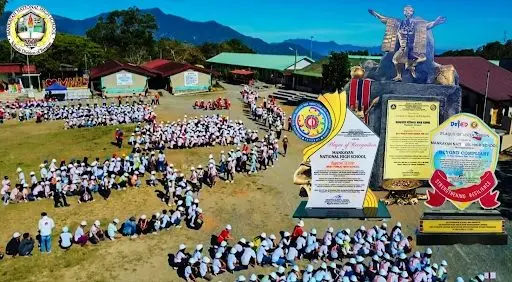

MOUNTAIN RESILIENCE IN ACTION- Hundreds of students in hard hats assemble across the Mankayan National High School grounds during a schoolwide disaster preparedness and evacuation drill. Against the backdrop of the Benguet mountain range, the campus-wide exercise tests response times, emergency routing, and evacuation procedures, reflecting the institution’s commitment to building a resilient, safe haven.
By Rubenson B. Bilag
In the rugged, mineral-rich mountains of Mankayan, Benguet, education is far more than the simple transmission of academic concepts. It is a persistent act of survival, community solidarity, and profound hope. Mankayan National High School (MNHS), established in 1968 and nationalized under Presidential Decree No. 1050, occupies a precarious yet sacred 30,000-square-meter terrain in Barangay Poblacion. One of the local areas hit hardest by the devastating July 16, 1990 Luzon earthquake, which fractured its surrounding topography and caused sections of its open playground to slowly erode and sink, the institution carries a historical memory so etched with seismic vulnerability.
The school community has steadily rebuilt itself, not just as a collection of concrete and steel structures, but as a living sanctuary of safety, peace, and holistic community regeneration. Adhering strictly to Republic Act No. 9155, the Governance of Basic Education Act, and Republic Act No. 10121, the Philippine Disaster Risk Reduction and Management Act of 2010, MNHS established a grounded institutional framework that treats disaster readiness, environmental stewardship, and peacebuilding as inseparable pillars. Under the steady guidance of School Principal IV Sharon B. Angupa, PhD, and bolstered by the meticulous administrative documentation and strategic coordination of Administrative Officer IV Hanky Mae B. Aten-an, the school has redefined what it means to foster a safe learning environment. Through their collective stewardship, with the practical ground-level execution of SDRRM Coordinator Darryl D. Salupen and the entire teaching and non-teaching community, MNHS has transformed from a disaster-prone site into a recognized model of resilience, achieving a historic three-time regional victory as a Gawad KALASAG Best Implementer under the Public Secondary Schools Category and a national qualifier.

CRITICAL FIRST-AID RESPONSE- Student emergency responders wearing protective gear, face masks, and safety helmets execute trauma care and stretcher stabilization procedures during a simulated casualty response drill. A hands-on demonstration highlights the school’s commitment to building practical life-saving skills and emergency preparedness among its youth.
At Mankayan National High School, resilience is a deliberate system. Under the comprehensive framework of Disaster Risk Reduction and Management, safety is woven into every single fiber of school operations. DRRM here is not just a document; it is the master roof that shelters all school initiatives. From structural reinforcement against earthquakes to fire prevention drills and hazard response, everything springs from one goal: keeping every learner safe and secure. Under this strong DRRM umbrella, all school systems align to build total community resilience. This commitment is vividly brought to life through the continual sustaining of award-winning programs that define institutional excellence: clinching the overall Brigada Eskwela title for the Secondary Large Category, maintaining distinction as an outstanding recipient at the Regional Healthy Learning Institution in line with DepEd’s Oplan Kalusugan, hardening campus infrastructure against earthquakes and typhoons through Brigada Eskwela, securing nutritional security and slope stabilization through Gulayan sa Paaralan, and fortifying learners’ minds through Brigada Pagbasa.


DISCIPLINED EVACUATION-Mankayan National High School students wearing safety helmets and high-visibility vests march in orderly single-file lines past the school’s Vision and Mission boards during an evacuation drill. Observed by evaluation officials, the exercise tested student protocols for swift, calm, and organized relocation during simulated natural or human-induced disasters.
Understanding a truly resilient institution requires looking beyond figures and statistical charts to examine the cultural heartbeat of its people. At MNHS, safety protocols and school progress are firmly anchored in the indigenous Cordilleran concepts of binnadang, representing communal cooperation and mutual aid offered freely to ease daily burdens, and pangpangoan, the traditional practice where older siblings or mentors guide and assist younger members during shared community work. These deeply ingrained local values serve as the ethical and practical foundation of the school’s comprehensive Disaster Risk Reduction and Management (SDRRM) Action Plan, locally named BALATEY DI RIGAT: Braving Against Life Threatening Activities Towards Environment Yielding: Dropping Out Inconveniences, Ravage Injuries, Grief and Turbulence. Rather than relying solely on top-down administrative orders, the school leadership puts binnadang into daily action to build a protective network that surrounds every student, teacher, and non-teaching staff member. As Principal Dr. Sharon B. Angupa shares regarding the philosophy guiding the school’s institutional journey:
“Disaster management and peacebuilding are not mere compliance checklists handed down from the bureaucracy; they are moral imperatives rooted in our indigenous soul. When the ground beneath Mankayan shook decades ago, it tested our physical foundations, but it also awakened our communal spirit. Through binnadang, we realized that no single classroom, no single teacher, and no single administrator can carry the weight of vulnerability alone. We survived, and ultimately thrived, because we wove our individual strengths together into a collective shield for our children. Our three-time Gawad KALASAG victories belong to every parent, teacher, student, and local leader who refused to let adversity dictate our future.”

UNITED FOR SAFETY– Sharon B. Angupa, School Principal IV of Mankayan NHS delivers opening remarks during the2-day INSET on disaster preparedness with stakeholders such as. The collaborative session emphasizes the school’s proactive stance in forging an unbreakable safety net through school-community partnership and institutional readiness.
This institutional commitment is fully shared by Administrative Officer IV Hanky Mae B. Aten-an, who manages the administrative documentation, institutional records, and coordination processes that keep the school’s safety programs structured and steady across all grade levels. Reflecting on the collaborative work behind the school’s administrative milestones, Aten-an notes:
“Behind every successful safety audit, every approved memorandum, and every transparent School Report Card is a shared community heartbeat. My role as a documenter and administrative coordinator has taught me that data and compliance only matter when they translate to human security. When we look at our students participating in earthquake drills, or our non-teaching personnel fixing water lines past regular hours, we are witnessing living proof that administration in a public school is an act of love and radical care.”

SAFEGUARDING THE SANCTUARY –Hanky Mae B. Aten-an, AOIV addresses faculty, staff, and local law enforcement during a orientation on the MNHS Contingency Plan for Human-Induced Attacks as part of the school’s initiative to maintain a living sanctuary of peace and security, stakeholders gathered to establish structured response protocols to protect students and school grounds against potential security threats and emergencies. Photo by Rubenson B. Bilag
Walking through the 43 functional classrooms and 14 academic buildings of Mankayan National High School reveals a carefully planned environment where structural safety works hand in hand with local cultural values. The campus layout directly reflects the three core operational programs under Balatey Di Rigat: IAKDANG (Initial Action and Knowledge towards Disaster Adjustment, Needs and Guidance), IPASKIT (Intensifying Partnership for Active Services, Kindred Interactivities that Transform), and IDAD-AN (Instigating Disaster Alertness and Designed Actions on Needs). Under IAKDANG, the school administration conducts continuous risk assessments, hazard mapping, and updates localized safety policies that directly address the sloping terrain of Poblacion. Through IPASKIT, the school builds strong inter-agency partnerships with local authorities and civic organizations to maintain peace and immediate disaster response capabilities. Through IDAD-AN, the institution ensures long-term recovery, structural rehabilitation, and continuous emergency action plans designed to meet the campus’ evolving physical needs.
The broader campus view offers clear evidence of shared community effort across every corner of the school grounds. Student leaders from the Supreme Student Learner Government (SSLG) and the Youth for Environment in Schools Organization (YES-O), including student representative Justine Clyde Bolislis, conduct a student-led school watching and hazard mapping activity. Armed with standard inspection checklists, they check window latches, clear drainage canals, and inspect building stability alongside Physical Facilities Coordinator Lemuel L. Totanes, connecting student participation with overall facility maintenance and structural preservation. Finally, a wide panoramic view of the Mankayan National High School campus shows its multi-level academic buildings, the newly built stage with integrated staff offices, the covered court extended through congressional support, and the thriving community tree nursery established in partnership with Benguet State University (BSU) and the Barangay Local Government Unit (BLGU) of Poblacion.
The practical achievements of Mankayan National High School reach far beyond local disaster preparedness and emergency response routines. In a mountain municipality historically exposed to severe weather hazards, soil movement, and economic challenges, the school demonstrates that genuine peacebuilding, locally known as pamanay, happens when physical hazards and environmental risks are tackled through open, active local governance. By establishing formal Memoranda of Agreement with partner agencies, including the Bureau of Fire Protection (BFP), the Philippine National Police (PNP), the Municipal Disaster Risk Reduction and Management Council (MDRRMC), Benguet State University, and local mining stakeholders, MNHS ensures that learning continues safely without interruption even during severe seasonal disruptions. Furthermore, integrating peace education concepts, Climate Change Adaptation and Mitigation (CCAM) protocols, and student support services into daily MATATAG lessons gives real purpose to daily safety practices. Students do not simply study academic subjects; they actively practice their roles as environmental stewards, active community peacekeepers, and responsible citizens who uphold essential civic values (Maka-Diyos, Maka-tao, Makakalikasan, Makabansa).

OCD-CORDILLERA REGIONAL VALIDATORS AT MANKAYAN NHS- A validation team from the Office of Civil Defense – Cordillera (OCD-CAR) holds a commemorative photo with officials, staff, and responders of Mankayan National High School (MNHS) following their comprehensive on-site regional validation. The team assessed MNHS for the prestigious Gawad KALASAG Seal and Special Awards 2025, which honors excellence in disaster risk reduction and management. The group is pictured holding the event banner on the school’s unique, modern, angular steps. Photo by Rubenson B. Bilag
As Mankayan National High School continues to stand firm against mountain storms and the lingering memory of past earthquakes, it offers a timeless takeaway for educational institutions everywhere. True disaster risk reduction is not merely about constructing reinforced walls or filing mandatory quarterly reports; it is about cultivating a deep culture of shared responsibility that values every human life. By grounding its daily work in local culture, practical action, transparent leadership, and genuine teamwork, MNHS turns simple classrooms into lasting safe havens for every learner, demonstrating how community unity can overcome even the most challenging landscapes.
##########
About the Author:
 Rubenson “Rubie” B. Bilag a trans woman public secondary school English teacher and the school paper adviser for the English publication- The Daybreak at Mankayan National High School in Benguet. A graduate of the Master of Arts in English program at Baguio Central University, his cultural research and writing explore indigenous heritage, traditional ecological knowledge, and community resilience across the Cordillera highlands.
All photos by Rubenson B. Bilag.