On a cold, sunny winter day in Quebec, with sunlight filtering through scattered clouds and an icy wind stinging the cheeks, around 50,000 souls merged today into a human river of union flags and vibrant chants, weaving a tapestry of loving resistance against the advance of laws attempting to corner collective freedom. From Place du Canada, the epicenter of this wave of solidarity, the march “Dans la rue pour le Québec” – “In the Streets for Quebec” – wound its way along René-Lévesque Boulevard to the doors of power, closing city arteries in a fraternal embrace that recalls how peoples rise not with blind rage, but with the tenderness of those defending what is shared. This was not just another protest: it was a libertarian hymn to the dignity of labor, called by nine major labor federations representing hundreds of thousands of working hearts.
Teachers from the Fédération autonome de l’enseignement (FAE), nurses from the Fédération interprofessionnelle de la santé du Québec (FIQ), public employees from the Alliance du personnel professionnel et technique de la santé et des services sociaux (APTS), along with the powerful Fédération des travailleurs et travailleuses du Québec (FTQ), the Confédération syndicale du Québec (CSN), the Centrale des syndicats du Québec (CSQ), the Centrale des syndicats démocratiques (CSD), the Syndicat de la fonction publique et parapublique du Québec (SFPQ), and the Syndicat de professionnels du gouvernement du Québec (SPGQ). Five national networks federating some 4,500 community organizations—from shelters for the vulnerable to grassroots health centers—also rallied, in an unprecedented convergence that transcends the labor sphere to embrace Quebec’s social soul. No one was missing. Their voices, intertwined in chants, slogans, and banners under the winter sun, proclaimed a fierce love for the Quebec built by generations: a model of equity where the state does not crush but uplifts.
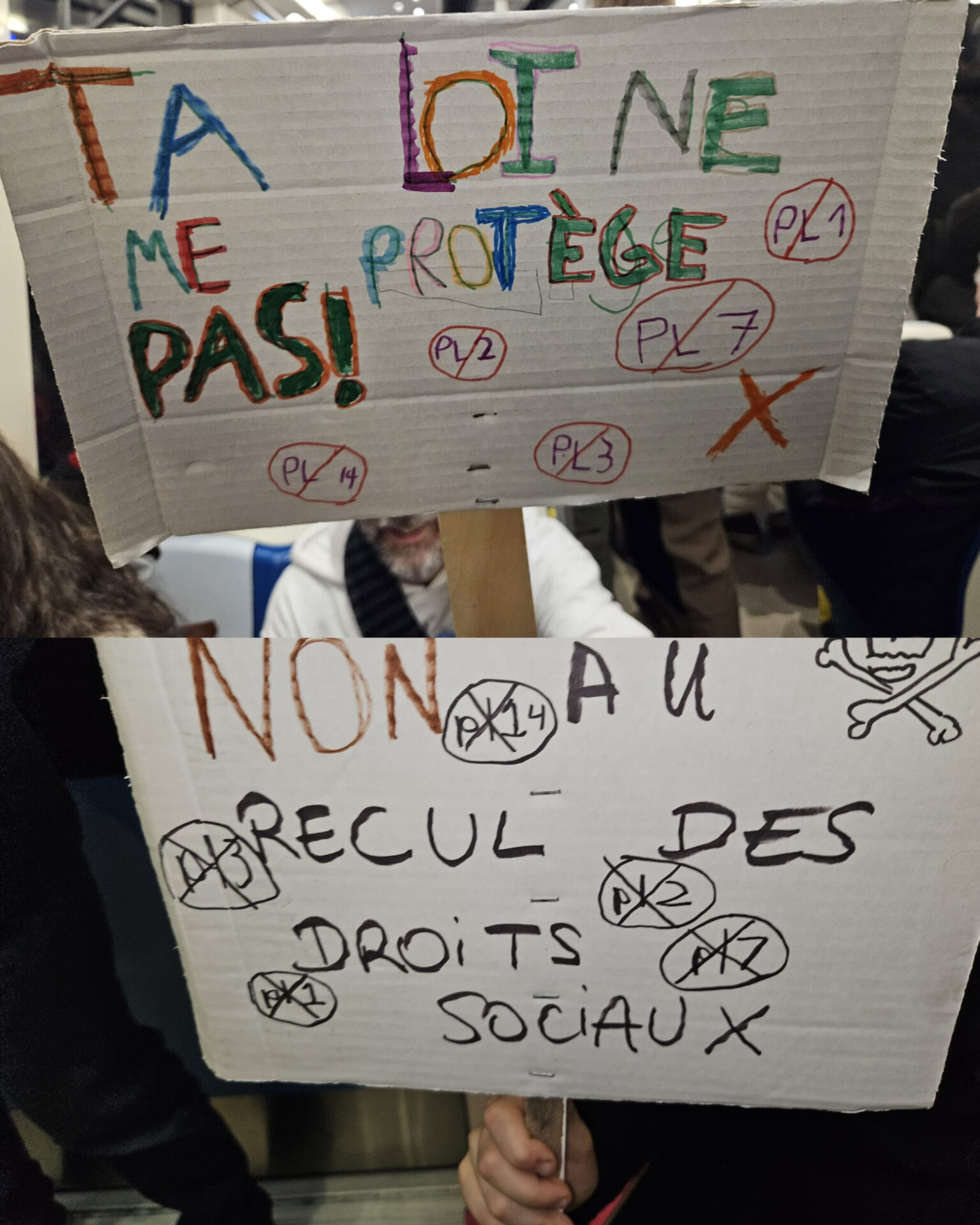
The Legislative Poison: Laws That Bind the Free Spirit
At the core of this epic beats the rejection of Loi 14 –Law 14–, which takes effect tomorrow and arms the government with tools to stifle public-sector strikes, turning negotiation into a monologue of power. Organizers call it a “gag law,” a padlock on the workers’ supreme tool: the strike that compels fair dialogue. Behind it comes Projet de loi 3 –Bill 3–, a mirage of “transparency” that would make union dues optional, crippling the internal life of unions and limiting their capacity to fund political campaigns or gatherings like this one that nourish living democracy. In the libertarian pen of the labor movement, these are not technical reforms: they are scissors cutting through the threads of solidarity, part of Premier François Legault’s rightward shift and his Coalition Avenir Québec (CAQ), which slashes public services while the cry of the streets responds with the strength of the collective.
Social Wounds: The Cry of the Forgotten
In healthcare, overcrowded emergency rooms and endless waiting lists plead for more hands, not fewer rights; in education, the shortage of teachers overloads classrooms where Quebec’s future dreamers grow. Community networks denounce chronic underfunding that forces them to mend what the state unravels, meeting growing demands with skeleton budgets. This march, loving in its diversity—retirees from Saint-Eustache, prison proofreaders, urban activists—reveals a wounded yet untamed social fabric beneath the bright, cold sky: a reminder that true freedom is not decreed from offices, but forged in the streets, where “I” dissolves into “we.”
A Horizon of Libertarian Hope
The organizers seek not vengeance but redemption: to delegitimize these laws by showing transversal opposition, to reaffirm unionism as a democratic bulwark, and to weave a broad front capable of withstanding the authoritarian tide. In the words of their leaders, they march “to affirm that social justice is non-negotiable, and that a strong society cannot be built by suffocating debate.” Today, Montreal pulsed with that solidary truth, a beacon for the world: in times of legislative chains, the libertarian love of the people dissolves fear and incarnates a possible utopia. Quebec, with its generous rhythm, teaches that resistance is an act of deep affection toward humanity itself.