After a thumping win in the Bihar Assembly elections, the BJP-led central government started to implement its hidden agendas, which it kept pending for more than five years. On Friday, November 21, 2025, it notified the four labour codes, which were waiting for implementation since 2019 and 2020.
The government claims that India’s Labour Codes mark a major reform by modernising labour laws, ensuring decent working conditions, timely wages, and long-term protection for workers across all sectors.
Terming it a historic decision, the Government of India has announced that the four Labour Codes – the Code on Wages, 2019, the Industrial Relations Code, 2020, the Code on Social Security, 2020 and the Occupational Safety, Health and Working Conditions Code, 2020 are being made effective from 21st November 2025, rationalising 29 existing labour laws. By modernising labour regulations, enhancing workers’ welfare and aligning the labour ecosystem with the evolving world of work, this landmark move lays the foundation for a future-ready workforce and stronger, resilient industries driving labour reforms for Aatmanirbhar Bharat.
In a press release, 21st November, the government states that the implementation of the four Labour Codes addresses this long-pending need to move beyond colonial-era structures and align with modern global trends. Together, these Codes empower both workers and enterprises, building a workforce that is protected, productive and aligned with the evolving world of work — paving the way for a more resilient, competitive and self-reliant nation.
Now under new codes, it will be mandatory to issue appointment letters to all the workers, this written proof will ensure transparency, job security, and fixed employment. Under the Code on Social Security, 2020 all workers including gig & platform workers will get social security coverage. All workers will get PF, ESIC, insurance, and other social security benefits.
Under the Code on Wages, 2019, all workers to receive a statutory right minimum wage payment. Minimum wages and timely payment will ensure financial security.
Employers must provide all workers above the age of 40 years a free annual health check-up. It will promote timely preventive healthcare culture.
Now it will be mandatory for employers to provide timely wages, ensuring financial stability, reducing work stress and boosting overall morale of the workers.
To increase women force participation, under new codes, women are permitted to work at night and in all types of work across all establishments, subject to their consent and required safety measures. Women will get equal opportunities to earn higher incomes – in high paying job roles.
Previously, ESIC coverage was limited to notified areas and specific industries; establishments with fewer than 10 employees were generally excluded, and hazardous-process units did not have uniform mandatory ESIC coverage across India. Now ESIC coverage and benefits are extended Pan-India – voluntary for establishments with fewer than 10 employees, and mandatory for establishments with even one employee engaged in hazardous processes. Social protection coverage will be expanded to all workers.
Some Major Benefits of Labour Reforms Across Key Sectors, As Claimed By The Central Government:
- Fixed-Term Employees (FTE): FTEs to receive all benefits equal to permanent workers, including leave, medical, and social security. Gratuity eligibility after just one year, instead of five. Equal wages as permanent staff, increasing income and protection.
- Gig & Platform Workers: ‘Gig work’, ‘Platform work’, and ‘Aggregators’ have been defined for the first time. Aggregators must contribute 1–2% of the annual turnover, capped at 5% of the amount paid/payable to gig and platform workers. Aadhaar-linked Universal Account Number will make welfare benefits easy to access, fully portable, and available across states, regardless of migration.
- Women Workers: Gender discrimination legally prohibited. Equal pay for equal work ensured.
Women are permitted to work night shifts and in all types of work (including underground mining and heavy machinery), subject to their consent and mandatory safety measures. Mandatory women’s representation in grievance redressal committees. Provision to add parents-in-law in Family Definition of Female employees, expanding dependent coverage and ensuring inclusivity.
The Prime Minister, Narendra Modi has welcomed the implementation of the Four Labour Codes, describing it as one of the most comprehensive and progressive labour-oriented reforms since independence. He said that these reforms greatly empower workers while significantly simplifying compliance and promoting ‘Ease of Doing Business.’
The Prime Minister stated that the Four Labour Codes will serve as a strong foundation for universal social security, minimum and timely payment of wages, safe workplaces and remunerative opportunities for the people, especially Nari Shakti and Yuva Shakti.
P M Modi further said that the reforms will build a future-ready ecosystem that protects the rights of workers and strengthens India’s economic growth. He added that they will boost job creation, drive productivity and accelerate the nation’s journey towards a Viksit Bharat.
In a series of posts on X, Shri Modi said; “Today, our government has given effect to the Four Labour Codes. It is one of the most comprehensive and progressive labour-oriented reforms since Independence. It greatly empowers our workers. It also significantly simplifies compliance and promotes ‘Ease of Doing Business’.”
“These Codes will serve as a strong foundation for universal social security, minimum and timely payment of wages, safe workplaces and remunerative opportunities for our people, especially Nari Shakti and Yuva Shakti.”
“It will build a future-ready ecosystem that protects the rights of workers and strengthens India’s economic growth. These reforms will boost job creation, drive productivity and accelerate our journey towards a Viksit Bharat.”
Union Home Minister and Minister of Cooperation Amit Shah has also extended his heartfelt greetings to all the workers of the country on the implementation of the new Labour Codes across the country.
In a post on X platform, Union Minister Amit Shah said greetings to all workers across the country on the nationwide implementation of the new Labour Codes. He said that enacted under the leadership of Prime Minister Shri Narendra Modi, these codes represent the biggest reform in the history of Labour Laws.
Mr. Amit Shah said these codes, which guarantee minimum wages, social security, equal opportunities for women workers and legal recognition for gig and unorganized workers, will improve the living standards of workers. They will also accelerate the creation of a developed and self- reliant India to become a role model for labour laws around the world. Thanks to Modi Ji for these historic codes.
On the other hand, the Trade Unions claim that within 24 hours of the notification of draconian anti-worker, pro-employer four Labour Codes, as termed by trade unions, thousands of workers are rising in rage, burning the notification copies to ashes across the nation at factory gates and workplaces.
On 22 November, 2025, KKC members, led by Unorganized Workers and Employees Congress (KKC) Chairman Dr. Udit Raj, held a strong protest in front of Shramik Shakti Bhavan against the New Labour Codes introduced by the Modi government.
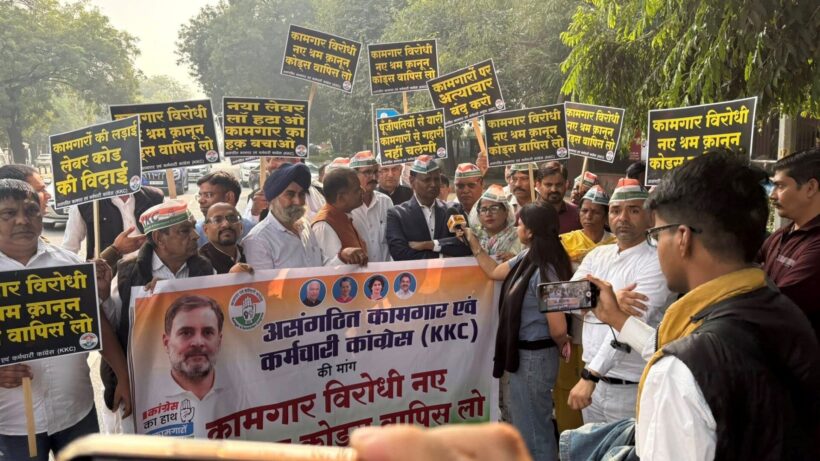
Unorganized Workers and Employees Congress (KKC)- PHOTO KKC FB PAGE.
“The new labour codes are anti-labour and anti-social security. This is a conspiracy to usurp workers’ rights, perpetrated by corporations. We demand that the Modi government immediately withdraw these anti-labour codes”, Dr. Udit Raj said.
Joint Platform of Central Trade Unions (CTU’s), including INTUC, AITUC, HMS, CITU, AIUTUC, TUCC, SEWA, AICCTU, LPF, UTUC and independent industrial federations, has called for nationwide combative resistance and defiance against labour codes, urging for the repeal of anti-worker, pro-employer labour codes and scrapping of Shram Shakti Niti 2025 on November 26th to immediately rise in rage through defiance wearing black badges and burning the labour codes copies across the nation at all workplaces and residential areas.
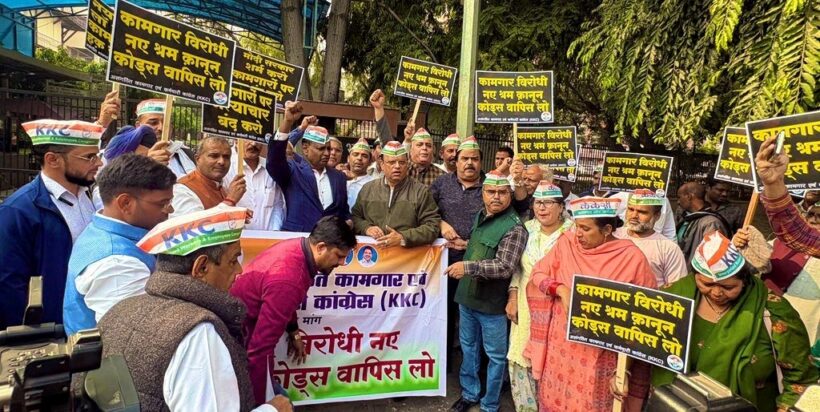
Unorganized Workers and Employees Congress (KKC) –PHOTO CREDIT KKC.
In a joint statement released on 21st November 2025, the Joint Platform of Central Trade Unions expressed strong condemnation against the blatantly unilateral implementation of anti-worker, pro-employer labour codes from today.
“In unequivocal terms, we call it the Union Govt’s deceptive fraud committed against the working people of the nation.
This arbitrary and undemocratic notification of the four so-called ” labour codes” notified on 21st November 2025, defies all democratic ethos and has wrecked the character of the welfare state of India to rubbles.”
The release elaborates that the joint platform of ten central trade unions and independent industrial federations have been resisting the implementation of these draconian labour codes since the day they were enacted, repealing existing 29 central labour legislations.
The trade unions allege that instead, without heeding to any of the appeals, protests and strikes of the central Trade Unions, this Union government has made effective the labour codes to cater to the demands of employers’ representatives.
The Joint Platform of CTUs, denouncing the Govt’s act as the most undemocratic, most regressive anti-worker and pro-employer move, reiterate in strongest terms that the lethal assault on the working people will be confronted with the fiercest and most united resistance in history.
In a strong message, the CTUs state that the notification of these codes, amidst deepening unemployment crisis, rising inflation is nothing short of a declaration of war on the working masses. The Union government in cahoots with its capitalist cronies is attempting to take the country back to the exploitative era of master-servant relationship.
Reacting over the “fixed-term employment ensuring equal benefits” claim of the government, CITU states that the fixed-term employment legalizes permanent temporariness in perennial and core jobs. Employers/corporates are endowed with unrestricted power to replace permanent jobs with short-term contracts. Gratuity after one year does not compensate for the loss of continuity of service, seniority, and actual benefits. This provision is aimed at destroying stable employment and weakening unionization.
On the “equal opportunities and safer conditions for women workers” claim of the government, CITU reacts- “Allowing night shifts without enforceable safeguards and consent leads to coerced consent in a distressed labour market. The Codes do nothing to address the real problems faced by women workers, i.e., contractualization, unequal pay, harassment, unsafe workplaces and denial of maternity benefits. Prohibitions on gender discrimination remain meaningless without strong enforcement, which the Codes dismantle completely.”
Countering the government’s claim on “Universal Social Security for all, including gig and platform workers”, CITU comments that the Social Security Code does not guarantee universal coverage in any sense. Sections 109–114 merely talked about schemes for gig and platform workers, without mandatory timelines and defined benefits or allocations. The proposed aggregator contribution of 1–2% of turnover is too inadequate to fund pension, PF or health benefits; Aadhaar-based portability etc. are all meaningless unless employment relations and employers’ obligation is ensured through statutory provisions and employment records and proper enforcement machinery, which are all absent in the Code. The social security code has not decreased the threshold number of employees in the EPF, ESI & Gratuity provisions from the existing threshold of 20 and 10 respectively and the wage ceiling in the EPF & ESI for the coverage. But in the PIB statement, it is deceptively claimed that all workers will get PF, ESIC, insurance and other social security benefits.
The Platform of Central Trade Unions has warned the government that the working people of India will put up a formidable fight till the labour codes are withdrawn.
The Communist Party of India (Marxist) Polit Bureau has also strongly opposed the unilateral notification of the four Labour Codes by the BJP-led Central Government.
The party pleads that the Government’s claim that the Labour Codes will boost employment and investment is completely baseless. The Codes are designed to leave labour unprotected in the face of the onslaught of capital. Their aim is to lure national and international capital by ensuring that all meaningful regulations covering various aspects of labour rights will be nullified. Further, they seek to snatch away the right to strike and criminalise any collective action by the working class.
The Labour Codes, in totality, seek to establish a jungle raj by unilaterally empowering the corporate class to bulldoze the rights and entitlements of workers with proactive sponsorship of the Government and administration.
D. Raja, General Secretary, Communist Party of India, criticizing the new labour codes, in a tweet on 22nd November, alleges, “The BJP government’s push to implement the four labour codes, rammed through Parliament five years ago without proper debate or consultation, reveals its true objective: facilitating the loot of labour for corporate houses without any scrutiny or hindrance. These codes constitute a direct assault on hard-won labour rights and represent a death knell for job security in India. By diluting protections, easing hire-and-fire, weakening unions, and undermining social security, the BJP is laying the groundwork for unprecedented exploitation. For a country where crores of workers already struggle with precarious livelihoods, these measures will prove traumatising, deepen insecurity and widen inequality across every sector of the workforce.”