by Dorothy Adenga and Tracey Kadada
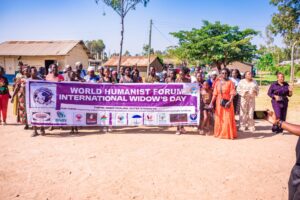
International Widows Day is observed annually to recognize the challenges faced by widows and to advocate for their inclusion, protection, empowerment, and dignity. In commemoration of this important day, Risen Flames Network (RFNET), in collaboration with members of the World Humanist Forum and other partners, organized a celebration in Eldoret, Kenya, that brought together widows, community leaders, development partners, and representatives of various community groups.
Participants shared experiences, learned from one another, and explored strategies for improving their social and economic well-being.

The discussions emphasized the importance of healing from loss, building resilience, creating sustainable sources of income, and strengthening community support systems and served as an opportunity to launch the Jitegemee Basket Initiative, a six-month pilot project aimed at strengthening self-reliance and sustainable livelihoods among widows.
Official Launch of the Jitegemee Basket Initiative.
Rose Neema Onyango, shared her personal journey as a widow spanning nine years and reflected on the experiences that inspired the formation of the organization.
She explained that Risen Flames Network was born out of her lived experience as a widow who was left young and her desire to ensure that no widow walks the difficult journey of widowhood alone. Drawing from her lived experiences, she emphasized the need for support, healing, empowerment, and opportunities for growth.

Rose officially launched the Jitegemee Basket Initiative and outlined its vision of nurturing self-reliance, economic independence, and sustainable livelihoods among widows.
She further highlighted the importance of internal development and emotional healing as foundations for personal transformation. According to her, inner healing enables widows to develop confidence, resilience, and strength, ultimately contributing to healthier families and communities.
Rose also shared her vision of bringing widows together locally, nationally, and internationally to create a strong movement that promotes healing, economic empowerment, advocacy, and social transformation.
The initiative was established as a practical response to the economic challenges faced by widows and seeks to promote self-reliance, economic empowerment, and sustainable livelihoods.
Through support from the World Humanist Forum in internal development, widows will engage in their humanist clubs, farming activities that contribute to food security and income generation.
To complement the farming programme, members will establish kitchen gardens for vegetable production at household level. The gardens will improve family nutrition while providing an additional source of income through the sale of surplus produce. To strengthen financial inclusion and economic resilience, members officially launched a weekly table banking and savings programme.
She concluded her remarks by reaffirming the organization’s guiding motto: Educate, Empower, Liberate, Transform and encouraging participants with the inspirational words in her local language “Mach Nyaka Liel” — “There is still much more that life has to offer.”
The message from international mentors
The celebration was further enriched by a special audio message from international mentors and supporters of the widows’ empowerment movement, namely Antonio Carvallo, Ragnar Sverrisson and Julius Valdimarsson.
In their message, the mentors emphasized that widows are valued members of society who deserve recognition, respect, and celebration. They encouraged participants to remain strong despite the challenges they face and reminded them that widowhood does not diminish their worth, potential, or ability to achieve their goals.
They commended the efforts of Risen Flames Network in creating a platform that promotes healing, empowerment, and sustainable development. Their message inspired participants and reinforced the spirit of hope, resilience, and solidarity that defined the celebration.
Partner Contributions and Support
The event benefited from generous support from development partners and well-wishers committed to improving the welfare of widows and vulnerable households.
A notable contribution was the donation of chlorine-making machines, facilitated through the efforts of Ms. Ester Mapesa from SWIM, who also spoke about the importance of food security, access to safe drinking water, health promotion, and sustainable community development.
The chlorine-making machines were awarded to Kamrongo Widows Group and Rupia Widows Group.
In addition, participating groups received gifts including lesos, flour, and other essential household items as a gesture of solidarity and encouragement.
Key presentations messages from humanist activists

Maurine Kapyia delivered a presentation on entrepreneurship, economic resilience, and the challenges faced by single mothers. She encouraged widows to pursue income-generating opportunities and build sustainable livelihoods that can support their families and restore their dignity.
Antonina Makoba shared her personal journey through widowhood and explained how she transformed her experiences into an opportunity to establish a Community-Based Organization. Her story demonstrated the power of resilience, determination, and leadership
Dorothy Adenga spoke about raising a child living with a disability and encouraged parents to embrace acceptance, inclusion, advocacy, and unconditional love while supporting their children.
Dorothy Jemeli highlighted the work of Kapsoya Youth CBO and emphasized the importance of community engagement, youth participation, and collective action in addressing social and economic challenges.
Susan Abukakar encouraged widows to remain hopeful and determined despite life’s challenges and reminded participants that widowhood should never limit their aspirations.
Testimonies and Peer Support
The event provided a safe and supportive environment where widows openly shared their stories, challenges, achievements, and lessons learned.
Among those who shared inspiring testimonies were Melvin, one of the youngest widows in the network, who encouraged fellow widows to remain strong and hopeful and Caren Omollo, who shared words of resilience, courage, and determination.
These testimonies reinforced the importance of peer support, mentorship, solidarity, and community-based support systems in the healing journey.
The way forward
Over the next six months, participating groups will implement the Jitegemee Basket Initiative through farming & market linkage development for farm producers, humanist club sessions on internal development, Gender Based Violence and Education thematic tables sessions.
Humanist action with Single Fathers and Widowers in Uasin Gishu County
Another meaningful action was taken by a team of humanists leaded by Tracey Kadada, activist and coordinator of the Music, Art & Culture thematic table of the World Humanist Forum.

As a Humanist organization, we visited single fathers and widowers in Kambi Shetani (Devil’s Camp), Spain Village, Huruma, and Langas in Uasin Gishu County during Father’s Day and International Widows Day.
We distributed foodstuffs and stood in solidarity with men who are often forgotten despite carrying the responsibility of raising children and caring for their families after losing their spouses.
During our visits, we also engaged with young people and community members in these informal settlements, speaking about peace, non-violence, and the importance of rejecting gang activities. We encouraged dialogue, unity, and positive community engagement as pathways to safer and more peaceful neighborhoods.

Our initiative was a reminder that compassion and support should reach everyone in need. Widowers and single fathers also face emotional and economic challenges and deserve recognition, inclusion, and community support. By standing with them and promoting peace, we reaffirm our commitment to dignity, equality, and caring for all vulnerable members of society.