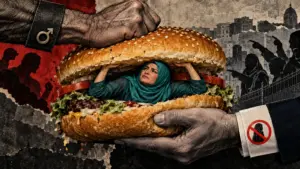
In the book entitled “Starke Frauen zwischen Gewalt und Diskriminierung: Ein schreibtherapeutischer Ansatz” (“Strong Women Between Violence and Discrimination: A Writing Therapy Approach”, English translation of the book planned by 2027), I attempt to create an open project that addresses violence against women in the form of ethnic discrimination, physical and emotional violence, and Islamophobia, and that proposes a modest attempt at writing therapy for the metamorphosis from a broken mirror to a colourful mosaic. Peace begins when women reclaim their dignity by actively campaigning for a women’s world not characterised by violence, but by solidarity and equality/equity. Because while we talk about solutions and put our modest writing therapy into practice, the violence continues…. “Never again” is the motto… The question is: When will we manage to do that?
By Milena Rampoldi, ProMosaik.
People always say, speak your mind! Then you’ll feel better! I would rather say, talk yourself out, write yourself out and get to know yourself.

I don’t see the female way to oneself so much as the path to happiness, but rather as the steep path to self-knowledge and to the self-awareness that the whole experience – which also includes trauma, violence and discrimination – is, and will remain, “a part of myself, because it defines and constitutes me as a human being and as a woman.”
I do not need any lengthy therapy that extinguishes or transfigures my experiences, because I accept my experience and turn the shattered mirror into a colourful mosaic, a mosaic of opposites, polyphony, cacophony and dialectics within myself.
This path is broad, wide and full of prospects. It’s not as steep as it might seem at first, because I don’t see myself as a victim. And I’m not a victim. But nevertheless, my life is a broken mirror as long as I see this broken mirror like this and leave it lying in front of me without taking action and giving myself over to passivity instead.
The magical turning point is very simple: I don’t meditate in front of the broken mirror, but instead I pick up all the pieces of the mirror, take a clay tablet, and press all my pieces of mirror into this clay tablet before it hardens.
The result of my self-therapy is the recognition that these shattered mirror remains are parts of my experience, of my life, of myself and my feminine primordial power. These pieces are exactly the ones that made me strong. They are colourful because I painted them like mosaic stones. I no longer mirror myself in it. They are no longer my you, but my I. They are no longer my enemy, but my experience, which is part of my spiritual life and has been integrated into my self. Their edges no longer cut into the skin of my soft hands, because they are embedded in hardened clay.
These mirror pieces, which no longer cut, have now become an essential part of my strong, feminine personality. I can’t tell you why they are just these mirror parts, because they are the result of a brainstorming session I had with myself.
Perhaps I chose them because they express how discrimination, trauma and violence can take different forms in a woman’s life.
These are my personal experiences and the experiences of other women on their difficult journey towards female strength.
These are the experiences of unbroken women whom I have had the honour of listening to and who have entrusted me with their life stories so that they can become a part of this book, which is like a mosaic tapestry that we are weaving together as a collective of women. The voices of individual women thus become the threads of this multicultural tapestry of diversity.
These are the experiences of women who can cry with dignity, fall to the ground, feel and accept the force of the fall, and then get straight back up and look dynamically ahead.
I would like to call the pieces of the broken mirror fragments, because they belong to a whole, to my “I” and to the “you” of the other women who have entrusted me with these stories to write them down in this book, which, in the spirit of Martin Buber, becomes a space for dialogue and authentic communication.
These fragments do not mix, they do not blur, they do not cancel each other out, because they lie there, indented in the clay.
They are like the colourful tesserae of a mosaic, separated from each other by thin, white lines. The chromatic intensity of the stone does not diminish, but rather increases in the presence of the other, independent stones.
And every fragment of this female writing therapy bears the name of a very special woman, whom I have given a name in this book.
And each fragment is personal. It is the expression of the deep individuality of the woman who told me about it. Her voice has been transformed into writing and immortalised in this book. Every letter in this book is like an echo of her voice, reverberating in the collective soul of women.
Now the broken pieces of mirror are pressed into the clay without losing their colour. Because they embrace colour in the mosaic and emphasise their feminine identity. What they have lost, however, are the sharp edges and the reflection of women in their own suffering of the past, which was burned away by painting the stones. And on this scorched earth of the traumatic past, women experience their profound rebirth, their existential turning point and their magical new beginning.
These fragments whisper the following to us:
OK, I was discriminated against. That’s part of me. OK, I was beaten. That’s part of me. OK, I was raped. That’s part of me. OK, I was insulted and mistreated. That’s part of me.
OK, I was cheated on and betrayed. That’s part of me.
I’m not a hero because I went through this.
But I’m also not a victim because I went through this.
I am nothing other than myself with my experience, which has made me strong because I have not been broken by it, like the reed in the wind that is swayed by the wind of fate without being broken in Grazia Deledda’s novel “Canne al Vento”.
After the first nine fragments contained in this book, which discuss discrimination in general and then Muslim violence against women, there follow fragments that deal with Muslim women’s experiences of Islamophobia in Europe.
Finally, I will present my interpretation of the anti-Islam film “Submission” by Ayaan Hirsi Ali and Theo van Gogh, which, for me, is a prime example of anti-Islam/misogynistic thinking, but which, paradoxically, also manipulates Muslim violence to spread an Islamophobic worldview. “Submission” is a paradigm of the prevailing Islamophobia, which is directed in particular against Muslim women.
Muslim women are discriminated against in the name of Western women’s rights and at the same time Muslim women are labeled as pure objects of Muslim men’s violence against women. To create a peaceful society, we therefore need an internal solution to Muslim violence, so that we can simultaneously oppose Islamophobia.
On both sides, the Muslim woman, in the sense of Edward Said’s idea of objectifying the Orient is on one hand an object of racist thoughts and on the other hand of misogynistic violence. To put it figuratively, the Muslim woman is squeezed into a “hamburger”, the halves of which are called Islamophobia and Muslim violence.
This book is an open project. Readers can take part in the project. Because a new open book like this one will then emerge from their contributions.
In this book, I would like to give the women who tell the stories and their primal power a voice, with modest gratitude…. And I would like to ask the women who are reading this to send us their anonymous stories… or their poems…