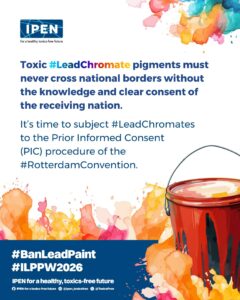
Groups say lead chromates, key pigments used to make lead paint, should be subject to global controls to help eliminate lead paint threats to children, families, and workers.
16 October 2026, Quezon City. The International Pollutants Elimination Network (IPEN) and its participating organizations (POs) worldwide will join forces with their local and global partners for the 2026 International Lead Poisoning Prevention Week (ILPPW) from October 18-24. In line with this year’s theme “From Detection to Prevention,” IPEN has been the world leader in detecting and eliminating lead paint threats, with its global network having conducted lead testing on more than 5,000 paints in 59 countries since 2009.
During ILPPW, various activities are being planned by more than 50 IPEN groups in more than 40 countries from around the world to raise awareness about the health effects of lead exposure; highlight the efforts of countries and partners to prevent lead exposure, particularly in children and workers; and push for the completion of action to eliminate lead paint through regulatory action at the country level.

Updated in time for the 2026 ILPPW, this public notice seeks to guide dealers and consumers on 260 foreign-made leaded paints that would be illegal to import, distribute, and sell in the Philippines.
Last month, IPEN welcomed the decision by the Chemical Review Committee calling for a Rotterdam Convention listing of lead chromate pigments, a key ingredient used to make lead paint. When listed, the Convention’s Prior Informed Consent rules would apply to lead chromates, meaning that the 168 Parties of the Convention must be notified and must consent before receiving lead chromate imports. This will give countries without lead paint restrictions an incentive to adopt a ban, and provide those with regulatory controls a means to enforce them.
Cameroon was the first country to initiate action under the Rotterdam Convention to consider lead chromates. “Even five years after our country adopted a ban on lead paint, we continued to find lead paint on the market in Cameroon. These enforcement challenges led Cameroon to notify the Rotterdam Convention on lead chromates,” said Gilbert Kuepouo, Executive Director of the Centre de Recherche et d’Education pour le Développement (CREPD), an IPEN member group in Cameroon. “The government’s expectations are high that a listing will help resolve this challenge and protect children and families in Cameroon from lead paint.”
In Latin America, recent research by IPEN member groups from Argentina, Brazil, Colombia, and Mexico found significant trade in lead chromates across the region, with the US-based Vibrantz Technologies responsible for 84% of this trade. The groups called on Vibrantz and other producers “to stop this harmful production and trade” and called on governments to establish “regional and international measures” including creating a trade code for lead chromates, harmonizing customs records, and providing clear information regarding the content and hazards of shipments, among other measures.
Lead paint is a well-known source of lead exposure, with particular risks for children who face serious health threats from even very low levels of lead exposure. Childhood lead exposure damages the developing brain, as well as the nervous, immune, reproductive, and cardiovascular systems, with a range of adverse effects including loss of IQ, attention deficit disorder, hypertension, and other physical and behavioral problems.
Often, these effects are permanent, irreversible, and untreatable. Some countries, including China, Niger, and Liberia, as well as the regional Eurasian Economic Union (EAEU) bloc, have recently seen progress in policies to ban lead paint, but about half of the world’s countries still lack comprehensive rules to end lead paint sales, leaving millions of children at risk of lead poisoning.

Including lead chromates in the Rotterdam Convention promotes transparency and gives countries control over these toxic paint pigments crossing their borders.
“It is past time to end the scourge of lead paint globally,” said Manny Calonzo, of EcoWaste Coalition in the Philippines and a former IPEN Co-Chair. “We call on governments, industry, and civil society to work for stronger national and global policies to act now and eliminate this toxic threat to our children’s health.” In 2018, Manny was awarded the Goldman Prize for his work to eliminate lead paint in the Philippines.