The United States and Israel continue attacking Iran while the powers that could contain the war watch as the planet moves closer to the nuclear brink…
“It begins when those who can stop the next attack decide merely to watch it…”
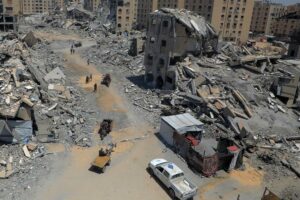
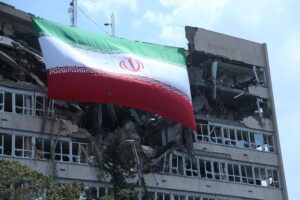
The United States attacks Iran. Israel attacks Iran. They attack again and then announce new targets, as though a nation of nearly ninety million people were a firing range placed at the disposal of their aircraft. We are no longer facing a diplomatic warning or an isolated operation. We are facing an open war whose daily repetition seeks to turn aggression into routine.
“When bombs fall on a known schedule, barbarism begins to look dangerously like administration.”
Washington has carried out attacks on consecutive nights and now threatens to destroy power plants, bridges, and other infrastructure if Tehran continues acting against shipping and U.S. forces. Israel, its essential military ally, is likewise maintaining its operations. Each new attack expands the battlefield, narrows the space for negotiation, and pushes Iran toward increasingly severe responses.
“The power that sets fire to the bridge often presents itself afterward as the only one concerned about traffic.”
Iran responds with missiles, drones, and pressure on strategic routes. That response could extend the war into the Persian Gulf, Iraq, the Red Sea, and the Strait of Hormuz, through which a decisive share of the world’s energy flows. But the sequence must not be hidden beneath a false verbal fog. The United States and Israel are bombing Iranian territory, and Iran is responding to those attacks.
“Impartiality does not mean concealing who fires first, but also examining what each shot provokes.”
The nuclear brink is present. Facilities connected to Iran’s atomic program have been attacked, threats have been made to bomb additional underground complexes, and the international agency responsible for oversight has lost the ability to fully monitor nuclear materials, equipment, and activities. Even without an atomic explosion, attacking nuclear facilities can cause contamination, loss of oversight, and desperate decisions.
“Playing with nuclear facilities is a very modern way of lighting matches inside a refinery.”
And what are the other lions doing? Russia denounces the aggression but fails to impose a ceasefire. China calls for an end to the attacks, while cautiously protecting its commercial and energy routes. The European Union debates principles while remaining outside the fundamental decisions. India calculates its interests and avoids confronting Washington openly. All possess influence; none has yet turned it into a barrier capable of stopping the bombers.
“The great powers speak of balance with the calm of those watching the fire from an insured room.”
Russia and Iran are strategic partners, and bombing Iran means bringing an American war ever closer to Russia’s security space. China depends on regional energy flows and knows that a disruption in Hormuz would strike its economy. Europe will face renewed pressure from energy costs, inflation, and migration. India will not remain untouched either. Yet the powerful continue behaving as though the war were a regional problem rather than a fuse connected to the global system.
“Geography often punishes those who believe fires respect the borders drawn on maps.”
Meanwhile, on screens around the world, the war appears in small print. First the stock markets, then oil, then sports, and finally a few seconds for the dead. Destroyed cities become repeated images, and victims become figures that disappear before the next commercial break.
“When a bomb occupies less space than advertising, information has not advanced; humanity has retreated.”
The United States and Israel must stop the attacks. Russia, China, the European Union, India, and the Security Council must abandon the comfort of statements and build real, immediate, and coordinated diplomatic pressure.
“Because the nuclear brink does not always arrive announced by a massive explosion…”
“Sometimes it approaches slowly, attack after attack, while the lions watch and the world changes the channel…”
“History never forgives those who started the war, but neither does it absolve those who had water and preferred to deliver speeches…”
Short Bibliography
• United Nations Office for the Coordination of Humanitarian Affairs, OCHA. Islamic Republic of Iran: Humanitarian Update No. 01, March 2026. On civilian casualties, displacement, damage to homes and infrastructure, and the humanitarian consequences of the bombings.
• International Atomic Energy Agency, IAEA. Reports on Aerial and Missile Attacks Affecting Iranian Nuclear Facilities, March–April 2026. On the attacks against Iranian nuclear facilities, radiological risks, and the obligation to protect nuclear safety during armed conflicts.