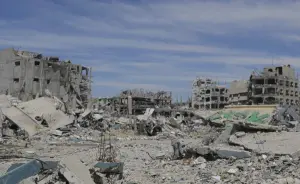
When Britain’s Green Party passed a motion declaring Zionism a form of racism on 4 October, the British media erupted in controversy. Politicians, commentators and representatives of Jewish organisations were given extensive opportunities to express their reactions. But where were the Palestinians? According to an analysis by NewsCord, of 447 articles published across British national news outlets during the first twenty days of October, only 33 quoted a Palestinian. Here was a debate intimately connected with Palestinian rights and their future, yet Palestinian voices were largely absent. This raises a question that goes beyond the controversy itself: what happens to our capacity for empathy when journalism repeatedly makes some people’s experiences less visible than those of others?
Discrimination in journalism does not always require racist language or openly expressed hostility. It can operate through something far more insidious: deciding whose voices deserve to be heard, whose suffering merits our attention, and whose experiences can safely be ignored. When one population is presented as individuals with names, families, fears and aspirations, while another appears primarily as statistics, anonymous victims or a political problem, the consequences go beyond unequal reporting. Such choices shape the meanings through which audiences perceive other human beings, making it easier to identify with the suffering of some while leaving the suffering of others distant, abstract and easier to disregard.
This is not an isolated phenomenon. In 2024, the Centre for Media Monitoring published an extensive study of British coverage of Israel and Palestine during the first month following 7 October 2023, analysing more than 176,000 television clips and 25,000 online articles. It found that Israeli perspectives were referenced almost three times more frequently than Palestinian perspectives on television, while emotive language describing Israeli suffering appeared eleven times more frequently than equivalent language describing Palestinian suffering. Such patterns cannot be explained simply by examining the attitudes of individual journalists. They must also be understood in terms of the editorial priorities and institutional decisions that shape what reaches the public. When a media organisation repeatedly privileges one population’s voices and experiences while marginalising another’s, its overall coverage can reveal an institutional bias that no individual article necessarily makes explicit. Whatever the intentions behind it, such a pattern can serve a function: bringing the suffering of some people closer to the audience while keeping the suffering of others at a distance. Propaganda is not only what you publish, it is also what you don’t.
The American schoolteacher Jane Elliott demonstrated how readily discrimination can be learned and reproduced. In 1968, following the assassination of Martin Luther King Jr., she divided her pupils into two groups according to eye colour, arbitrarily declaring one superior to the other. Within a remarkably short time, the children began treating one another differently. Those designated inferior became fearful and uncertain, while those given privileges readily exercised their newfound power. Elliott’s exercise revealed how easily prejudices and hierarchies can become accepted as reality. But it also raised a more hopeful possibility: if discrimination is learned, might it also be unlearned?
How does this happen? In Silo’s Scheme of the Psychism, our experiences are not simply stored as isolated memories. Information arriving through the senses is recorded together with the feelings, bodily sensations and meanings associated with it. Over time, these structured memories contribute to what Silo calls our formative landscape: the accumulated experiences, values, beliefs and emotional tones through which we have learned to interpret the world. When we encounter something new, consciousness does not approach it as a blank slate. What we perceive interacts with what we have already experienced. Prejudices, therefore, are not merely opinions we hold; they can become part of the very landscape through which we see other human beings.
This brings us to empathy. When we see an image of someone suffering, or hear an account of their experience, that information enters our psychism through the senses. It can activate memories of our own suffering, fear, loss or vulnerability. These memories carry sensations and emotional tones of liking or disliking, attraction or aversion. Their activation produces a new internal experience, which consciousness registers and which, in turn, contributes to memory. We do not directly experience the suffering of another person. We experience what happens within ourselves when their suffering encounters our own history. This helps explain why the same image can awaken compassion in one person, distress or rejection in another, and apparent indifference in a third.
Our responses to suffering are therefore neither automatic expressions of universal compassion nor simply matters of personal choice. They are conditioned by our formative landscape: our family, culture, education, personal experiences and the stories we have heard about others. Someone raised to regard a particular population as threatening may experience rejection where another feels solidarity. Someone repeatedly exposed to suffering may become overwhelmed or resigned rather than indifferent. But these initial reactions need not determine what happens next. Can we become conscious of the influences shaping our responses and begin to transform them?
Something significant is changing, however, in the way these landscapes are formed. For generations, television networks and newspapers exercised considerable influence over which images and voices reached the public. Today, particularly among younger people, news also arrives through social media, often in videos recorded by those experiencing events themselves. Images and testimonies from Gaza can reach audiences without first passing through traditional Western news organisations. According to Ofcom’s 2026 research, 78% of British 16–24-year-olds encountered news through social media or video-sharing platforms in the preceding month. This does not make their information unfiltered or necessarily more reliable: algorithms, selective presentation and misinformation introduce other distortions. But people growing up in the same society may now encounter profoundly different representations of the same events, contributing to different formative landscapes and responses to suffering.
Fortunately, our formative landscape is not an inescapable prison. Silo describes a capacity of consciousness that he calls reversibility: the possibility of deliberately directing our attention towards what we perceive and remember, rather than simply allowing habitual reactions to carry us along. When confronted with another person’s suffering, we can examine our own responses. Why does this image disturb me? Why do I feel sympathy for one person but suspicion towards another? What experiences or beliefs might be influencing my reaction? We can also seek out unfamiliar voices and experiences that challenge what we think we know. Reversibility does not magically eliminate prejudice, but it opens the possibility of recognising our conditioning and changing our relationship with it.
But recognition is only the beginning. We may feel deeply moved by another person’s suffering and still experience helplessness, convinced that nothing we do can make a difference. What can transform resignation into action? One possibility lies in the meaning we give to our lives. When we develop a deeply felt Purpose — perhaps to contribute to a more humane world, overcome discrimination or help reduce suffering — that direction gradually becomes part of our formative landscape, transforming the values and meanings through which we interpret experience. It provides new references for consciousness and allows us to imagine possibilities that previously seemed closed. The suffering of others need no longer lead only to distress or helplessness; it can also become an invitation to act.
A Purpose, however, does not transform reality simply because we believe in it. In Silo’s psychology, images of a possible future can mobilise our centres of response, helping to translate intention into action. We might imagine taking a concrete step: listening to an excluded voice, challenging a prejudice or joining a local initiative. When we act, the experience and its emotional significance are recorded in memory, becoming part of the landscape through which we interpret future possibilities. Even small actions can weaken the conviction that nothing can be done. In this way, faith in our own capacity to act can grow through experience, creating a positive cycle in which meaningful action strengthens our confidence to undertake further action.
This is where journalism has an extraordinary responsibility. Journalism cannot manufacture empathy, nor should it manipulate audiences into predetermined emotional responses. But it can create the conditions in which empathy becomes possible: by giving voice to those who are excluded, presenting people as human beings rather than abstractions, providing historical context and revealing possibilities for nonviolent change. Reporting suffering is necessary, but reporting only suffering can reinforce helplessness. Journalism can also illuminate those working to overcome it. Returning to the controversy surrounding the Green Party motion, the question is not whether Palestinian voices should replace Jewish voices, or vice versa. It is why a debate involving the rights, identities and futures of both peoples should leave so many of those directly affected unheard. Ultimately, nonviolent journalism begins with a simple commitment: to humanise the dehumanised.