17 January 2026, Quezon City. Laboratory analyses detected lead above the legal limit of 90 parts per million (ppm) in three imported paints purchased by the EcoWaste Coalition from a local online seller, rendering them illegal for importation, distribution, and sale in the Philippines.
Based on the test reports provided by SGS, a global testing company, the submitted samples of green, beige, and orange Nasmc Spray Paint contained 7,460 ppm, 10,000 ppm, and 30,500 ppm of lead, respectively.
The Chemical Control Order (CCO) for lead and its compounds issued by the Department of Environment and Natural Resources (DENR) in 2013 established a strict 90 ppm maximum limit for lead in all paints, including spray paints. The CCO further set phase-out deadlines for lead-containing decorative and industrial paints, which ended on December 31, 2016, and December 31, 2019, respectively.
As stamped on the bottom of the paint cans, all three products were manufactured on June 25, 2025, which is well past the phase-out deadlines, the EcoWaste Coalition pointed out.
Bought for P141 per 450 mL can from a Shopee dealer, Nasmc Spray Paint provided no lead content information or lead in paint hazard warning on its label to forewarn consumers. The name of the manufacturer and the country of manufacture were also not disclosed. However, the label described the product, usage, and emergency instructions.
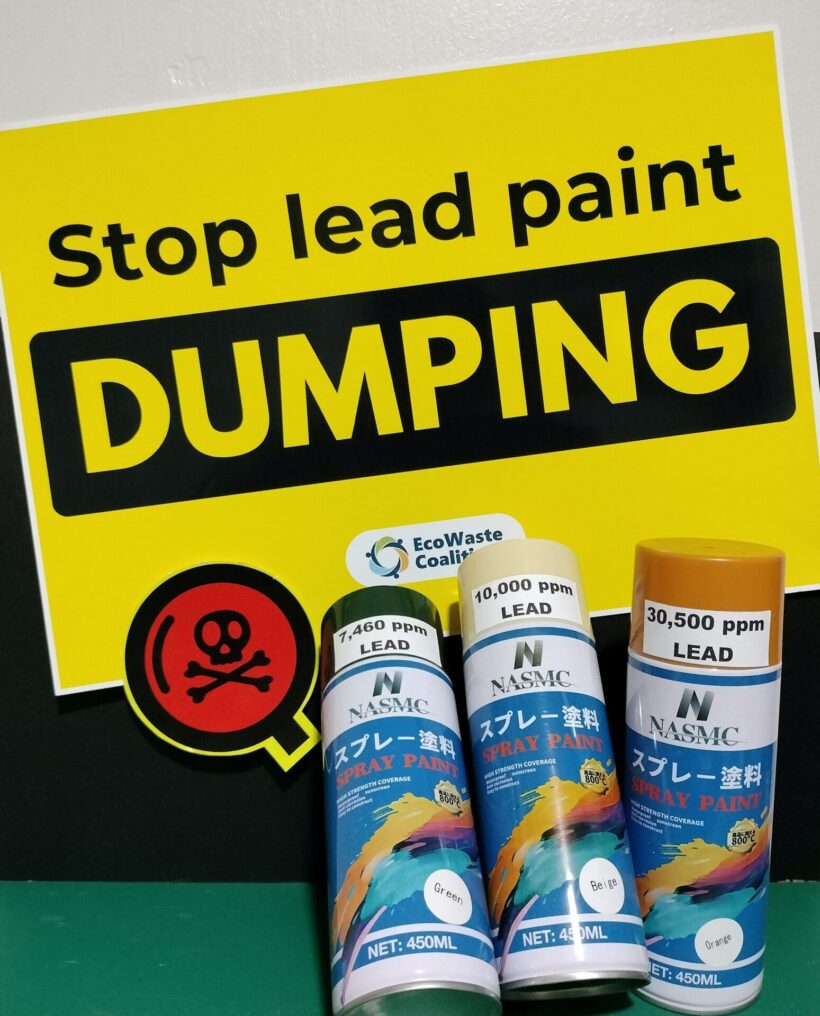
The three lead-containing Nasmc products will be added to the “Public Notice on Lead-Containing Paints” co-published by the EcoWaste Coalition, International Pollutants Elimination Network (IPEN), and the Philippine Paint and Coatings Association, Inc. (PPCAI). The notice currently lists 228 laboratory-tested lead-containing paints, mostly marked “made in China” or “made in Thailand.”
The persistent sale of imported spray paints with lead content prompted the EcoWaste Coalition to advise consumers to be vigilant and refrain from purchasing paints with poor labeling information and lacking verifiable proof of compliance with the CCO’s lead content limit.
Lead-containing paints are a major source of lead exposure among children globally. “There is no level of exposure to lead that is known to be without harmful effects,” according to the World Health Organization (WHO), which has included lead among the ten chemicals or groups of chemicals of major public health concern, along with arsenic, asbestos, benzene, cadmium, dioxins, mercury, highly hazardous pesticides, etc
Lead is a powerful multi-system poison that harms numerous bodily systems and organs, including the brain and central nervous system. Exposure during early childhood, when the developing brain is most vulnerable, is particularly dangerous, as it can lead to lower intelligence quotients (IQ), inattentiveness, impaired learning ability, conduct disorder, aggression, and other behavioral problems.
To address the unlawful entry of lead-containing paints in the Philippines, the EcoWaste Coalition is campaigning for stronger measures to stop lead paint imports, including the listing of lead chromates as hazardous chemicals in the Rotterdam Convention to control the global trade of these common lead-based pigments and paints containing such pigments.
————————————————————————————————————————————————————————
https://www.ecowastecoalition.org/leadspraypaints/
https://chemical.emb.gov.ph/wp-content/uploads/2017/03/DAO-2013-24-CCO-Lead.pdf
https://www.who.int/news-room/photo-story/photo-story-detail/10-chemicals-of-public-health-concern