By Maxine Lowy
Just as the camanchaca—the dense coastal fog characteristic of northern Chile—often envelops the landscape of Tocopilla in darkness, for many years a thick mist obscured the memory of this town, which had witnessed an intense period of social ferment followed by inconceivable horror. Now, a family from Tocopilla is undertaking a loving and meaningful act: transforming the painful history of their parents, brothers, and uncles, Juan Carlos and Jorge Elías Andrónico Antequera, into a vehicle for strengthening an active historical memory.
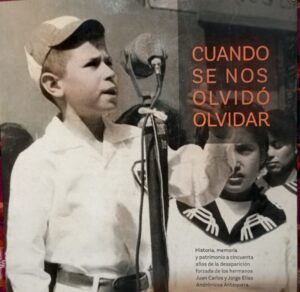
The auditorium of the Museum of Memory and Human Rights was packed on October 3 for the presentation of Cuando se nos olvidó olvidar (When We Forgot to Forget), a beautifully designed publication that is far more than a book.
It is a joint project spanning three generations of a family determined to recover not only the lives of Juan Carlos and Jorge Elías, who were abducted and forcibly disappeared 52 years ago, but also that of Herminia “Mina” Antequera Latrille (1929–2020), whose life was inextricably intertwined with the history of her two eldest sons. The book also serves as a roadmap for transmitting memory at a time when denialism is gaining increasing strength.
The book grew out of a series of guided conversations with the family and is complemented by a meticulous review of judicial and academic archives, as well as archives formed by sites of memory. It also incorporates materials that Mina Antequera Latrille painstakingly collected over decades. Between its covers, readers will find a biographical narrative, the legal history of the case, an extensive collection of photographs, facsimiles of historical documents, and, finally, an educational guide for putting this approach to historical memory into practice.

JC Andronicos Ahumada
Why Remember?
From their respective vantage points, psychologist Elizabeth Lira, former Human Rights Undersecretary Daniela Quintanilla, and historian Carlos Rojas, a member of the book’s editorial team, explored different dimensions of the concept of memory. Juan Carlos Andrónico Ahumada also participated, representing the family and in his capacity as director of the Agitar Memorias Corporation, which conducts workshops for diverse audiences on historical memory and the enduring struggle of women such as his grandmother, Mina.
Elizabeth Lira, recipient of Chile’s 2017 National Prize for Humanities and Social Sciences, has devoted her career to studying memory and the consequences for a society that forgets. She poses the question: “Why remember? […] It is to understand the history of this mother who fought until the very last day of her life for justice, but also to we must understand the processes and the responsibility we have as a society toward those who disappeared. We must remember, above all, because it must never happen again. As long as society does not profoundly reject disappearance and torture, we remain at risk of seeing it happen again.”
“Seeking, preserving, recounting, and transmitting are also ways of calling institutions—and those of us who make them up—to account,” Daniela Quintanilla observed. She served as Undersecretary for Human Rights during the final two years of Gabriel Boric’s government. “Accepting this responsibility means understanding that the search is not over, that Jorge Elías and Juan Carlos remain disappeared. The question—‘Where are they?’—remains unanswered, but the attempt to erase their existence has failed. They live on in the heritage Mina created, in the memory this family has kept alive, and in the dream of a different society that this book gives us an opportunity to reclaim.”
But let us be clear: this is not a vision of heritage as something static and definitive. As Carlos Rojas of the Institute of Heritage Studies explained, “A contemporary understanding of heritage involves ongoing processes of activation, using strategies that engage people in recognizing the value of attributes that matter in their everyday lives. In this sense, the documents and press clippings Mina left behind sustain a deep conviction that the search for Truth and Justice must continue, whatever the circumstances. That is what we want to pass on to new generations.”

Mina Antequera Latrille Archive
Stories That Have Not Been Forgotten
Juan Carlos and Jorge Elías grew up with their three siblings in a home permeated by the aroma of freshly baked bread, wafting from the Panaderia El Sol, next door, a bakery owned by their paternal grandfather, a Greek immigrant. The text and photographs collected in the book portray a childhood much like that of many children in northern Chile: they enjoyed the beaches, played baseball and soccer on the dirt field across the street, and flew kites.
Both brothers participated in Salvador Allende’s presidential campaign. It was at their respective universities in Antofagasta—where Jorge studied electrical engineering and Juan Carlos sociology—that they joined the MIR (Movement of the Revolutionary Left). Jorge undertook the important social task of coordinating the installation of electrical services in a newly established neighborhood, with several of his siblings participating in the work. The brothers also joined the demonstrations that converged in the streets of Antofagasta in support of the embattled government.
The nationalization of Cobre Chuqui, Soquimich, the thermoelectric power plant, and state control of Tocopilla’s port under the Popular Unity government brought a substantial presence of socialist government officials to the area. When the civil-military coup took place, long-standing resentment toward the nationalization policies and the officials who had implemented them erupted in retaliation through brutal repression. In the Antofagasta region, and in the municipality of Tocopilla in particular, 31 people were extrajudicially executed or disappeared during the first months following the coup.
It is not known with certainty what measures the brothers took to protect themselves during that terrifying period. In early 1974, Jorge traveled to Santiago to take charge of a communications project supporting the resistance: Radio Rebelde, which the MIR operated from a house in the La Granja district, where its antenna was installed. In April, his mother, Mina Antequera, his brother Juan Carlos, and his sister Arety joined Jorge and his partner in the house. They shared six months of close family life, a period they remembered as one of “beautiful moments,” including the birth of Mina’s first grandchild.
Their lives changed radically on October 3 and 4. On the afternoon of October 3, agents of the DINA, the National Intelligence Directorate, arrived at this strategically important MIR property. They took Juan Carlos away, but the repressors did not leave. When Jorge arrived in the early hours of the following morning, they took him too, and agents remained in the house for another day. Mina served them food in the hope that “wherever my sons are, they will be treated well, too.” Her daughter ironed the shirt of the man commanding the group of military personnel. In one of his pockets, she found something that would prove crucial to the investigations that followed over the coming decades, although she could not possibly have known its significance at the time: an identification card bearing the name of Lieutenant Fernando Laureani Maturana. Several surviving witnesses later testified that they had been held alongside the brothers at the clandestine detention and extermination center at 1367 José Domingo Cañas Street, in the Ñuñoa district.
That week, the facility was particularly crowded with people deprived of their freedom and subjected to torture. On October 4, David Silberman, the director general of Chuquicamata, who had been detained since the previous year, was abducted from Santiago Penitentiary and taken to 1367 José Domingo Cañas Street, as the same witnesses confirmed. On October 5, Miguel Enríquez, the MIR’s top leader, was killed, triggering a cascade of arrests.

Mina Antequera Latrille Archive
The Legacy of Mina, Juan Carlos, and Jorge
Mina’s life dramatically changed as of October 5. The complaint she filed that day with the Comite Por la Paz, the human rights defense institution created by the Santiago Archbishop Raul Silva Henriquez, was the first of more than a thousand steps she would take over the course of the following decades. Along the way, she joined a movement composed predominantly of women who left no stone unturned in their quest for justice for their children and other family members who had been taken from them. They were transformed and empowered, drawing strength from one another through their shared cause. Together, they became the driving force of the resistance.
For Elizabeth Lira, “Mina embodies a set of values associated with caregiving as a natural role of mothers. […] A task, a function, emerges with great force: caring for life, caring for the organization, caring for coexistence, caring for the family, caring for respect for others, building dignity, and educating people in these values. We must seek ways to be constructive and consistent in every sphere, reclaiming this role, which, in my view, has a very strong ethical dimension. In this way, we create the conditions necessary to sustain democracy.”
After Mina’s death, while the family was preparing the house for sale, they discovered a sturdy wooden chest in the courtyard, which they had never noticed before. When her grandson and companion in the human rights endeavor, Juan Carlos, opened the intriguing chest, he found documents, press clippings, photographs, and small objects: a symbolic yet very tangible record of four decades of commitment, driven by a powerful inner force. It was a treasure chest of memory, left as an inheritance for present and future generations. Today, its contents are in the process of being incorporated into the Mina Antequera Latrille Archive at the Museum of Memory and Human Rights.
Juan Carlos Andrónico Ahumada never knew his uncles. Nevertheless, he has become a bearer of their memory. Carrying forward their struggle is, for him, a legacy.
“Perhaps the most valuable thing we have received from Mina, Jorge, and Juan Carlos is not simply the memory of their actions, but the way they chose to make their presence felt in the time they were given to live. It is a way of understanding culture, education, social organization, and commitment to others as inseparable practices in the construction of democracy. And perhaps that is what still endures today, 52 years later.”