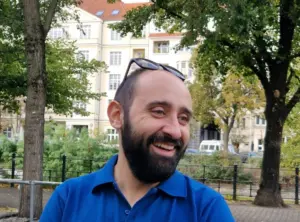
An interview by Helga Merkelbach
I met Mahmoud when he guided us, a group of friends, on his tour “Revolutionary Role of Cafes” in Berlin for the organization Querstadtein e.V. This non-profit association lets people, who are usually rather talked about, have their say.
Homeless show where and how they live, migrants tell their stories (of war, poverty and lately climate catastrophes) and how they live in Berlin now. Mahmoud surprised me with his concept of home in his life.
Learning independence
“When I was nine or ten years old, my father worked in Saudi Arabia, my mother was a teacher of Arabic. Me and my sister were brought up by her to help each other in the family. My sister helped inside the house; Me, I had to go to the market. I took my bike and the shopping list – and brought the worst vegetables.”
His mother hugged Mahmoud and taught him to become an expert, never to pay the first price and watch out for good quality. At home he would also help with the chores and was upset that his sister only worked inside; he had not yet heard the term gender roles. “I was simply an angry teenager, I was angry with my family, with society. I wanted social change, justice…” But, actually, going to the market and doing chores inside was the beginning of living independently.
His sister got married, now has children and until today has not learnt how to go to the market. Mahmoud, however, has taught and empowered his younger sister to be independent like himself.
In Berlin he prefers street markets (first introduced in the city by Turkish migrants and called Turkish markets) rather to the supermarket chains; he loves them for their simplicity, the chats, the bargaining, handmade products like homemade Tahini and Greek real olive oil.
Entering revolution
At the age of twenty-one, when the protests started in Syria, he was scared to join them in his hometown Homs, stood by the side with his cousin and was observing, when suddenly he found himself inside the demonstration. “I yelled out my anger.”
In the early times in 2011 there were only two groups: the people and the regime. “All we wanted was improvement, adjustment. But the reaction of the regime was so brutal, even kids were treated brutally. There was beating, prison, rape, torture that provoked anger and engagement.”
A friend invited him to a café and “we talked. Before 2011 the student union usually looked after students. But at my university they had begun to act like the police. They observed, wrote reports and soon after, students were arrested. After a one-hour talk with my friend we started a new union, our own. We were smart. We wore masks when taken photos of. We used false names.” They managed to organize 40 to 50 demonstrations, with 200 to 500 people, men and women together “as we studied together at university” – different from the usual separate demonstrations of women and men in that time.

The “Fighting Goats” monument alludes to the fable of two stubbornly fighting goats on a bridge who, in the end, both fall exhausted into the water and die. When passing by, Mahmoud feels reminded of the futility of war. © H. Merkelbach
End of Life or Beginning of a New Life
Towards the end of 2011 Mahmoud moved to Damascus “with a friend of mine as we were colleagues at university.”
“One day again I was invited by my friend to meet him and eleven other students at a café in Damascus at 6 pm. I was belated. At 6.30 my friend was out of reach. My friend and the eleven had all been arrested. I expected the police to find me, too. It was a fast decision. I went to my apartment, five minutes only. I had five minutes only to pack everything you need for your life: take it or not, too heavy or not. I took my room mate’s stuff too, his laptop, for safety reasons.”
“It was the hardest decision in my life. I had no money, I really thought this is the end. But it was only the beginning of a new life, first in Jordan from 2011, then 2020, in Germany.”
Shaping Home
On his guided tour Mahmoud tells everything about how his life in Syria and now in Berlin are connected. Among the almost four million Berlin inhabitants about 1.5 million have a migration background. Mahmoud has found a home at “Refugio”, a place where new and long-time Berliners live and work together. It was established in 2015, 40 apartments, a number of NGO offices, space for meetings and artists’ studios. On the ground floor Refugio volunteers run a café where any visitor is welcome and can learn about the coexistence of Germans and immigrants.

Refugio © H. Merkelbach
For three years now Mahmoud finishes his guided tour at “Refugio”. Meanwhile, he has visited Syria again, fourteen days, one day for each of the fourteen years of absence.
“My family are waiting for me to come back. All want me to marry. I am single and I am happy. It was topic number one, marry and get kids. Topic number two were prices and war and destruction. Many friends who returned fell to the ground and cried.”
“I moved into a lot of countries, I am a traveller. Jordan was a station, Berlin is a station, neither is home forever.”
“I am different, all is different, friends are different. I see the world, the war in a different way.”
Go and meet Mahmoud and his friends and exchange your life stories with them!
Book a guided tour: https://querstadtein.org/
Book Mahmoud’s tour: https://querstadtein.org/tour/mahmouds-tour/
Visit Mahmoud’s favourite places in Berlin: https://www.google.com/maps/d/u/0/viewer?mid=1dw4Az2MI-hkzun7Ds3ajF4xcwSCw12E&ll=52.49029180000003%2C13.423387400000006&z=12
Visit Refugio café: https://refugio.berlin/