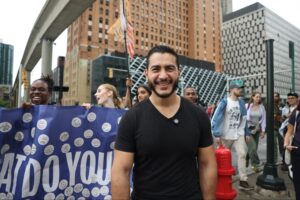
One week before the November 3 vote, the Michigan Senate campaign has entered another phase.
Two weeks before the election, we had observed that the conflict was no longer only about how Abdul El-Sayed was defined, but also about the rules used to define him. When he was asked to distance himself from the Muslim Brotherhood, El-Sayed did not simply deny any connection. He questioned the assumption that, because he is Muslim, he should have to prove that his allegiance lies with the Constitution.
Now the question seems to have widened again: not only who can define a candidate, but who can decide which political alliances are considered acceptable.
From the candidate to his voters
On October 25, Donald Trump returned to Michigan and intensified his attacks on El-Sayed.
At a rally in Port Huron, he again called him a “jihadist,” invoked September 11, and claimed without evidence that the Democratic candidate was linked to the Muslim Brotherhood. Reuters reported that Trump even referred to United Flight 93, one of the planes hijacked on September 11, 2001, while someone in the crowd shouted “deport him.” El-Sayed, who was born in Michigan, rejected the accusations. [1]
But this time the attack did not stop with the candidate. Trump also said that Jews who support El-Sayed should be “ashamed.” [2]
This marks an important shift.
The dispute is no longer only about whether El-Sayed fully belongs to the American political community. It goes so far as to suggest that a particular choice by voters — for example, a Jewish voter supporting a Muslim candidate who is strongly critical of Israel — may itself be considered politically or morally illegitimate.
The boundary is therefore being drawn not only around the candidate, but also between voters.
When voters cross the boundary
And yet, just as this boundary is being hardened, some voters seem to be crossing it.
El-Sayed’s campaign has hired a liaison for Jewish voters and intensified meetings and door-to-door outreach. A public letter supporting El-Sayed has gathered hundreds of signatures from Michigan Jews, while others continue to strongly oppose his candidacy. [3]
The point is not that “Jews support El-Sayed.” That would not be true. The point is almost the opposite: the community does not behave as a single political bloc.
Some Jewish voters remain deeply critical of his positions on Israel and Gaza. Others, while sharing some of those concerns, place greater weight on civil rights, constitutional democracy, or other political priorities.
A boundary drawn from the outside does not necessarily coincide with the choices made within the community.
On the other side as well
A similar movement is visible among some Arab American voters.
In 2024, a significant part of this community voted for Trump, in part as a protest against the Biden administration’s policy on Gaza. Today the picture has changed.
The Washington Post spoke in Dearborn with several Arab American voters who supported Trump in 2024 and now intend to back El-Sayed. Their reasons are not all the same: Gaza, Lebanon and Iran, but also the rising cost of living, wars abroad, and disappointment with the promise of “America First.” [4]
This is not evidence that the entire Arab American community is moving toward the Democrats. Internal differences remain strong.
But here too something significant emerges: religious or ethnic identity does not automatically determine political choice.
And after Trump’s attacks on El-Sayed, Bishara Bahbah, founder of Arab Americans for Trump, also criticized the remarks, calling them racist and unacceptable. [5]
Two ways of drawing a coalition
Two opposing movements are thus overlapping. On one side, Trump and part of the Republican campaign are trying to draw sharper boundaries: El-Sayed is portrayed as outside the national community; Jews who support him are reproached for their choice; and Muslim faith becomes a lens through which political loyalty is interpreted. On the other side, actual voters continue to produce less orderly combinations.
Jews supporting a Muslim candidate critical of Israel. Arab Americans who voted for Trump in 2024 and now choose El-Sayed. Arab American Trump supporters who publicly criticize the president when they believe he has crossed a line.
These choices do not yet form a coherent new coalition. But they show something simpler and perhaps more important: voters are not obliged to respect the boundaries politics draws for them.
One week before the vote
Eight weeks after the primary, the question was whether El-Sayed could cross the boundaries of his own coalition. Three weeks before the vote, the question was who would define what El-Sayed represented. Two weeks before the vote, the conflict had moved to the very rules of definition.
One week before the vote, another question appears: will voters accept those boundaries — or cross them on their own?
This may be the most interesting development of the past week. Politics constantly tries to classify voters: Jews, Muslims, Arab Americans, progressives, conservatives. But democracy also lives in the moment when voters reject the category assigned to them and decide for themselves whom to stand with.
Next week we will see whether, and how, these movements are reflected in the result at the ballot box.
Notes
[1] Reuters, October 25, 2026, on Trump’s rally in Port Huron and his attacks on El-Sayed.
[2] Jewish Telegraphic Agency, October 26, 2026, on Trump’s remarks directed at Jewish voters who support El-Sayed.
[3] Jewish Telegraphic Agency, October 21 and 26, 2026, on the campaign’s outreach and divisions within the Jewish electorate.
[4] The Washington Post, October 22 and 27, 2026, on shifts among part of the Arab American electorate and on some former Trump voters who now support El-Sayed.
[5] Associated Press, October 26, 2026, on Bishara Bahbah’s criticism of Trump’s attacks on El-Sayed.
[6] On October 24, Barack Obama campaigned for El-Sayed in Detroit. Although this was an important development, it does not substantially alter the dynamic analyzed here.
Article based on publicly available materials consulted through October 27, 2026