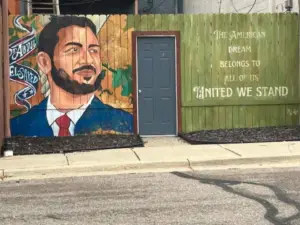
Two weeks before the November 3 vote, the Michigan Senate campaign appears to have taken another turn. Three weeks earlier, we had posed a question: who will succeed in defining what Abdul El-Sayed represents? Donald Trump and Mike Rogers were trying to present him not only as a progressive candidate, but as a “radical,” a “terrorist sympathizer,” someone whose Muslim identity could be turned into a reason for suspicion.
Now that battle seems to have moved one step further: the issue is no longer only how El-Sayed is defined, but also the rules by which that definition is constructed.
A question — and the hidden question
At a public event in Michigan, a participant asked El-Sayed whether he was willing to distance himself from the Muslim Brotherhood. His immediate answer was simple: yes, absolutely. But El-Sayed did not stop there. He asked why the questioner assumed that a Muslim candidate had to explicitly demonstrate his distance from an Islamist organization. He then compared that kind of suspicion to the questions about “dual loyalty” once directed at John F. Kennedy because he was Catholic. [1]
Video of the exchange spread rapidly online, surpassing 13 million views, according to the Wall Street Journal. The interesting point, however, is not the virality but the change in the structure of the response: El-Sayed is no longer merely rejecting an accusation. He is questioning the premise that makes the accusation possible.
From the answer to the rule
Taken in isolation, the question about the Muslim Brotherhood may look like a request for political clarification. But in the context of this campaign it takes on a different meaning. Trump has continued to call El-Sayed “Mohammad,” to describe him as a “jihadist,” and to link him without evidence to the Muslim Brotherhood. Even at a rally in Kansas, far from Michigan, the president returned repeatedly to El-Sayed, along with other Muslim political figures. [2] Rogers, for his part, has repeatedly tried to link El-Sayed to people or organizations described as extremist.
In this context, the question no longer concerns only a political position. It also contains an implicit question: how much must a Muslim candidate prove that he fully belongs to the American political community? This is where El-Sayed’s response changes the ground of the argument. He is not merely saying: “I do not belong to the Muslim Brotherhood.” In substance, he is asking: why am I the one who has to pass this test?
A broader conflict
The tension does not concern only the two candidates. The Associated Press has described the Michigan race as a focal point for tensions now running through parts of the Jewish, Muslim and Arab American electorates: Israel, Gaza, antisemitism, Islamophobia, security and national belonging overlap in ways that are difficult to separate. [3]
This makes any attempt to turn religious or cultural identities into political shortcuts particularly delicate. Criticizing the Israeli government does not automatically amount to hostility toward Jews; being Muslim does not imply sympathy for Islamist movements. These distinctions are obvious in theory. In a polarized election campaign, however, they can become precisely the terrain of political conflict.
Who defines whom?
Three weeks before the vote, the question was: who will succeed in defining what El-Sayed represents? Two weeks before the vote, that question seems to have deepened. El-Sayed is not merely trying to offer an alternative definition of himself. He is challenging his opponents’ right to construct that definition from his religion and to demand proofs of belonging that would hardly be required in the same way of other candidates.
The conflict thus moves from defining the candidate to the rules of definition. And perhaps this is where the Michigan campaign goes beyond the personal case of Abdul El-Sayed. The question is no longer only who he is. It is also which questions a democracy considers legitimate to ask a candidate — and what assumptions those questions conceal.
Notes
[1] WSJ, October 20, 2026, “How an Abdul El-Sayed Opponent Handed Him a Campaign Highlight”; Guardian, October 19, 2026, “Man who heckled Abdul El-Sayed is former Josh Hawley aide, records show”.
[2] Guardian, October 19, 2026, coverage of Donald Trump’s rally in Kansas, including renewed attacks on El-Sayed and other Muslim political figures.
[3] AP, October 17, 2026, “A bitter Michigan Senate race rattles Jewish and Muslim voters already on edge over the war in Gaza”.
Article based on publicly available materials consulted through October 20, 2026.


