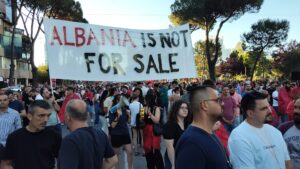
More days and weeks have passed, and the protest has entered its third month. Today, the “Flamingo Revolution” marks its 75th consecutive day. Despite the heat and the holiday season, Albania remains gripped by a mobilization that has not lost momentum and has, in the meantime, opened up new fronts.
Even on days when temperatures exceeded 35 degrees, protesters continued to gather every evening outside the seat of government; for instance, evening temperatures on *Bulevardi Dëshmorët e Kombit* reached 38°C.
In recent weeks, the mobilization has expanded in both scope and geography. The daily sit-ins in Tirana have been accompanied by formal complaints filed with SPAK (the Special Prosecution Office against Corruption and Organized Crime), referendum initiatives, and protests against the proposed administrative-territorial reform.
 Picture Credit: ©️Trivet
The flamingo has become a symbol of resistance and has showcased the full extent of Albanian creativity.
From Parliament to the police station
On July 27, during the final parliamentary session before the summer recess, protesters returned to the area outside Parliament. They were met by a massive security operation, with access points to the zone closed off and law enforcement deployed across a much wider perimeter than usual.
Twelve people were taken to police stations; some were reportedly detained while filming, helping a protester who had fallen, or simply while positioned far from the main flashpoint. All were released after a few hours, yet the attempt to intimidate protesters remains clear.
 Picture Credit: ©️Trivet
July 27: a protest in front of the Albanian Parliament, with police barriers extending well beyond the Parliament grounds.
A few days earlier, Edi Rama had unveiled “BESA,” a strategic document in which the government acknowledges a crisis of confidence in itself and proposes new tools for “listening” and “dialogue”—forms of transparency that institutions and the law ought to guarantee already. In doing so, however, he appropriates both the flamingo—the symbol of the protest—and the *besa* (a central concept in Albanian culture linked to one’s word of honor and responsibility toward the community), bending them to serve government propaganda.
 Picture: Credit: ©️Trivet
A sign asking, “State Police or Police State?”
New territorial battlegrounds
A new source of protest has emerged following the government’s proposal for administrative-territorial reform. The draft plan aims to reduce the number of municipalities (*bashki*) from 61 to 46, effectively eliminating fifteen municipalities through mergers: Përrenjas, Poliçan, Dimal, Divjakë, Klos, Memaliaj, Belsh, Rrogozhinë, Libohovë, Selenicë, Maliq, Patos, Cërrik, Këlcyrë, and Fushë-Arrëz.
By August 3, opposition to the reform had spread to at least 12 municipalities; today, August 13, it has reached all 15 municipalities slated for merger. In 14 of these, the opposition has taken the form of public demonstrations, while in Cërrik, it has involved a petition drive.
The handling of the wildfires also fueled the protests, highlighting the vulnerability of the landscape and the systems tasked with protecting it. The flames reached areas including the hills surrounding Kruja—the city of Skanderbeg—threatening homes, explosives depots, and the archaeological site of Albanopolis, and forcing the evacuation of residents from several villages. The head of the fire service resigned at the very height of the crisis.
 Picture Credit: ©️Trivet
Protest in Belsh. The signs read “Municipalities for the citizens, not for the powerful” and “Our municipality is not a number.”
Local mobilizations have also begun to yield initial results, albeit partial ones. On August 5, the state-owned power company KESH suspended work on the Mërtur River following protests by residents of Nikaj-Mërtur. This suspension does not yet amount to a cancellation of the project; residents are demanding a comprehensive review and guarantees for the protection of the river and its ecosystem.
An initial victory was also achieved by the 74 families affected by the TID project in Durrës—following a year of mobilization—when the government repealed the 2020 decree establishing “New Development Zone No. 5” in the historic Epidamn district, although it did not formally cancel the controversial project itself.
As in Mërtur, then, the resistance has forced the authorities to back down without definitively resolving the dispute: residents are still calling for the project to be suspended and revised, as well as for the full disclosure of all related documents.
From the public square to the courtroom
The ResPublica Center and the environmental group EcoAlbania have launched a legal challenge against the bulldozer work carried out on the Pishë Poro-Narta dunes. According to the organizations, the operations—described as “preliminary”—have already damaged habitats, vegetation, and the delicate balance between the lagoon and the sea.
On August 7, an initiative was announced to promote a referendum to repeal Law 21/2024 on protected areas—one of the five demands raised by the protesters. Given that Albania’s last national referendum took place in 1998 regarding the adoption of the Constitution, this move also represents a call for direct participation in the face of institutions perceived as unwilling to listen.
Finally, on August 12, a signature drive was launched to file a complaint with SPAK against Edi Rama and other public officials. The aim is to call for an investigation into the procedures followed for projects planned in Zvërnec, Rrjoll, and Divjakë-Karavasta, as well as the role of *ad hoc* legislative amendments that opened protected areas to tourism investment—based on information reported by Albanian Files.
 Picture Credit: ©️Trivet
A sign mocking and accusing the book *The Albanian Files*
A local, national, and geopolitical protest
Mass graves have been discovered in northern Kosovo—specifically in the Zubin Potok area, at Kalludër and Jabukë—and search operations are ongoing. According to Kosovar authorities, the remains may belong to individuals abducted and killed in the spring of 1999—victims of a genocide too often overlooked in public discourse, yet one that still accounts for 1,600 missing persons. Almost simultaneously, plans were announced to open Serbian consulates in Shkodër and Bujanovac. This prospect sparked a protest in Shkodër on August 2nd.
International developments have further fueled the protest. During a visit to Belgrade, Volodymyr Zelensky reiterated that Ukraine does not recognize Kosovo’s independence and continues to regard it as part of Serbia’s sovereign territory. Although this merely reaffirmed previously stated positions, it sparked strong reactions in Pristina and Tirana—particularly given the political, humanitarian, and material support Kosovo and Albania have extended to Ukraine. Memories of the genocide suffered by the Albanian people, combined with the context of current conflicts, have intensified criticism regarding the relationship between Rama and Vučić—who served as Minister of Propaganda at the time of the genocide—thereby reinforcing perceptions of complicity and a “betrayal of the people’s interests.”
 Picture Credit: ©️Trivet
Image of the march at the end of the sit-in
Territory, the climate crisis, grassroots democracy, memory and diaspora, foreign policy, and justice continue to converge within a mobilization that has never centered on a single demand. The flamingo has become the symbol of a people’s resistance.