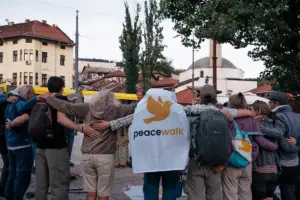
After crossing several European countries, participants in an international peace initiative have reunited in Kosovo, carrying a message of dialogue, reconciliation, and human connection through a region still marked by the wounds of war.
On November 3, two routes of the international Peacewalk to Jerusalem came together on a bridge in Mitrovica, Kosovo. Walkers arriving through Serbia met those who had travelled through Bosnia and Herzegovina and Montenegro, joining their paths into a single journey toward Jerusalem.
The meeting was more than a logistical milestone. In a region where borders, identities, and historical divisions continue to shape everyday life, the simple act of walking together carries a powerful symbolic message: peace begins when people are willing to meet one another beyond their differences.
The occasion was marked by a global initiative called Bridge Day, inviting supporters around the world to gather on bridges in their own communities. While participants reunited in Mitrovica, others joined symbolically from different countries, transforming bridges into places of encounter rather than separation.
Sarajevo: Remembering the Past, Building the Future
Before reaching Kosovo, the Peacewalk participants spent a week in Sarajevo, the capital of Bosnia and Herzegovina, a city whose history embodies both the richness of cultural coexistence and the devastating consequences of war.
Walkers from different countries gathered for meetings, workshops, conversations, and exchanges with local peacebuilders. The program included guided visits through the historic city, a Living Library where participants shared personal experiences, and discussions about the challenges of building peace in divided societies.
Sarajevo’s mosques, churches, and synagogues stand as reminders of centuries of cultural and religious coexistence. Yet the city also bears the visible scars of the 1992–1995 siege, including bullet-marked buildings and the Sarajevo Roses, shell craters filled with red resin commemorating those killed during the conflict.
One of the most significant moments of the gathering was a visit to Srebrenica, where the genocide of July 1995 remains one of the darkest chapters of recent European history.
Standing among the white grave markers, participants confronted the human consequences of ethnic hatred, nationalism, and the failure to prevent mass violence.
The experience offered an opportunity not only to remember the victims but also to reflect on the responsibility of present generations to prevent such tragedies from happening again.
Another memorable moment came during a barefoot walk through Sarajevo in the pouring rain. Participants walked silently through the streets before gathering in a circle to sing together.
According to the Peacewalk newsletter, one local peacebuilder was deeply moved when the group began singing a song she had carried with her for years. Having sometimes felt isolated in her work, she experienced the gathering as a reminder that those working for peace are not alone.
Such encounters illustrate an important dimension of the initiative: peacebuilding is not limited to political agreements or institutional negotiations. It also involves overcoming isolation, recognizing shared humanity, and developing relationships across cultural and historical divisions.
Through Montenegro: Peace as a Daily Practice
Leaving Sarajevo, the walkers continued through Montenegro toward Kosovo, crossing landscapes of mountains, small villages, industrial areas, and rural communities.
Along the way, local residents offered food, advice, accommodation, and gestures of hospitality. These everyday encounters became an essential part of the journey.
The walkers also faced practical challenges. Without support vehicles, participants have increasingly taken responsibility for carrying their belongings, finding accommodation, organizing meals, and making collective decisions.
Living and travelling together requires patience, flexibility, and cooperation among people with different backgrounds, expectations, and needs.
In this sense, the Peacewalk is not simply a demonstration in favor of peace. It is also an experiment in practicing nonviolence through daily relationships, shared responsibilities, and the collective resolution of difficulties.
A Bridge in Kosovo, a Message Beyond Borders
The reunion in Mitrovica on November 3 carried particular significance.
Mitrovica remains one of Kosovo’s most sensitive cities, where the Ibar River has long symbolized divisions between communities, particularly Kosovo Albanians and Kosovo Serbs.
By choosing a bridge as their meeting point, the walkers offered a symbolic alternative to the logic of separation.
Rather than allowing historical conflicts to determine the possibilities of the future, the initiative emphasizes encounter, dialogue, and the willingness to move forward together.
Around seventeen participants were continuing the journey through Kosovo at the time of the newsletter’s publication. They were expected to reach Pristina on November 6 and continue through Kosovo until November 14, before heading toward North Macedonia and Greece.
The broader destination remains Jerusalem, a city of profound religious, historical, and political significance, but also one associated with some of the world’s most enduring conflicts.

Walking Toward a Different Future
At a time when Europe and the Middle East are experiencing renewed militarization, political polarization, and armed conflict, initiatives such as the Peacewalk offer a different approach to international relationships.
Their contribution is not measured by the number of kilometers travelled or the immediate political changes they produce, but by the connections they create among individuals and communities.
The journey through Sarajevo, Srebrenica, Montenegro, and Kosovo illustrates how the memory of violence can become a starting point for dialogue rather than a justification for continued confrontation.
The Peacewalk’s experience also raises a broader question: Can societies begin to overcome historical divisions by creating new shared experiences rather than remaining confined to inherited narratives of conflict?
The walkers do not claim to have all the answers. Their approach is to continue meeting people, listening to different experiences, and discovering what becomes possible through cooperation.
As the initiative continues toward Jerusalem, its message remains simple: peace is not only a destination to be reached, but a way of relating to one another that can begin here and now.
For information about the Peacewalk, participation opportunities, and ways to support the initiative, visit peacewalk.info.