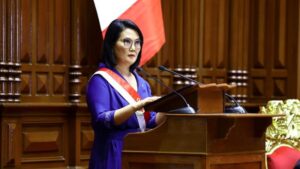
Finally, on July 28, Keiko Fujimori Higushi took office as the constitutional president of the Republic of Peru, following three previous attempts: in 2011 (against Ollanta Humala), in 2016 (against Pedro Pablo Kuczynski), and in 2021 (against Pedro Castillo). Today she delivered her first address to the nation and swore in the Council of Ministers.
Assessment Without Self-Criticism
In her first address to the nation as president-elect, Keiko Fujimori reaffirmed the statements she had made days earlier, noting that she finds a “state in a state of neglect, lacking a vision for the country, devoid of strategic management, and weakened by corruption.”
Fujimori Higushi assessed the state of the country, highlighting that it had fallen “into the hands of opaque interests, to the detriment of citizens; public procurement resulting in losses; and extortion that stifles entrepreneurs and small business owners,” and promised “a new way of governing.”
To achieve his goals, he proposed beginning his term with seven priorities:
- Emergency response and public safety (using all the tools at the state’s disposal).
- Improving quality of life (reorganizing social programs).
- Expanding productive infrastructure.
- Simplifying the functioning of the state (transforming the public procurement system).
- Fiscal sustainability (raising the minimum living wage to 1,300 soles, reducing barriers to foreign investment, and reactivating Prompyme).
- Strengthening the rule of law (while respecting the separation of powers).
- Strengthening foreign policy.
However, the speech, which lasted nearly an hour, lacked any admission of fault regarding the actions of her Fuerza Popular caucus and its allies in recent years—actions that had contributed to the very problems the president herself had identified.
Beyond the assessment and proposals, serious doubts also remained regarding what was left unsaid or only partially addressed. Thus, the scope of statements such as “making use of all the tools of the State to restore authority” and the “strengthening and expansion of flagrancy units”—for which delegated powers will be requested (in the case of security)—remains to be clarified.
Another aspect that requires further examination is what the “reorganization of social programs” will entail, given that during a reform in April 2025, the previous government shut down the Qali Warma social program, which provided meals to more than 4.2 million schoolchildren in over 64,000 public educational institutions.
In her address to the nation, the president-elect also announced plans to “double the bimonthly payment under the Pension 65 program” from 350 soles to 700 soles, a program that serves more than 820,000 beneficiaries nationwide; and to increase the minimum living wage from 1,130 to 1,300 soles, which will include a compensatory bonus for micro and small businesses (mypes).
Opposition Senators and Deputies Walk Out of the Chamber
In an unprecedented move, before her first State of the Nation address, opposition members of the Senate and Chamber of Deputies walked out of the chamber and headed to Plaza San Martín, where they joined the crowd demonstrating in parallel with the official transfer of power. Senators and deputies concluded their march in front of the Palace of Justice, delivering a message of hope to the public, who are awaiting concrete actions from the new government.
“We don’t believe a word of it”
Víctor Cutipa Ccama, a senator from Juntos por el Perú (JP), told Pressenza that they walked out of the chamber as an act of protest: “It is an act of expression through which we are signaling that we do not believe a word of what this regime says—a regime with a past rooted in the 1990s, marked by repression, death, and human rights violations; and we believe—and are certain—that what lies ahead in the coming days or starting today is nothing more than a carbon copy, a repetition of the 1990s.
The people of Peru had hoped that this election would result in an opposition victory in the Senate, so that we could at least strike a balance and achieve stability in the country. Unfortunately, that has not happened; they have already taken control of the Senate and the Presidency of the Congress of the Republic. But from the Senate and the Chamber of Deputies, we will mount the necessary resistance to prevent this regime from moving forward with impunity.
We’re going to start with the pro-crime laws—we have to repeal them. But we have an outstanding obligation to the people of Peru, which is to establish a Constituent Assembly to draft a new constitution. Furthermore, we must pass the referendum law. Previously, in the first vote, Congress would vote on constitutional reform issues, and the second vote required a referendum to consult the people of the country. They got rid of that—they erased it, they repealed it—because they abused the parliamentary majority they held. Today, we are going to restore it.”
“We are going to repeal pro-crime laws and eliminate special privileges”
Congresswoman Caterin Palomino Casavilca, of Juntos por el Perú (JP) representing Huancavelica, also told Pressenza: “As a caucus agreement and in response to the people, we’re going to propose the repeal of all pro-crime laws, but the people are also demanding an end to the perks in Congress, such as the elimination of bonuses. The people are starving; there is no education, no healthcare—yet there are bonuses for workers and for members of Congress. These are inequalities. Furthermore, we will work for the freedom of our president, Pedro Castillo Terrones; that is the banner we are raising. It is what the people are demanding.”
Roberto Sánchez (JP) alongside relatives of victims of state violence
The president of the Juntos por el Perú (JP) party and former presidential candidate, Roberto Sánchez, also participated in the demonstration organized by the families of victims of state violence, along with social and student organizations and political parties. The event called for justice and reparations in pursuit of national reconciliation.
College students: “Increase the budget for universities”
“There are many demands we can make, but one of them is that the budget allocated to public universities be increased, because it keeps getting smaller and smaller; and in addition to that, there should also be a thorough evaluation of how the budget is managed within the universities themselves, because there is a lot of corruption and misuse that does not truly reflect the fulfillment of our basic needs,” they noted.


