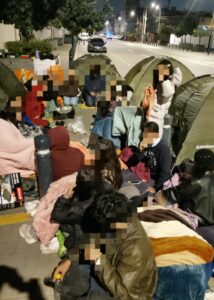
The decision that will put to the test whether merit or poverty defines the future of thousands of young people.
On August 18, dozens of PRONABEC scholarship recipients held a sit-in outside the Ministry of Education, accompanied by their parents and civil construction workers, demanding that Minister José Antonio Chang Escobedo finally listen to them and respond to their proposals. They spent the night in tents, knowing that this exercise of their right is threatened by a recent PRONABEC directive with academic sanctions, delays in their studies or even expulsion from their universities. They are doing so to defend their right to continue studying and as citizens. This situation reveals the extent to which the State has ignored the circumstances of thousands of vulnerable students.
By: Jhovana Yauri.
The Ministry of Education seeks to modify the regulatory framework governing the National Scholarship and Educational Credit Program (PRONABEC) since 2020, contained in the Regulations of Law No. 29837, approved by Supreme Decree No. 018-2020-MINEDU. The proposal made through Ministerial Resolution No. 365-2026-MINEDU introduces 27 changes questioned by the scholarship recipients themselves.
The protest takes place hours after the Lima Bar Association (CAL) issued an official statement rejecting the regulatory proposal for eliminating funding for repeated courses, tightening the grounds for losing the scholarship and threatening students’ freedom of expression. The association also demanded, in a separate statement addressed to PRONABEC Executive Director Enrique Roberto Kocyen Chon Yamasato, that a transparent, participatory and binding public consultation process be guaranteed before approving any modification.
With the draft regulation still without a final resolution, citizen and legal pressure, which now includes social organizations such as the Acuerdo Histórico Ciudadano (AHC), is focused on a single demand: that the Ministry of Education respond by shelving the proposal and opening the Equitable Dialogue proposed by the young people on what should be improved in the PRONABEC Law.
The question the Ministry prefers not to answer
At this juncture, it is difficult to ignore that Peru is going through a troubling moment in terms of public policy. While the world is promoting strategies to expand access to higher education and reduce social gaps, here modifications are being discussed that, according to the scholarship recipients themselves, could restrict opportunities for those who need them most. In this regard, education cannot become a privilege reserved for those born with greater economic resources, since it is a right fought for over many years and a fundamental tool for social mobility.
However, if in Peru 9 out of 10 students complete secondary education without reaching the expected level in Mathematics or Reading, according to the 2025 National Assessment of Learning Achievement (ENLA); and, in addition, more than 1.5 million young people between 15 and 24 years old live in poverty (according to ENAHO), the real question is not why PRONABEC exists. The question is: why is there an attempt to weaken one of the few instruments that makes it possible to break the cycle of inequality?
Expense or investment? The rationale underpinning scholarships
There is debate over whether scholarships are an expense or a social investment, when in reality that discussion concerns the development of the entire country. Today, to a large extent, access to higher education depends on socioeconomic background and not merit, which constitutes a structural injustice that the State has an obligation to correct through its redistributive function, protected by law to prevent social gaps from continuing to grow (Stiglitz & Rosengard, 2016).
The market can be efficient and still exclude talented young people simply because of a lack of resources, while the financial system does not offer accessible loans for studies, since knowledge cannot be used as collateral for repayment (Stiglitz & Rosengard, 2016). Therefore, scholarships do not benefit a particular group of citizens, but rather correct an inequality of origin that affects society as a whole by preventing the full use of human talent (Arrow, 1992, as cited in Stiglitz & Rosengard, 2016).
In this sense, PRONABEC was created precisely as an instrument to fulfill that mission: to reduce the gap between talented young people living in poverty and those who have better conditions for accessing and completing higher education. Reality shows that students coming from public education face accumulated disadvantages from before they even enter a university.
To poverty of origin are added lower learning outcomes, lower probabilities of accessing higher education, greater risks of dropping out and, ultimately, fewer possibilities for social mobility. Therefore, PRONABEC does not represent a welfare benefit, but a public investment aimed at developing the human capital the country needs.
They are putting everything on the line: a protest that risks the scholarship recipients’ own academic careers
Today, dozens of scholarship recipients remain camped out to defend what they consider a right. They are not carrying out a simple protest. They are putting their health and their own academic careers at risk. Each day away from the classroom can translate into absences, academic delays, sanctions and even affect the continuation of their studies. Even so, they remain there because they understand that this struggle transcends their individual interests. They represent more than 67 500 active scholarship recipients and thousands of young people who see higher education as the only real opportunity to change the destiny of their families.
The scholarship recipients’ demands are concrete:
- Withdraw the draft Supreme Decree that modifies the Regulations of Law No. 29837, published through Ministerial Resolution No. 365-2026-MINEDU, considering that its 27 changes distort the purpose of PRONABEC and hinder access to and continuation in higher education.
- Nullify Executive Directorial Resolution No. 119-2026-MINEDU/VMGI-PRONABEC, due to its ambiguity and because it places students protesting against policies that affect their community at serious risk; in particular, they demand that the student representation currently provided for in Article 5, subsection j, which said resolution modifies, be preserved.
- Open a debate in Congress to review Law No. 29837, since, according to Héctor Chunga, legal adviser to the scholarship recipients, structural changes to the scholarship system must be discussed through legal reform and not solely through regulatory or administrative means.
Allowing the opportunities of those who work hardest to get ahead to be reduced is not an isolated event: it is another step toward the erosion of the rights of all vulnerable populations in the country. Today they close the door on a scholarship recipient; tomorrow they close the door on anyone.
Consequently, the State, citizens and their legislative representatives share the responsibility of ensuring that poverty does not determine anyone’s future. Enough of silently cutting rights.