The API Industrial Park in Munshiganj can reshape the future of this sector.
By S M Abul Hossain (Dhaka Bureau)
While Bangladesh’s pharmaceutical industry- which has established a strong position in the global market- has not plunged into a catastrophic shortage, it is currently grappling with a deep structural and policy crisis. Experts warn that if these challenges are not addressed in a timely manner, the supply chain for essential medicines and healthcare protection could face severe risks in the near future.
The accessibility of healthcare is one of the fundamental conditions of human rights. Yet, amidst current economic and bureaucratic tangles, this basic right has become a matter of high stakes and distress for marginalized people.
Core Causes of the Crisis: From Production to Marketing
According to the Bangladesh Association of Pharmaceutical Industries (BAPI), the production sector has been cornered by shortages of Active Pharmaceutical Ingredients (APIs) for life-saving drugs, packaging materials, and energy.
Power and Energy Crisis: Due to acute shortages of uninterrupted electricity and gas in factories, manufacturers are increasingly forced to rely on generators and diesel as alternatives. This has driven up the actual cost of medicine production exponentially.
Stagnation in Price Adjustments: Prompted by rising production costs, pharmaceutical companies applied for price adjustments on certain medicines, but these have not been approved in a timely manner due to policy complications. Furthermore, the marketing and regulatory approvals for several new life-saving and general medicines remain stuck in administrative red tape.
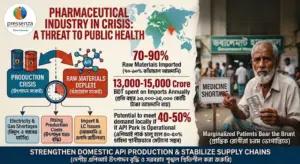
Import and Currency Market Pressures: Even though the industry meets a large share of internal demand, roughly 70 to 90 percent of its raw materials must be imported from abroad. Due to complexities in opening letters of credit (LCs) within the banking sector and volatility in foreign exchange rates regarding the US dollar, timely import of raw materials has been disrupted, directly impacting the production of life-saving drugs and injections.
Impact on Marginalized Populations and Limitations of the Public Sector
This overall crisis in the pharmaceutical industry is hitting the poor and marginalized populations of the country the hardest. Budgets and medicine allocations in public hospitals are already limited compared to the actual demand. Combined with the production and supply chain crisis, this frequently leads to severe shortages of specific medicines, saline, or life-saving injections.
As a result, helpless patients are compelled to purchase medicines from open markets or external sources at exorbitant prices, pushing their economic conditions toward further destitution. While top-tier pharmaceutical companies are barely managing to stay afloat, many small and medium-sized enterprise (SME) manufacturers are on the verge of shutting down, unable to cope with the soaring production costs.
Foreign Dependence and GMP Compliance
Bangladesh has played a commendable role in maintaining international standards. Meeting nearly 98 percent of domestic demand, the country currently exports pharmaceuticals to over 140 nations worldwide. However, the underlying reality is that the country’s reliance on foreign sources for essential raw materials- or APIs- is almost total.
Sources of Raw Materials: Over 80 to 85 percent of the raw materials used in Bangladeshi pharmaceutical production originate from China and India. Additionally, high-end complex molecules and specialized chemicals must be sourced from Germany, Italy, the United Kingdom, the United States, Japan, and various other Western and developed nations.
Quality Control: Strict compliance with the World Health Organization’s Good Manufacturing Practice (GMP) guidelines, along with international standards such as the British Pharmacopoeia (BP) and United States Pharmacopoeia (USP), is rigorously enforced by the Directorate General of Drug Administration (DGDA) to ensure the safety and quality of these medicines.
A Beacon of Hope: The API Industrial Park and Prospects
The sole key to a sustainable exit from this multifaceted crisis lies in securing domestic raw material production. Established in Gazaria, Munshiganj, under past government initiatives, the ‘API Industrial Park’ has the potential to transform the destiny of this sector.
According to analysts, if this park becomes fully operational, it could locally fulfill at least 40 to 50 percent of the nation’s total raw material demand. Currently, Bangladesh spends roughly 13,000 to 15,000 crore BDT (1.3 to 1.5 billion US dollars) annually on importing raw materials. Once the API park is fully operational, it will save massive amounts of foreign exchange.
Regrettably, however, due to delays in gas connections, prolonged red tape in constructing the Central Effluent Treatment Plant (CETP), and a lack of proactive policy support, the expected benefits of this promising project remain unrealized.
No Trading with Human Lives
To establish a humane and egalitarian society, sensitive sectors like pharmaceuticals and healthcare protection can never be left at the mercy of bureaucratic complexities or the ruthless profit-seeking of the market.
Experts emphasize the urgent need to immediately normalize gas and electricity supplies, simplify the LC process, and remove infrastructural bottlenecks at the API park to bring factories back to full production capacity. Failing to do so will trigger far-reaching negative consequences for the national economy and directly threaten the fundamental right of ordinary citizens to preserve their lives.

S M Abul Hossain: Senior Journalist and Renowned Writer. Contributor to Pressenza- Dhaka Bureau.