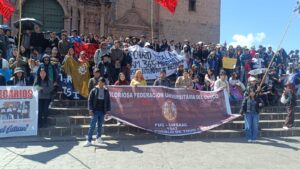
Students, current scholarship recipients, and former recipients of the National Scholarship Program (PRONABEC) held a series of decentralized demonstrations on Monday, July 13, in Lima and Cusco. The students are demanding that the public consultation period on the proposed amendment to the PRONABEC regulations—which the incoming administration intends to implement—be extended to 60 days, as this amendment would undermine the very purpose of this social program designed to provide educational support to Peruvians with academic excellence and limited financial resources.
“The proposed amendment to the regulations of Law No. 29837 undermines the purpose of PRONABEC, as it tightens the grounds for scholarship revocation, reduces support, prioritizes labor market criteria, and shifts the risk to the student, primarily affecting those who need it most,” the students stated.
The protest was organized by the Peruvian Student Federation (FEP), the National Front of Scholarship Recipients, Former Recipients, and Applicants of Peru (FRENABEP), the Historic Citizens’ Agreement (AHC), the Confederation of University Students of Peru (CEUP), and the University Bloc of the Coordinating Committee of Universities of Lima and Callao. The protest took place on the main thoroughfares of Metropolitan Lima and in the city of Cusco.
Change in Public Scholarship Policy
Representatives of the organizing institutions denounced that the process of amending the regulations is taking place amid a context of high political instability (a succession of four ministers between 2021 and 2026) and a shift in policy (the current model seeks to guarantee equal opportunities for higher education, while the next one would prioritize short-term budgetary sustainability). “This is not an administrative update to the regulations, but a substantial redefinition of the national scholarship policy,” they noted.
“The proposed changes tighten the grounds for losing a scholarship, restrict changes in major and institution, eliminate funding for repeated courses, reduce eligible benefits—especially for graduate scholarships—and concentrate decisions that were previously made collectively within administrative bodies. Taken together, they increase barriers to access and retention, shift the academic and financial risk from the government to the scholarship recipient, and weaken the protections that justify the existence of a public scholarship policy,” they added.
CAL: Amendment to the Regulations Constitutes an Unfair Barrier
For its part, the Lima Bar Association (CAL), led by Dr. Delia Espinoza, supported the students and rejected the changes to PRONABEC. They expressed “deep concern and institutional opposition to the proposed amendment of 27 articles of the Regulations of Law No. 29837 governing PRONABEC.”
At the institutional level, they warned of the negative impact of the proposed reform. On the other hand, PRONABEC Executive Director Enrique Chon explained that the proposed amendment seeks to restore the program’s merit-based nature and is necessary due to the increase in cases of poor academic performance during the 2024-II period, during which 857 scholarship recipients repeatedly failed courses.
- “It contravenes national objectives for improving education: the reform introduces restrictive barriers to current benefits, contradicting the nation’s educational goals;
- It violates the human right to education: This right is fully recognized in international instruments such as the International Covenant on Economic, Social, and Cultural Rights, the Universal Declaration of Human Rights, the UNESCO Convention, and the Protocol of San Salvador, among others.
- It runs counter to the objectives and policies of the Organization for Economic Cooperation and Development (OECD) in Peru.”
The students, for their part, described the 15-calendar-day period for public consultation as insufficient, as it would limit the participation of all stakeholders (scholarship recipients, former recipients, applicants, universities, institutes, and other actors). They also urged consideration of the special circumstances of many scholarship recipients, who are primarily economically vulnerable.
Open Dialogue
As of press time, the students and institutional representatives reported that today, Tuesday the 14th, they held a meeting with Education Minister Jorge Marticorena Mendoza and Congresswoman Ruth Luque, during which they requested that the proposed amendment be withdrawn or that the consultation period be extended to allow for a dialogue process. They also stated that they will continue their protests in front of the Ministry of Education to ensure their demands are heard.


