A Library Departs: History of ideas as lived experience
I have just learned of the death of the German philosopher and sociologist Jürgen Habermas. Jürgen Habermas ist tot. What a pity that such a library has departed! Habermas was a major figure of the second generation of the Frankfurt School and a cornerstone of contemporary critical theory. His theories –particularly those concerning communicative action, discourse ethics, and the public sphere– are standard subjects in university departments of philosophy, sociology, political science, and law. Habermas developed a comprehensive and systematic framework for understanding modernity, reason, and democracy, one that engages directly with the Western philosophical canon from Immanuel Kant to the present. For him, democracy depends on rational public dialogue.
I once met Jürgen Habermas in London. I attended one of his lectures, and at its end I asked him a question; we spoke briefly afterwards. I remember that I had also written –and given him– a portrait dedicated to him in a yellow envelope. In one of the photographs I keep in my personal archive, he is holding that envelope. Inside it I had written: “I want to see your eyes—eyes that saw Nazism die, […] eyes that saw Theodor W. Adorno.” Adorno had challenged Popper’s philosophy of science and Heidegger’s philosophy of existence, and Habermas started as his student and later became his assistant. Thus, over the years I read his work, sometimes in dialogue with –and sometimes against– other thinkers, especially the work of Cornelius Castoriadis. I also followed his interventions closely as a leading public intellectual, particularly in Germany, where his vast body of work has been widely translated and debated across the Anglophone world and beyond.
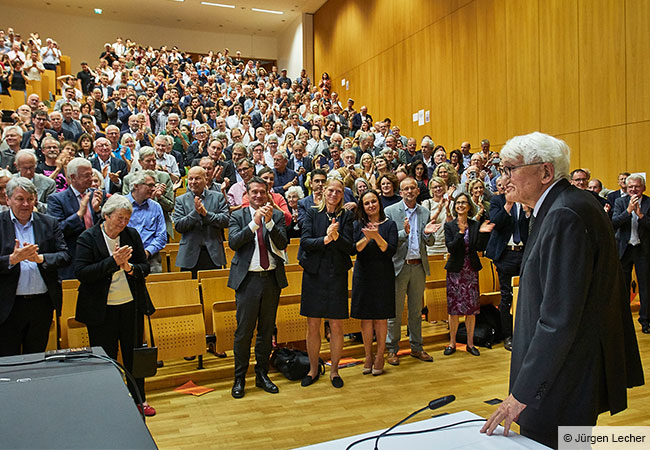
Standing ovations for the honoree Jürgen Habermas following his lecture “Once Again On the Relationship Between Morality and Ethical Life,” with which he honored Goethe University on the occasion of his 90th birthday.
I received the last email from the Goethe University Library in Frankfurt, which holds the archives of Jürgen Habermas, about a year ago. A few days ago, I found myself wondering whether he might write something about the ongoing war in Iran. Now, upon news of his death, I recall that singular day in 1998. I am fortunate to have kept some vivid notes from the lecture, and later, after I returned home –while everything was still fresh in my mind– I wrote the text that follows—a kind of testimony:
“”The Royal Institute of Philosophy in London invites Professor Jürgen Habermas to deliver a lecture this March. The title is: Hermeneutic vs. Analytic Version of the Linguistic Turn. I have a book by Habermas, but I have never had Habermas himself before me. Tonight, however, I will have him close to me. Many people refer to his works, or to his lectures, from which he draws his philosophical ideas. Without philosophers like Habermas, we might never have freedom. Philosophers like Habermas help us to discuss and, in a sense, give us the courage to think. Philosophers like Plato, on the other hand, sometimes take that courage away.
I am waiting for the lecture. “Great thinker!”, “The greatest philosopher in the world!” people are saying. What does it mean? I feel a little intimidated by all this. Does “great” mean that he has thought for us? By using the word “great,” are we merely measuring the importance of his personality? I can see someone adjusting the podium and the microphone.
He enters the amphitheater and sits directly in front of me. His hair is completely white—not a single black strand remains. I can see through his glasses. He is spirited and very tall. He sits like a student, wearing a black suit with pale, faded stripes. His nose –if I may be a little humorous– looks as though it has been punched by Theodor W. Adorno, his youthful teacher. That was my first thought as he began the lecture. And my second? It is too difficult to understand what he is saying! He speaks words with music, as if he is pulling them down from the heavens above. “Wow!” I exclaim.
He wears a black watch. He rarely looks at us, yet every cell in my body strives to be devoted to him. He begins to make subtle, expressive movements as his words take shape. He looks at me while I am smiling, and for the first time I see his blue eyes clearly across the few metres that separate us. When he rests his hands on the podium, he does not prop up a body but a spirit. He looks at me once more, letting me see unmistakably the eyes of ‘a giant in distress’.
“We cannot experience the meaning of a sentence…” he says, among many other things. Meanwhile, he wears a ring. For a while, I reflect on the portrait I am forming by observing all these details. The portrait is what I think about Habermas, not what others think of him. (In those days, as a student in London, I was writing texts on people from all walks of life.) He speaks English with a distinct Hegelian cadence.
He takes out a large handkerchief to wipe his bent nose. The handkerchief seems like a small ghost, until he slips it back into his pocket. The light of the amphitheater falls on him as he bends down, illuminating his hair, which looks like delicate cotton. “When I talk about theoretical philosophy,” he says, and repeats it: “When I talk about theoretical philosophy,” moving his hand with a deliberate flourish. Again he says “theoretical philosophy,” showing with pride that he is a philosopher of action-praxis.
I wonder whether Aristotle above all, as well as Christ, Muhammad, and Buddha, could understand Habermas. He has caught a cold and reaches for his handkerchief quite often; the handkerchief seems like a small ghost. Sometimes the way he moves his hand seems to say, “As long as the philosophical issues are so vast, just leave them!” I wonder what it will be like when I finally shake his hand: the hand of a social theoretician and the hand of a young writer.
While he speaks, he slightly elongates the vowels of his words and occasionally glances at his watch. When he finishes, the audience applauds for a long time, and he bows to us before sitting down. He is dissent incarnate. Another professor says something, and then a few questions follow. He crosses his hands in front of his chest and answers each question with care. To one, he responds, “What you have just said, I ignore, and I cannot tell you the reason for which I ignore it.” As he answers, he shifts subtly, and during one question he raises his hand to his ear in order to hear more clearly.
I have already raised my hand to ask a question. The coordinator notices me, but it is Jürgen himself who, once he has finished with the previous question, signals me to speak! Jürgen grants me the right to address him. “In your book The Philosophical Discourse of Modernity (Der Philosophische Diskurs der Moderne, 1985 [In English, 1987]), you argue that the project of Enlightenment remains uncompleted, and I fully agree with your point. What I would like to ask now is this: Would you say that, in the second half of this century, philosophy has shifted from the problem of knowledge to the problem of meaning?”
“Sorry?” he says, sounding slightly anxious. Everybody laughs, and he comes closer to me, asking, “Would you mind repeating your last sentence?” I repeat it aloud, and I can see in his eyes that he fully understands what I want to ask.
“Oh, very good!” he begins, and I interrupt him, adding, “Because I disagree with many thinkers in Paris, but I agree with you.” A missile was just launched into the heart of the rivalry between German Critical Theory and French Post-structuralism. The room erupts in laughter, and Habermas himself seems genuinely touched.
“It is nice to hear these words from you,” he says, and I am deeply moved as well. Again, the room erupts in enthusiastic laughter—a missile has just been launched again, against the Parisian thinkers! He continues, out of all the others: “Well yes, in linguistic terms, yes,” followed by a few more words in his Hegelian pronunciation, which I do not fully understand. “As far as science is concerned, again I can say yes. Yes, I agree with you.” As he speaks, I look into his eyes while simultaneously taking careful notes.
When the lecture concludes, I am the first to approach him. “Hello again!” he greets me warmly.
“Hello, Mr. Habermas! I am a writer, and I am writing about you. I would like to give you this envelope, which contains a few of my thoughts.” We shake hands—long, firm, almost like politicians. I feel deeply moved.
“Thank you so much,” he replies, taking the envelope in his hands.
“Would you mind giving me your German address, so that I may write to you?”
“Of course,” he replies, and I hand him my notebook and pen. As he writes the first word, he says, “Ring, like this one,” showing the gold ring on his hand. The handwritten address seems as if it belongs to 19th-century Germany—a great epoch for philosophy and music, with figures such as G.W.F. Hegel, Arthur Schopenhauer, Friedrich Nietzsche, Ludwig van Beethoven, Richard Wagner (who intertwined music with philosophy), and Franz Schubert! We have our picture taken together, and after a while, others come forward to meet him. Smiling, he remarks, “I am not a cinema actor.” I watch him closely while noting all of this down.
I see him holding my envelope. Wow, what a moment! I notice a hair on his black suit and, for a fleeting second, I think of plucking it to have his DNA. I take in his face, his nose—distinctive, bent, and strikingly beautiful. A small moustache complements him perfectly, adding a subtle, almost playful dignity.
“Have you ever read that physicist?” my friend Immanuel asks him. “Yes, but he is too complicated for me,” he replies with ironic amusement. “I am not clever enough to understand him.” The photographer, another friend of mine, asks him for a photo. He is persuaded to stay for one last shot, looking shy. He removes his glasses, wipes his forehead with a handkerchief, and glances at me as I take notes. It is time to leave. He puts on his warm coat and, rifling through the sleeve, finds his scarf. “Oh!” he exclaims. We step outside, and across the street I see a tall man holding the yellow envelope.
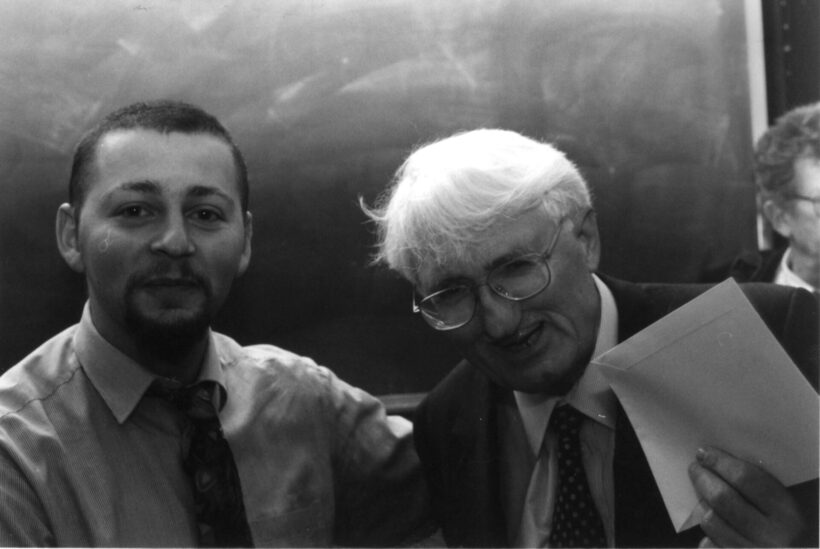
The German philosopher and professor, Jürgen Habermas, holding the envelope given from Dimitris Eleas. London Royal Institute of Philosophy, 1998. Archive of D. Eleas
This is the content of the yellow envelope:
Dear Jürgen Habermas,
I write a literary portrait for you—a portrait with a German name and surname. I take this chance to offer you some of my thoughts:
I want to see your eyes—eyes that saw Nazism die, eyes that write words of philosophy, eyes that saw Theodor W. Adorno. I want to find Reason in your eyes. I want to see the adolescence of our civilization reflected there.
German man, from “servant” of Adorno, philosopher and “politicos.” Famous at monastery, shipyard, parliament.
For a young writer like me –a writer of small texts– you are memory (past) and imagination (future). Could I become your servant in order to observe you? Philosophical observations on you are, perhaps, the definition of Modernity itself.
I cannot stand those who transform thought from a labyrinth into a net.
Dimitris Eleas, London, March 13, 1998””
Nearly thirty years have passed since I stood in that London amphitheater, a young writer intoxicated by the proximity of history and the wild impulse to preserve even a strand of his DNA. Today, as that ‘living library’ finally closes its doors, I realize I never needed to be his servant –assistant is the word I should have written back then…– to observe him. By teaching us that reason is found in our speech to one another, Jürgen Habermas ensured that his eyes –and his ‘unfinished project’– would remain wide open in all of us.